Saturday, September 7, 2013

Food products from Southeast Asia (SHrg105-516)

Actually, the first stop of our Southeast Asian vacation wasn't Laos. We had a five-hour layover in Bangkok before our flight to Vientiane, so we took the BTS Skytrain to the Phaya Thai station to get some breakfast. We made our way down from the platform and headed to the first cluster of good-smelling stands on the street. Here is where we began more than three weeks of mostly pointing at instead of ordering our meals.

Street Food
Most of the time, we had no idea the names of the dishes we were eating. In many cases, I looked them up later or after we returned home. I never did figure out the exact name of our breakfast that morning. It was a kind of pork meatball soup with some root vegetables, not potato, served with rice (left). We ended our trip with street food in Bangkok as well, except it was served from a mall instead of a stall. At MBK Center's Food Island, you buy a pre-paid card to be used at a variety of stands (even beer!); if you don't use all the money you put on the card, you can be refunded the remaining balance. We handed over our cards for Pad See Ew, a noodle dish perhaps second in popularity only to Pad Thai, and Kuaytaiw Pet, duck noodle soup (right).
Some of the best street foods were simply snacks we stumbled upon while wandering around. In Phnom Penh's Psah Toul Tompoung, or Russian market, we ordered some Num Ta Leng Sap, Khmer vegetarian pancakes served in broth (left). We stooped on a sidewalk near Westlake in Hanoi to nosh on Banh Gio, a traditional Vietnamese dumpling steamed and stuffed with minced pork and mushrooms (right). 
In some cases, the street snacks consisted of non-Asian flavors. In Luang Prabang, there is a whole row of stands serving sandwiches on fresh French baguettes. I had my chicken and avocado one with a pineapple shake; TJ tried an avocado shake, which was actually quite tasty (left). In Haiphong, as we were waiting for a ferry to Cat Ba Island, we lunched on Vietnam's famous version of the baguette sandwich, Banh Mi, with fried, fatty, and finger-licking pate (right).
In the Sukhumvit section of Bangkok, there's a famous street full of food stands known simply as Soi 38. Besides the variety, it's known for being tourist-friendly, with lots of signs and displays to help you order (left). We arrived way too early for the night market to be in full swing, but I was still able to complete my mission of trying Suki Haeng, a dry, non-broth version of Sukiyaki, or Japanese hot pot (right).
 
We found that many food vendors, including those who didn't speak English, were more than willing to help us order, even without the presence of pictures. It helped that most stands specialized in one type of dish, so you just had to make choices about sizes and ingredients. At this stand in the Banglamphu section of Bangkok, the yellow sign made it clear what you had to pick: small or large, white (rice) or yellow (egg) noodles, and cured pork or pork wontons (left). We shared a large Kuay Teow Nam with cured pork in yellow noodles, although afterward, when we saw the workers making them fresh, we regretted not getting the wontons. Our table, literally on the street, held the necessary accoutrements: chopsticks, lime, fish sauce, sugar, and hot pepper paste (right).
Unfortunately, not every vendor was as stand-up as this establishment. Some proprietors, aware of tourists' strong desire to try street food, take advantage of their dearth of knowledge and abundance of politeness with scams. At Dong Ba Market in Hue, friendly ladies will corral you behind their stalls, plying you with food that fills the table. At one point, I wasn't eating as fast as TJ, so the vendor poured one soup into another, so there would be room for yet another plate. To make it stop coming, you have to be quite forceful, and only then, of course, do you find out you are paying per skewer and per dish (yes, I had to pay for two soups put in one bowl) at quite inflated prices. This meal turned out to be one of the most expensive we had during our trip. But the cost was still less than most of our meals out, so I forgave myself for falling victim -- except for the lingering worry that one of those soups might've contained dog meat.

Traditional Dishes
The food was so cheap that we didn't feel like we had to limit ourselves to just street food. One step up from street-food stalls were streetside stir-fry stands. These slightly-more-established-ments actually have tables and chairs, some even indoors, but the "kitchen," or wok with a gas burner, is still outside. These places had a family-dining-room feel, right down to the homemade hot sauce (top left). Plus, there was the allure of being able to watch your food being cooked almost tableside (top right). In Cat Ba, you can even choose which protein to throw in the wok: squid, shrimp, or even horsehoe crab, which we didn't try (bottom).
 
Even at bona fide restaurants, we sometimes just opted for snacks. In particular, Southeast Asian salads made refreshing and cheap treats. We tried a very Spicy Cashew Salad in Vientiane (left) and Laap or Larb, a salad of minced meat and basil, in Luang Prabang (right).
Sometimes, we ate snacks just because we couldn't pass up a popular spot. We had already eaten dinner when we walked back from Wat Sok Pa Luang in Vientiane; nonetheless, we were drawn to the long line at KFC, or Khouvieng Fried Chicken, named after the road where it's located. While waiting in line, we could smell and see the chicken being cooked in huge vats of oil (left). With our thighs and fries (right), we didn't have cole slaw, but Green Papaya Salad, offered in various forms throughout Southeast Asia.
Salads and fried chicken are traditional Laotian cuisine, and as we headed to other countries, we often ordered the local specialities. A set menu in Hoi An allowed us to sample White Rose, a set of shrimp dumplings, and Cao Lau, a chewy rice noodle and pork dish, with a wonton vegetable pizza as an appetizer (left). At Quan An Ngon in Hanoi, the menu was so long that I forget all of what we ordered, but I do remember the squid-paste patties and an eel salad (right). The waitress tried to steer us toward another salad, probably thinking our palates couldn't handle the eel salad, but it was distinctly delicious.
In Thailand, we tried true versions of dishes I had already eaten (and in one case had tried to make). In Rambuttri Village in Bangkok, TJ finally got Pad Thai while I sized up the Green Curry with pork (left). Later, I would get to taste red and yellow curries, too. I tried a curry that I had previously been unfamiliar with, Massaman Curry, at a restaurant near Khao San Road in Bangkok (right).

Barbeque Joints
The United States doesn't have a monopoly on good, old-fashioned grilled meat as a traditional meal. Many Southeast Asian restaurants dedicate themselves to barbeque. On a street across from the Old Market in Siem Reap, quite a few places tout a variety of charred flesh; at the one we went to, we got a selection of shrimp, chicken, and beef. The proprietor even showed us how to mix a traditional dipping sauce of lime, peanuts, hot peppers, and Prahok, or fermented fish paste. The end result is quite pungent but somehow works well with the tenderized and marinated meat.
In Vientiane, TJ conferred with a young man equally reluctant yet eager to speak English about the goods on his grill (left). The main meat was goat, and a small grill platter came with it and some sausage (right). All grill platters came with peppers, herbs, and greens to help eat the greasy meat, for both flavor-adding and finger-cleaning purposes.

High-End Restaurants
In other places, we went so far as to "splurge" on high-end meals at fusion or charitable restaurants. At Tamarind, a cooking school and restaurant in Luang Prabang, the very reasonably priced set dinner included, among other dishes, a sampler platter of Jeow, or dipping sauces, served with authentic sticky rice, not just rice that sticks together (left). It also included pumpkin stir-fried with ginger, chicken cooked in lemongrass, and fish steamed in banana leaves (right).
Fish steamed in banana leaves, also known as Amok, is the national dish of Cambodia. We tried a seafood version of Amok at Sandan, another school of sorts, along with a squid stir-fry dish (left). The Sihanoukville restaurant is one of a series of schools in the area that train underprivileged youth to work in the hospitality industry, as both cooks and servers. The organization is doing good work, as the service and the food -- including a prawn, pork, and coconut dip as well as a papaya and squid salad (right) -- were spot on.
 
In Thailand, the ubiquitous green papaya salad is called Som Tum. Diamond Cliff restaurant on the resort island of Koh Lanta has adapted it to Western, particularly American, tastes by offering a fried version. In it, the papaya slices are battered and deep fried, then the rest of the ingredients are mixed together as a dipping sauce (left). Another Koh Lanta restaurant, Drunken Sailors, also tried to improve upon a local favorite, Tom Yum Goong, through frying. In this case, the lime and shrimp soup becomes a flavorful version of fried rice (right).
 

Western Repasts
The fusion foods were great, but with three weeks in the region, we sometimes needed an absolute break from Southeast Asian flavors, so we fell back on some Western favorites. But we remained risk-takers by opting for raw items such as sushi (I know, I know, sushi is Asian, not Western) at MBK Center's Fifth Food Avenue in Bangkok (top left) as well as beef tartare and carpacchio at Le Malraux in Siem Reap (top right). And for some reason, Mexican food has caught on in Phnom Penh, so TJ's birthday meal was burritos and tacos at Taqueria Corona (bottom).
You have probably seen in many of the pictures that we took advantage of the ability to drink in public, another Western tradition. Most of the time, we drank the local beers (discussed in another post), but we couldn't resist trying some non-lager brews. In Phnom Penh, we tried OatS, a stout, and CentenniALE, a pale ale, as part of the 2-for-1 happy hour special at Himawari Microbrewery, in the hotel of the same name (left). They were much more satisfying than the Golden and Stout varieties we quickly downed amid the contrived and creepy Oktoberfest decor of Munich Beer Restaurant, which lured us in only because of its location near our hotel in Phnom Penh.
When the local beers grew unappealing, as the food sometimes did, I would go for cocktails, even though they weren't as cost-effective. The raspberry daiquiri at Khinlom Chom Saphan, along the Chao Phraya River in Bangkok, was much more refreshing than the overly-sugary versions from some unnamed U.S. chain restaurants (top left). At Aqua Bar in Koh Lanta, I had another berry cocktail, served more like a martini, while TJ has some of the local whisky on the rocks (top right). But in the end, I always came back to Asian flavors, even in my cocktails. The "Tamarin Sauce" at Asana, a bar in Siem Reap that offers bartending classes, included lemongrass and other "paddy herbs," which seemed like a perfect toast to our trip (bottom).
 

Saturday, August 31, 2013

Laos along the Lower Mekong River (SRes227)

If you're going to start a whirlwind tour of Southeast Asia, there are worse places to start than Laos, which won Best Tourist Destination Award for 2013 from the European Council on Tourism and Trade. (Of course, this distinction is a bit dubious, considering Syria won the award in 2007, and we don't plan on visiting there any time soon.) Our travels kept us alongside the Mekong River, used throughout the 19th and 20th centuries for various conflicts, including the French conquests to form Indochina.

The name of our first stop, Vientiane, comes from a Buddhist language and means "city of sandalwood," but the Romanization and pronunciation has a French flair. Indeed, the Laotian capital mixes Continental and communist attitudes. Competing aerobics classes, strange variations of Zumba and Jazzercise perhaps, offered for free along the riverfront displayed a dedication toward a fit and unified citizenry, so much so that even some dogs got in on the action (left). Laotians are also obviously devoted to their leaders, as demonstrated by the statue of Chao Anouvong, the last king of Laos, also along the water (right); his stance is said to reflect a commander motivating his troops, even though he is not in warrior garb. 
But the presence of communism doesn't mean the absence of capitalism. The daily night market, with its artisan and not-so-artisan souvenirs, helps bring in the tourist dollars, as do the establishments overlooking the market, such as the rooftop bar Bor Pen Nyang.
The tourist market along the Mekong was nice, but much more interesting was the Ban Anou night market, where mostly locals go to grab a midnight nibble or stock up on foodstuffs for the upcoming day or week. TJ and I sampled lots of snacks on sticks (left), including pork belly and liver. We dared to get a bag of seasoned silkworms; we ate two of the grubby pods, made weird faces, then gave the rest of the fully-paid-for bag back to the vendor. To finish off, we got half a duck to go for less than a dollar; the fowl monger quickly grabbed a bird off a hook and expertly chopped it up right before our eyes (right).
Visiting markets in Southeast Asia is as obligatory as visiting temples. In Vientiane, you can't throw a rock without hitting a wat. We took a short walk down the street, across from the more popular Wat Si Saket, to Haw Phra Kaew, a former temple now housing an art museum full of Buddhas in all shapes and forms (left). There, I first spied the distinct orange robe of a monk, complete with a typical black umbrella, climbing the steps of the wooden and stone structure (right).
A couple days later, we visited more wats, this time ones with a view. In Luang Prabang, we passed a footprint of Buddha then statues of him at Wat Tham Phou Si (left) before ascending to Wat Chom Si, whose position on the peak of Mount Phou Si provided an excellent visit of the Mekong below (right).
In Luang Prabang, the Mekong merges with the Nam Khan River, creating a peninsula full of ancient temples and colonial buildings that is recognized by UNESCO as a World Heritage Site. In Vientiane, the view from the boring and broken concrete sidewalks along the Mekong is to a non-descript village across the river in Thailand, but in Luang Prabang, the view is through shady and leafy palm trees (left) to neverending lush and green hills on the other side (right).
One day, we took a ferry across the Mekong to Xieng Men, a small village in those hills. The ferry ride itself was a trip. The family affair included the money-collecting mother, the wheel-wielding father, the rope-mooring son, and, for good measure, two mascot dogs, one of which slept peacefully right under the chains of the steering column.
A few minutes of walking beyond the village led us to true countryside, with stitled houses perched above endless rice paddies and other gardens (left). Despite the mid-day heat, many villagers, all donning wide-brimmed hats and loose-legged pants, were out in the muck, tending to their fields (right).
This is true farm country, where animals are given full rights to roam the land. Chickens abounded, but we also saw goats muching their way through the brush (left) and water buffalo blocking absolutely no vehicles on the road (right). Thank goodness their neck bells warned us to make the slight detour around them.

Saturday, June 29, 2013

Public expectations of fairness, consistency, or equity (42U.S.C.10705)

I prefer to keep my blog posts about my observations of the country around me, but since I have landed back in the classroom, it’s been harder and harder for me to ignore the issue of education in the United States. Recently, a fellow teacher, who is lucky enough to be teaching in international schools instead of U.S. public schools, posted an article relating to education that kept me awake one night. No doubt, he had posted the article as an inspiring example of what young people, especially girls, can bring to our world if given the chance. Indeed, Maria Elena Grimmett is a role model for us all, young and old, female and male.

But I got hung up on some information about Grimmett’s inspiration, particularly when she was quoted as saying, “There was only one science teacher in the entire middle school, and she didn’t think she could help all of us fairly, so that’s why it had to stop. I decided to continue on my own, leading me to the path I am on today.”

Almost immediately, I had as much sympathy for that middle-school teacher as I did admiration for Grimmett’s achievement. I especially felt the weight of that word “fairly.” The article, appropriately, does not go into what the teacher meant by “fairly,” and it occurred to me that it might take a whole other article just to explain the various aspects of “fairness” that might have influenced that teacher.

The fact that Grimmett mentions “only one science teacher in the entire middle school” suggests that the teacher was concerned about the fairness of time. Some simple data collection and analysis, the kind Grimmett could easily perform, reveals this teacher’s time constraints. According to data from the Organization of Economic Cooperation and Development in 2011, most states require 990 hours of instruction at the middle-school level. But for the sake of argument, let’s even consider the best-case scenario, Texas, which requires 1,260 hours. According to the Texas Education Code, public schools must squeeze those hours into at least 180 days, which means on average students spend 7 hours a day in instruction during the school year. Of course, science is not the only course in middle school, so those 7 hours are probably split among at least 6 classes; not accounting for any lunch or other breaks, that generously averages to 70 minutes per day in science class.

But within that single science class, there are multiple students. According to data from the Organization of Economic Cooperation and Development in 2009, the average class size in U.S. “lower secondary schools” is 24.3 students. Rounding down to 24, that means the teacher can spend slightly less than 3 minutes with each student during each class; teachers, who are realists, realize that this would be time spent inefficiently, so if the class were working on science-fair projects, they would probably split meetings with students over many days. But even if this teacher dedicated an entire week to the meetings, he or she would still only meet with each student for 15 minutes; in a whole month, it would be an hour.

An adequate science-fair project, one not nearly as ground-breaking as Grimmett’s, is going to require far more than 60 minutes of consultation time. To compensate, some schools creatively incorporate community volunteers and/or high-school students to act as after-school mentors. Of course, parents also could and should serve as mentors, but many have legitimate or tenuous reasons why they don’t have time to help at home. Nonetheless, society would expect this middle-school teacher to give up his or her after-school time to assist students, even if that teacher had a child of his or her own who needed help with a science-fair project.

But let’s say a teacher is willing to sacrifice his or her personal time to help students – and many of them are – there’s another consideration to make, about the fairness of curriculum. In the example above, even without the after-school hours, the teacher would be dedicating at least an entire month of class, and probably more, to a science fair. No doubt, a science-fair project is a great way to teach and learn a lot of concepts and applications related to science. Unfortunately, however, it does not encompass everything that students are required to learn.

According to the Texas Administrative Code, each middle-school grade level is required to achieve at least 11 categories of “knowledge and skills,” each of which has at least 2-6 subcategories, in science. For each grade, 3-4 categories are about “scientific investigation and reasoning,” objectives that likely could be achieved with a science-fair project. But the remaining 7-8 are more specific objectives related to foundations in physics, chemistry, and biology.

Most certified teachers trained in the art of differentiation will tell you that science-fair project topics should be selected by the students to maximize interest and achievement. It’s quite likely that some, if not many, of students’ selected topics would not match the state standards. So for the sake of argument, that means all the objectives not related to “scientific investigation and reasoning” would have to be taught during the other eight months of the year, to make sure everyone has been properly prepared for testing. Oh, and did I forget to mention that testing usually takes place in early April, so really, the teacher has only six months left?

From this point, it becomes a cost-benefit analysis. Is giving up personal and classroom time worth the risk of not being able to teach the rest of the material in time for the tests? This analysis is complicated by the fact that even that one month with the science fair might be wasted because demonstrating “scientific investigation and reasoning” knowledge on a written test is quite different than demonstrating “scientific investigation and reasoning” skills through an experiment, an adjustment that also must be addressed some time during classroom instruction.

Some teachers take the risk because they see the long-term consequences: It likely will benefit society much more in the future if a student can perform an experiment rather than ace a test. But there is certainly no benefit for the teacher. And this is yet another type of fairness a teacher has to consider: fairness of achievement. If too many students fail that test, it might or might not cost society, but it will definitely cost the teacher.

Luckily, right now, despite much talk about merit pay, most states and school districts have opted for incentive pay, not performance pay, meaning that teachers who meet goals for professional development or test-passing rates can earn bonuses or pay raises. However, in an industry where salaries are on the low side, forcing many teachers to find second or summer jobs, not earning this incentive pay is definitely a loss to a teacher. If states and school districts move to performance pay, basing salaries – and even jobs – solely on student outcomes, the cost for teachers will be that much higher.

The underlying impetus for testing – that all students should be able to perform at the same minimum level – has caused another crisis for teachers. Somehow, the idea of equality in terms of minimum ability has turned into equality in all areas. It is a real worry to a teacher, myself included, to be accused, possibly even in court, of being negligent toward one student simply by providing more or different resources to another. Of course, the amount and type of resources cannot be equal for all students, so say the principles of differentiation, once again.

But a science teacher giving additional instruction to someone as motivated as Grimmett is dangerous because it might give the appearance of not fairly (re: equally) devoting additional instruction to another student (who, incidentally, might prefer the extra attention in history instead). Conversely, the same rule does not apply to lower-achieving students; they are often given extra time and resources in order to ensure that they achieve the “minimum” standard of the tests. To wit, the science fair at Grimmett’s elementary school was “discontinued due to a lack of staff and resources,” a lack possibly created by diverting staff and resources to testing demands, including remedial instruction. Sadly, the notion of devoting that same extra time and resources to students who want to achieve beyond the “maximum,” like Grimmett, has diminished, disappeared, or, worse, been decried as favoritism.

And this last charge is what I believe deeply wounds most teachers because it accuses them of lacking the very characteristics that drove them to become teachers: a love for humanity. I honestly want to help every student who walks through my door. It is more of a struggle with some students than others, to be sure, but still, I want to make each of them better, even if it is in a small way or in a way unrelated to language arts. And by telling me that the only way I can achieve that is to ensure each of them can exhibit the exact same knowledge and the exact skills in the exact same way, the students are robbed of their humanity, too. By acknowledging my students’ differences and treating them “unequally” because of those differences, I am treating them like humans. I would bet that this middle-school teacher wanted to treat Grimmett humanely and help her continue on her path of scientific exploration, but instead, she had to treat her “fairly.”

In the article, Grimmett says her interest in science began in third grade because of “an inspiring teacher who was supportive of science projects.” This elementary-school teacher seems like the good cop, while the middle-school teacher seems like the bad cop. But trust me, both of these teachers have had their hearts broken and reputations smeared in recent years. Both are being asked to do the impossible: Make consistent conclusions in a situation with many variables – schedules, class sizes, staffing levels, resources, standards, tests, incentives, parents, administrators, and politicians.

As any good science-fair guide will tell you, for a “fair” test of a dependent variable, there should only be one independent variable. To fairly evaluate if teachers affect students, those other variables must be controlled. Instead, society seems to want to ignore how they might be contributing to the overall results in the experiment that is education, which unfortunately forces teachers into the impossible position of trying to bring “fairness” into their classrooms.

Saturday, June 22, 2013

Domestic and imported lamb and mutton (142Cong.Rec.H2716)

For my first foray into Pakistani food, I wanted to do something simple, using some of the main ingredients of choice here: lentils and mutton, both of which are inexpensive on the local market and therefore had quickly found their way into my kitchen. Even the name of the dish I chose, Daal Gosht, is straight-forward because it simply identifies the two main ingredients: daal means lentils, and gosht means meat.

Usually, when I venture to try a new recipe, I like to rely on Food Network recipes, but it was immediately clear that the website does not have a Pakistani chef on staff. The only recipe that came close to Daal Gosht was a lamb stew, but it included no spices from the subcontinent; in fact, its flavoring comes from the highly European rosemary and thyme.

So I hunted down this more authentic recipe, even though it comes from an Indian food website, because it includes spices characteristic to Pakistan as well. (After all, Pakistani land was part of the British India empire for a long time, but I won't scratch at old wounds here; simply put, the country kept the cuisine but found its own religion.) I also incorporated some variations in technique from this Indian chef's recipe for dalcha, a Hyderabadi lamb and lentil stew.

The key to Pakistani cuisine, in my opinion, is the spices. The main recipe called for, from left to right, cumin, turmeric (in the Nescafe jar), coriander, garam masala, and red chili powder (left). I mixed a teaspoon of each into a bowl, creating a mosaic of tastiness, before mixing in the lassi, a yogurt-based drink, substituted for plain yogurt (right). In this way, the spices became part of a marinade for the mutton, as suggested in the chef's recipe, instead of just being added directly to the stew.
The lentils, probably not the Toor variety because of their brown and not yellow color, soaked in some water, while some lamb ribs tenderized in the marinade. At the supermarket, there are four times as many varieties of daal than varieties of rice, all in the same aisle of course, so although each is labeled, it's hard to know which to buy to make a multitude of recipes.
With the lentils and lamb in their baths, I began working with the wok. First, I browned up some coriander seeds, which give a great aroma to the stew (left). Then I sauteed the peppers and caramelized the onions before I added some minced ginger and garlic; I didn't have any paste of the latter two on hand (right). I also didn't have enough fresh tomatoes or any canned tomatoes, so I used one diced tomato and about a cup of tomato sauce.
 
Once the vegetables and tomato sauce boiled slowly for about three minutes, I added in the mutton, marinade and all (top left). Then I strained in the lentils (top right) and used the "lentil stock" to wash the rest of the marinade off its dish and into the stew (bottom).
While the stew simmered for more than hour, TJ tried his hand at making homemade naan, which we used to soak up the stew instead of rice. He used his own recipe, garnered from various ones on the internet, made primarily with flour, salt, and baking powder. He fried them stovetop in a non-stick pan, and before they cooled completely, he sprinkled them with sea salt.
The salt was a good choice because the stew was not seasoned as well as I had hoped. Perhaps it was because I didn't choose the right type of daal, or because I didn't use concentrated ginger and garlic paste, or because I substituted lassi for yogurt, or because I didn't have enough tomatoes. Nonetheless, the stew was a success, as it was definitely edible, with suprisingly tender mutton pieces. But I still have a long way to go before I achieve the genuine spice of a Pakistani meal.

Saturday, June 15, 2013

Development of a new chairlift and associated trails (76FR23273)

When it's the umpteenth straight day of temperatures of 110-plus, it's time to head for the hills. So we joined up with an embassy-led trip to the nearby Murree Hills, where the temperatures are 20 to 30 degrees lower. Our first stop was Dunga Gali, a small village resort that provides access to Ayubia National Park. We hiked one of the most popular paths through the park, the Pipeline Track, an easy four-kilometer trail that hugs the hillside.
Along the way, there are wonderful views of the protected forest within the park. On a clear day, you can see the distant snowcaps of the Himalayas, but because of the haze on this day, it was not meant to be (left). We also didn't spy any of the many species that call the park home: leopards, bears, flying squirrels, and foxes. But we did hear plenty of shrieks from high-flying birds and smelled messes left by ever-pesky monkeys. And carved in the rocks of the hill we saw a scorpion (right), a symbol of one of the regiments that helped build the eponymous pipeline in 1930 to provide water to the hill villages.
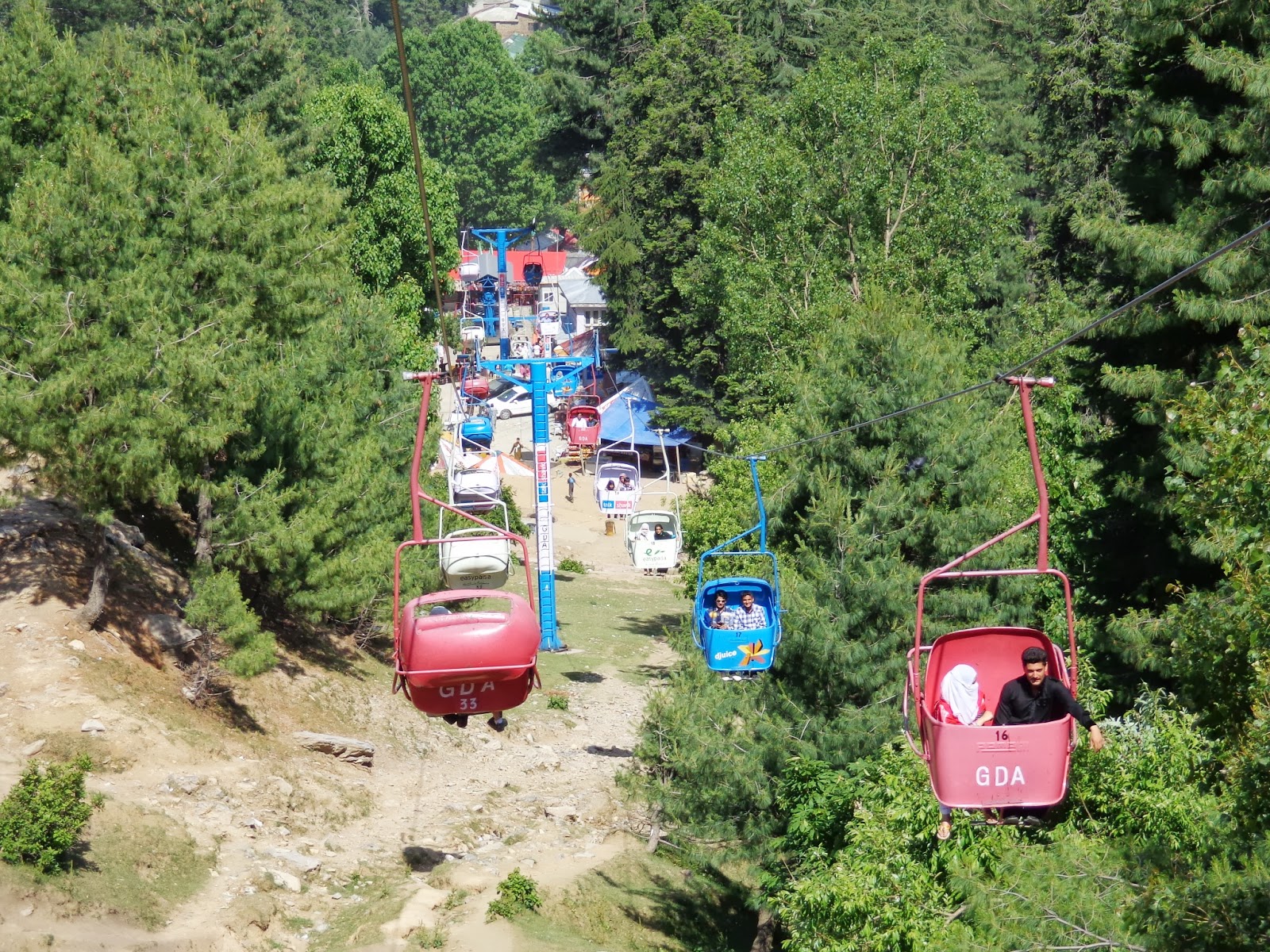
The trail from Dunga Gali ends in Ghora Dhaka, where there is a collection of restaurants and shops clustered around a popular attraction (left). On this day, the famous Ayubia chairlift was particularly busy because school had just let out for the summer, and there was a religious festival taking place nearby (right).
We disregarded any disrespect we had for Pakistani standards and took a round-trip ride up and down the hillside. In the end, the ride was no scarier than similar lifts at the Ohio State Fair, the SkyGlider, and Cedar Point, the Sky Ride. The most frightening part of the ride is getting off because the carriages don't stop or slow down, so you have to scramble off before you are jack-knifed by a metal car. Despite flashbacks of a near-death experience with a ski lift at Snow Trails, I was able to dismount without injury.
I'm not sure the view from the top was worth risking life and limb, but it was definitely beautiful. You could get a 360-degree view of the hill-filled Abbottabad district. For those of you paying attention, that is the district that contains the city of Abbottabad, where Osama bin Laden was killed. His compound, however, will never become a tourist attraction because it has been torn down.
The chairlift, on the other hand, is a full-blown tourist trap, complete with hoards of hawkers -- literally. There are quite a few young men who encourage you to pay for the privilege of holding a falcon (okay, it's not a hawk, but still). Others try to put air guns in your hands, so you will pay to pop some balloons. All along the road are villagers with roasted-corn and fresh-coconut stands, and around just about every corner hang rows of carpets, scarves, and shalwar kameez in makeshift showrooms.
You might notice the small windows available for our on-the-road sightseeing. Because of security requirements, all embassy-led trips are taken in armored vehicles. Although you won't see them in any of my pictures, a cadre of police escorted us everywhere, by car and by foot. Not only did they protect us from petty theft, which can occur on the hill trails, but they also helped us cut through the line at the chairlift and through traffic on the roads.

Although it was a little uncomfortable to be catered to in this manner, it was definitely preferable to other transportation options. After all, we could've been precariously perched atop a bus, made even more dangerous by severe switchbacks winding up the mountains. Indeed, we saw a bus that had overturned but luckily had not tumbled off an unrailed precipice.  
The roads seemed too narrow to accommodate any volume of traffic, which was particularly heavy on this day because the broader highway to the area had been shut down by a rockslide. Not even the most gloriously decorated bus (left), part of the truck-art tradition in Pakistan, or camel (right) garnered enough attention to get other drivers to yield. 
All in all, our first foray into greater Pakistan was a success. We discovered that the local joke -- "Islamabad, a beautiful city just minutes from Pakistan" -- holds some truth. Islamabad is immensely fascinating in and of itself, but it was definitely worth venturing farther afield to get a broader view of the country -- and a respite of cooler weather.   
Saturday, June 8, 2013

At the end of my stay in the U.S. capital, I felt as though I were at home in Tashkent (S.Hrg.109)

During the first week of our one-year posting in Islamabad, TJ found out his onward assignment. Although we told close family, we held off sharing the news with others because many factors can cause an assignment to be changed. But now that TJ has been "panelled" and has received his official "cable," we feel comfortable going public with the news: Our next assignment is -- drum roll, please -- Tashkent, Uzbekistan.

Why not Europe?
So, you might be asking: What happened to getting a plumb post as a reward for volunteering to go to Pakistan? This means you are old enough for us to finally have "the talk." It's mainly this: There are no guarantees in the Foreign Service; a diplomat agrees to "worldwide availability" for a reason. This is something TJ and I are well aware of. Although it would've been nice to land in Europe, that is not the reason TJ applied to come to Islamabad, nor is it the reason that I supported his decision. Obviously, the reason was the money. I kid, I kid. It was because of the chance to witness the complex nature of global relationships in Pakistan, as I explained in a previous post.

There are two ways a diplomat can get a leg up after going to a less desirable post. First of all, he or she can bargain for a linked assignment, basically arranging his or her onward assignment in conjunction with the next assignment. However, there are only so many linked assignments available, and by the time TJ was bidding, they were all used up. The second way is to lobby for an early handshake, in which, during the regular bidding cycle, a consulate or embassy is allowed to offer the position to someone before everyone has even submitted bids for assignments. 

Why Uzbekistan?
TJ actually received an early handshake for Tashkent. He found out well before others in his bidding cycle, the winter cycle, that he would be given the job. Speaking of bidding cycle, linked assignments can be used to obtain any position, as long as it matches up with the person's schedule for posting and training; on the other hand, early handshakes can be used only with those positions on a person's bid list. And therein lies the rub: TJ's bid list did not include many posts that people would consider "plumb." The closest one to Europe was in Kiev, Ukraine (incidentally, although the city appealed to us, the position did not fit). 

We looked at a lot at posts in South America. Many of them fit TJ's schedule because, with his Spanish, he would not require much training before proceeding to his onward assignment. He considered many posts in Washington, DC, for the same reason. But in the end, he decided to take a chance on Tashkent because it was mix of a fascinating place to live and an interesting position to work. And there are absolutely no concerns or complications about whether Sage and I can go with him. And yet still, I'm sure you have more questions ...

No really, why -- wait -- what -stan was it again?
Uzbekistan, which won its independence from Russia in 1991. Originally, it joined the Commonwealth of Independent States with the surrounding "Stans," but it withdrew in 1999 after opposing re-integration. It has had a hot-and-cold relationship with the United States; Uzbekistan opened an airbase to U.S. military operations in Afghanistan, which also threatened its security and stability, but ended the relationship after the United States accused it of human-rights violations, specifically during the Andijan massacre of 2005. Because of its history, the main language remains Russian, with its Cyrillic alphabet, but there is also an Uzbek language, with a Latin alphabet. Most Uzbeks speak both languages, and most read both as well; the literacy rate of the country is over 95 percent. The primary religion is Islam, but not the fundamental kind; it will be especially interesting to compare its brand of secular Islam to the Islam of Pakistan. For example, there is a growing wine industry, and it seems former Russians haven't given up their vodka.

So really, why Tashkent?
Well, besides the wine and the vodka, the city has some other great things going for it. It actually has a decent public-transportation framework, which will make travel in the city and beyond better. The historic Silk Road ran through Uzbekistan, and there are four UNESCO World Heritage sites in the country. Plus, Uzbeks have their own fallen Tour de France hero, the Tashkent Terror, but there is still respect for cycling, so I might be able to do some touring on two wheels as well as four. The national cuisine will be great fuel for riding; we ordered palov and lagman from Khiva Restaurant in Islambad, and they were both unique, filling, and delicious. But what it really boils down to is: Why not?

When and how long will you go there?
TJ's position requires Russian, so after leaving Islamabad and going on home leave, we will be in Washington for about nine months while TJ has language training (and I might, too, if there's room in the class). We will not get to Uzbekistan until the end of 2014 or the beginning of 2015, and we will be there for two years. And yes, it is utterly weird to know where we will be three or four years from now, considering we rarely know what we will be doing next weekend.

What will you do there?
You'll have to ask TJ for more details about his job, as they allude me, but I do know he will be working in a different section than he has in the past (consular). As for me, unlike Tijuana and Islamabad, there are international schools in Tashkent where I am allowed to teach, the primary one being Tashkent International School, so I might get back into secondary education. The school is based on the International Baccalaureate program, so I am already thinking about taking some IB training while I'm back in DC. 

But then again, I'm showing up in the middle of a school year, so I might have to look for something else, if only temporarily. I might even end up working for the federal government again. My current position as an English language instructor gives me some experience to help in the embassy's Regional English Language Office, and the embassy also has an EducationUSA Advising Center for Uzbeks who want to study in the United States, which is a field I've often considered entering. And of course, I can always see what being a native English speaker can get me into. Or, if all else fails, maybe I'll just find a way to help contribute to the burgeoning wine industry.