Some of you know how it is: You're in the middle of planning your departure, and you realize you haven't actually visited all the places your post is known for. And for people like me, that means you haven't blogged about them either. So just to clarify, I am no longer in Kyiv, but so, so many reasons still make it worth visiting even without me there. For starters, it's still a relatively undiscovered but extremely cheap destination with Soviet roots but European style; Ukrainians are friendly and helpful, and at least in the capital, most speak basic English to help tourists.
Public transport is inexpensive and mostly easy to use, but frankly, most of the main attractions are within walking distance from one another. A good way to organize a walking tour is to visit all the cathedrals, which are the pride of most Kyivites. St. Sophia's, a UNESCO World Heritage Site, is likely the most famous (top). Its central location and square mean it is frequently home to community events (bottom left), including the annual winter festival, which I visited during my first Christmas holidays in the capital (bottom right).


 I didn't actually go into the cathedral and its grounds until spring a year and a half later, when I was within a month of my departure. And I'll tell you, I think I saved the best for last. Its interior is impeccably preserved, with impressively colorful icons (top left). One has been replicated in pysanki, or hand-painted eggs, within the museum-like wings of the church (top right). Almost immediately below the artwork is the grave of Yaroslav the Wise, credited with the spread of Christianity through Kievan Rus (middle left). As the social, political, and religious capital of the region at the time, Kyiv was heavily fortified (middle right). If you climb the cathedral's bell tower, you can see how the churches that anchored the city have been overtaken by apartment buildings (bottom left). Even the short distance to the nearest cathedral has an interlude of government edifices (bottom right).


 Right down the boulevard, past a monument to Cossack revolutionary leader Bohdan Khmelnytsky, sits St. Michael's, a still-operating cathedral and monastery (top left). The sky-blue church was reconstructed in the 1990s, centuries after it was founded under the name of the patron saint of Kyiv (top right). In a park nearby stands a unassuming memorial to the Tens Church Foundations, named in honor of tithe, the typical percentage of income donated to the churches in the area, including St. Michael's and St. Sophia's (bottom).


 The modern base of the Ukrainian Orthodox Church rests in ancient St. Volodymyr's, named after the founder of Kievan Rus, who converted from paganism to Christianity in a bid to bag his fourth wife, a Byzantine princess named Anna (left). On the day I toured the cathedral, the leader of the Kyiv Patriarchate was going to make an appearance, so congregants packed inside to get a glimpse of His Holiness (right).

 Outside, women donned headscarves as they waited for the patriarch to arrive (top left), then they followed him inside for services (top right). Others remained in a circle around the church, awaiting a blessing ceremony that is part of the Second Transfiguration (bottom left). The main objects presented to the priest were apples, so women could eat them sans fear that their unborn children would grow up rejecting fruit. Lacking any such worries, I bought a fan of dried flowers as a vessel for the holy-water sprinkling (bottom right).


 Most Orthodox cathedrals' golden domes can be seen from miles away. Supposedly, the Golden Gate also was elaborately decorated with such glint (top left). Nowadays, ruins of the original city gate are contained within boring old brick (top right). Volodymyr's son built a church inside the battlement in celebration of his successful defense of the city in the 12th century (bottom left). Although not as tall as most of the cathedrals, the gate's position on a hill provides 360-degree views of the capital (bottom right).


Public transport is inexpensive and mostly easy to use, but frankly, most of the main attractions are within walking distance from one another. A good way to organize a walking tour is to visit all the cathedrals, which are the pride of most Kyivites. St. Sophia's, a UNESCO World Heritage Site, is likely the most famous (top). Its central location and square mean it is frequently home to community events (bottom left), including the annual winter festival, which I visited during my first Christmas holidays in the capital (bottom right).


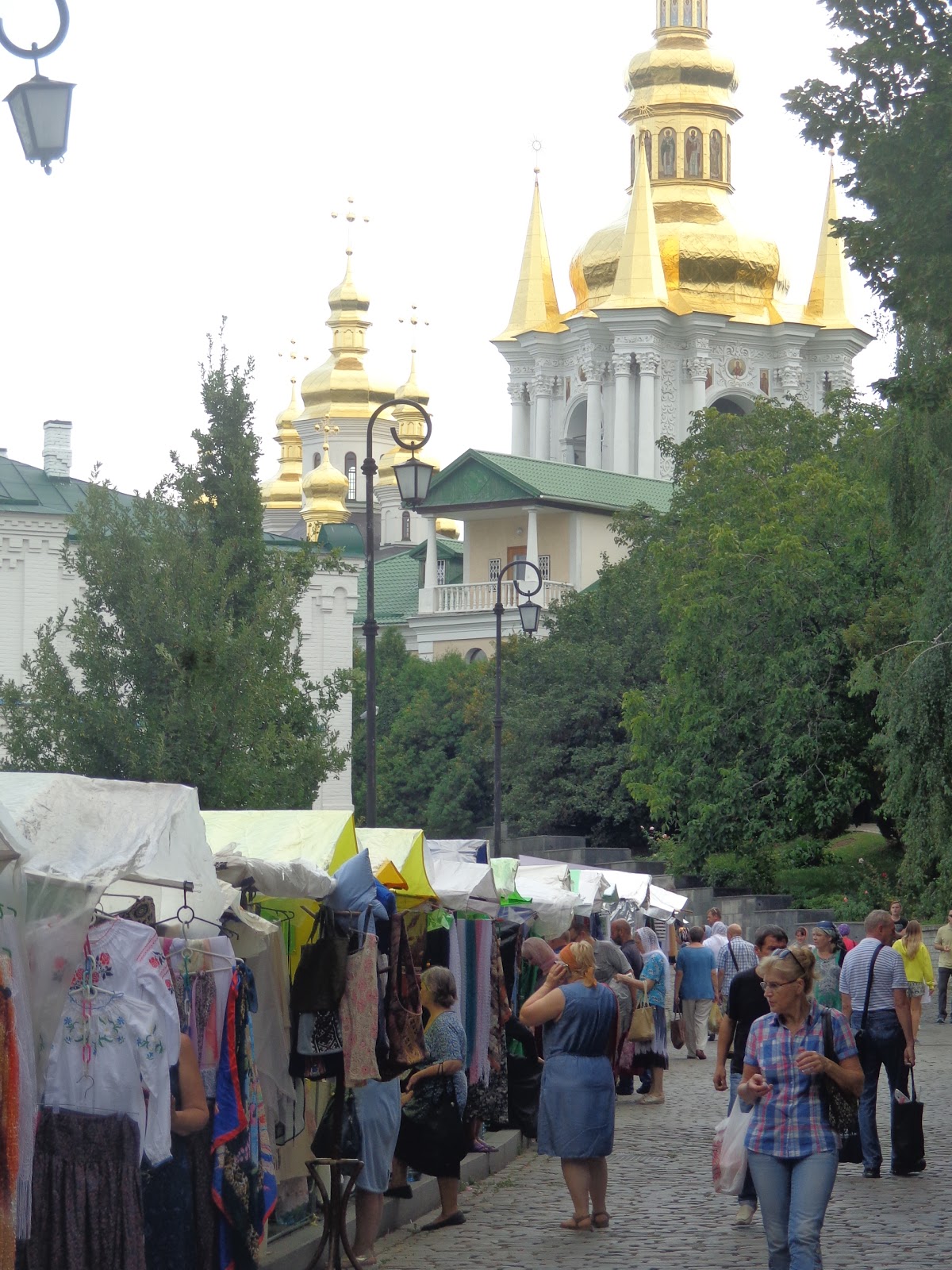
The most prominent cathedral of Kyiv's skyline is Pechersk Lavra, located along the same ridge as the Motherland Monument, which also overlooks the Dnieper River (top left). The cathedral's main bell tower can be seen even from across the river (top right). The cathedral is eye-catching (bottom left), but most visitors are drawn to the caves underneath, which house the most archaic monastery in Ukraine (bottom right).


 On the day I visited, sidewalks within the complex were covered with honey-fair stalls (top). People and actual bees swarmed to the booths for free samples of various comb concoctions (bottom left). The honeys, sometimes being peddled by fake bees, vary in flavor based on the region -- more specifically, the main plants the busy insects use to fuel their industriousness (bottom right). I took home a jar of sticky sweetness derived from wheat-loving bees.