Saturday, August 11, 2012

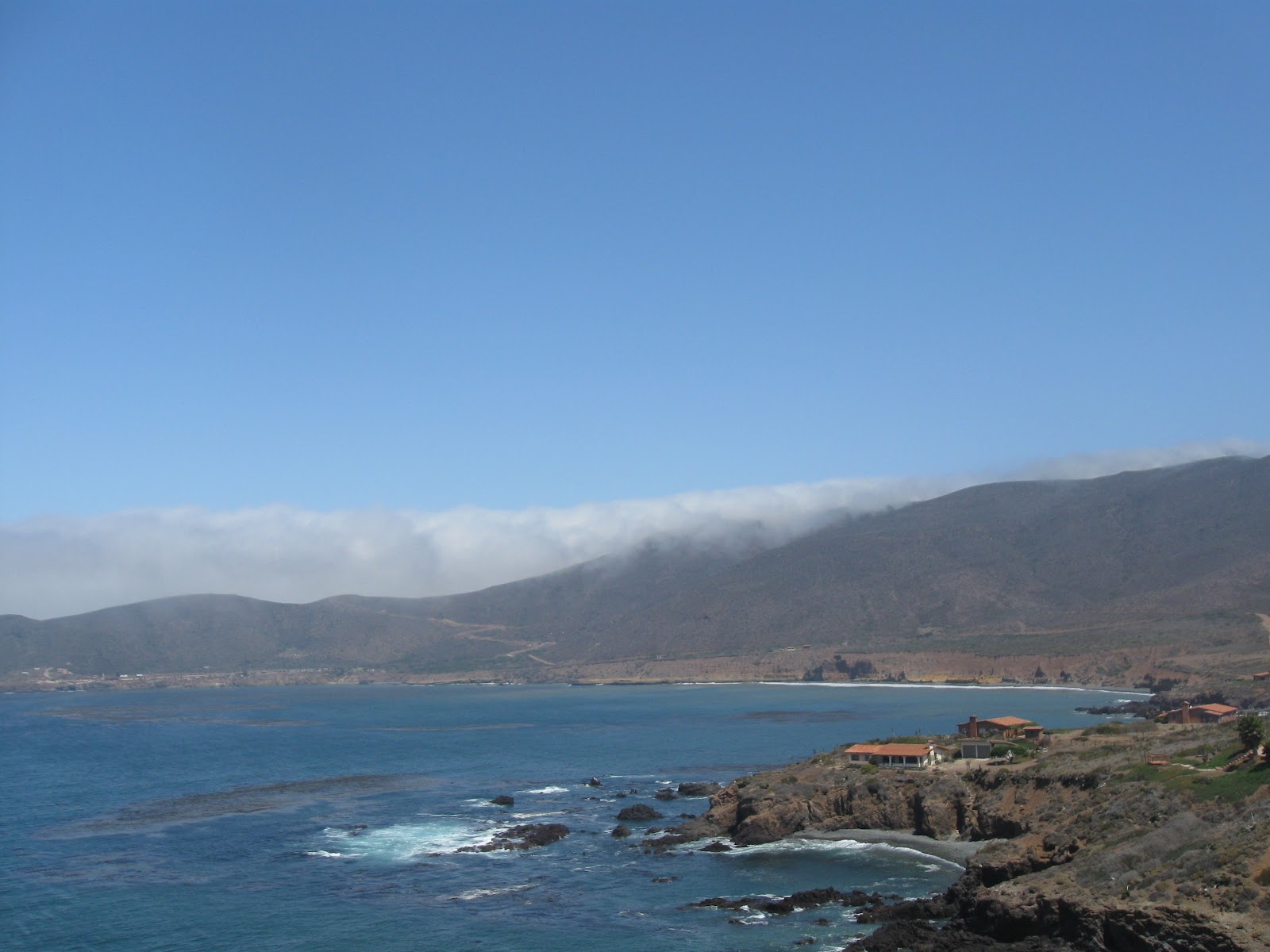
South of Santo Tomas in Baja California Norte, Mexico (71FR44966)

A camping trip is always a good way to get some weight off my mind, but it also tends to take some weight off my hips, too. When you have to start a fire instead of opening the microwave to cook something, you tend to be more thoughtful about what you eat. It doesn't hurt that many foods durable enough for the outdoors -- nuts, apples, granola -- are relatively good for you, too. 

I figured my three-day diet during our most recent trip, to Puerto Santo Tomas, could help me take off a couple of pounds. We had always intended to stop in Ensenada to fuel up on some last-minute supplies, like ice, but we also spontaneously swung by La Guerrerense (top). The street cart is named for its matriarch Sabina, who is from Guerrero and who was featured on an episode of No Reservations. We just wanted to sample some of her delicious tostadas, but we ended up getting four: mixed fish, octopus (bottom left), crab salad, and clam (bottom right). Even if they weren't as overflowing as the ones she made for Anthony Bourdain, they didn't bode well for my weekend weight-loss regimen.
Knowing that the road to our potential campsite would be long, we decided to drive down the old wine route of Baja California first. Most of the vineyards are open only by reservation, which we hadn't arranged, so we didn't actually get any samples. Instead, we wandered down to San Vicente to see what there was to see; after miles of winding roads, we turned around too early and missed the downtown entirely. Luckily, another mission of our trip was to visit some of the many missions in Baja, and our U-turn spot was the mission of Santo Vicente Ferrer, considered one of the most important Dominican missions in Mexico (left). Unfortunately, the gate to the foundations was locked, so we had to spy them through the fence (right). We also were blocked from visiting the mission of Santo Tomás de Aquino, which was also used as a fort by the Mexican military. Despite the hot weather, a river was high enough that we didn't think we should ford it just to see some crumbling adobe ruins. 
Indeed, the 20-mile road to from the transpeninsular highway to the ocean was arduous. Its name -- Canyon Gravel Road, according to Google Maps -- was apt, and we had to go carefully and slowly. After we drove out of the roadside town, it was at least an hour before we saw any signs of life, which at first were just a few donkeys (top left). The valley was so empty that TJ went so far as to call a herd of goats "civilization" (top right). Closer to the coast, there were abundant fields of brussel sprouts, full of pickers brought in by the busload (bottom).

After miles and miles of curves where we took bets on whether we would see water around the next bend, the Pacific finally appeared (top). Even once we reached the coastal road, we had to travel about 5 more kilometers to its end (bottom). But by then, at least there was more scenery to take my mind off my rump, which was partially numb from the bumping. 
Puerto Santo Tomas describes itself as a resort, which is a bit of an oversell. No one greeted us right when we arrived, but the keeper came across us before we rang the bell on the arch, as a sign instructed. The "resort" consists of a few houses, a couple of apartments, a boat ramp, and a restaurant that is open only by request. It's mainly a good base for fishermen who want more direct access to some of the most fertile areas of the Pacific.
Fishermen can bring their own boats or hire one of the many pangas in the adjacent fishing village (top left). Business has seen better days -- only two houses were occupied -- and some pangas have been retired (top right). Their loss was our gain, in the form of a quiet campsite on the side of a bluff (bottom). Because of the curve of the bay, we didn't have a view of the sunset, but the stars at night were amazing, considering that there was no electricity along the coast that we could see. I think I even saw the leche of the Milky Way.
 
TJ was more entranced by the actions of honest-to-god fishermen, who set lobster traps and dove for clams right below our bluff (top left). One wetsuited guy used a basic airline (no tank) to navigate through the algae to the seabed while the two men who remained in the boat pulled up and checked the traps (top right). The boat's movement scared up a raft (yes, that's what a group is called!) of sea lions (bottom). Each morning, we enjoyed watching them frolic near the rocks while we drank some coffee. The first night, we had a no-frills dinner of grilled ham-and-cheese sandwiches, which somewhat made up for the many tostadas.
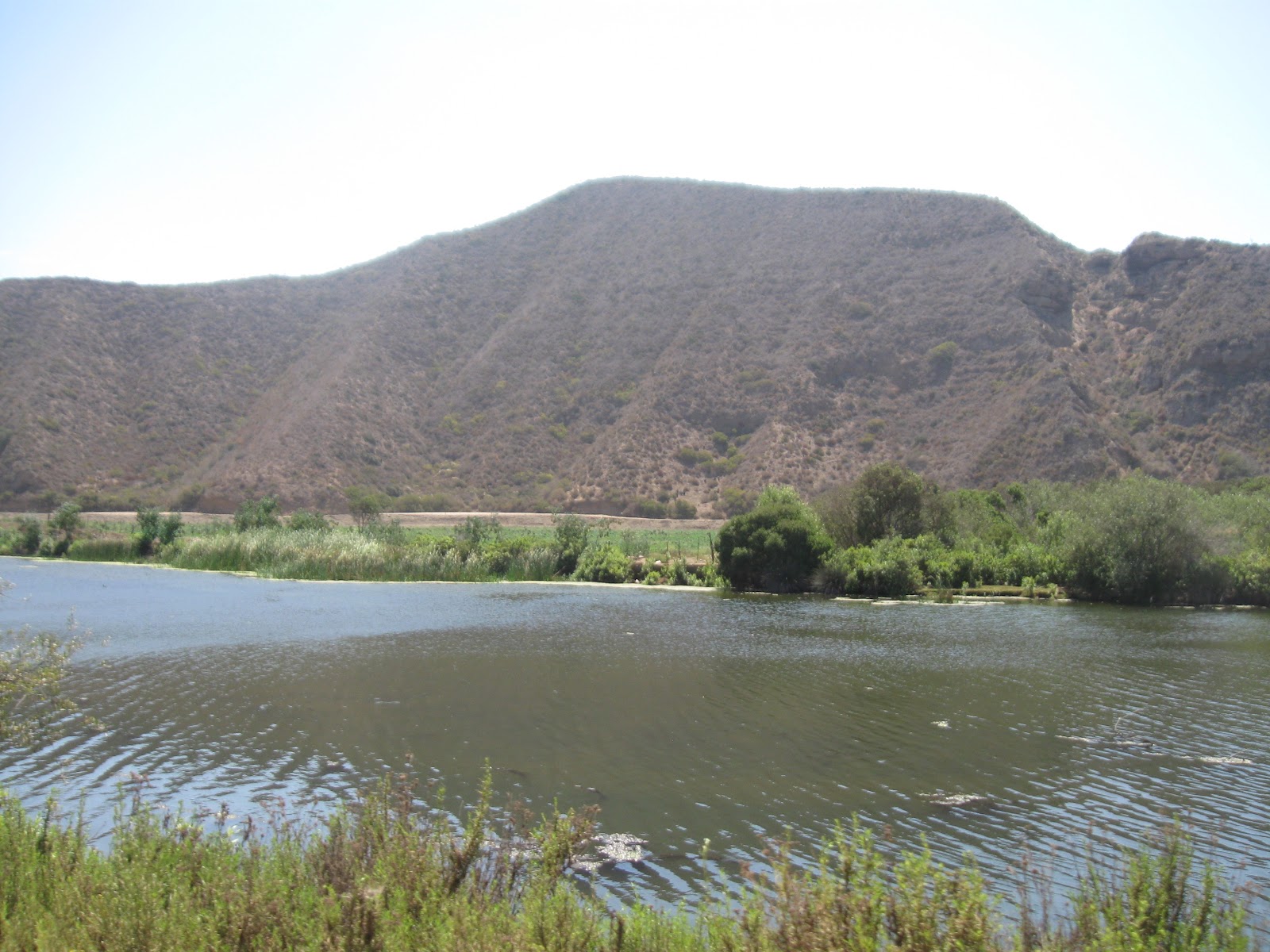
The next day, we returned to La Bocana, where Canyon Gravel Road meets the coastal road and where San Ignacio Lagoon (top left) meets the Pacific Ocean. When the tide is right, the water is low enough to wade across the lagoon to a sandy spit of beach (top right). We knew we couldn't coax Sage into crossing, so TJ and I took turns scrambling down the rocks to take a bracing dip in the waves (bottom).
TJ doesn't need to be on a diet and wasn't satisfied with simple sandwiches, so he arranged to get a calico bass from the keeper of the inn for our next night's dinner. The keeper even went to the trouble of filleting it for us, but he still wouldn't accept payment; instead, we bought only the firewood, including some mesquite. Worried that the fish would stick to the metal, we lined our basket with foil (left), then TJ seasoned the fish with lime, Old Bay, seafood-soup mix, and olive oil (right). 
Our firepit was a bit unusual, so TJ had the added challenge of shifting coals from the pit to the grill area (top left), while he was cooking an appetizer of shrimp caldo and some onions and peppers to go with the fish (top right). But in the end, the meal, complete with a cucumber salad, came out perfectly, as always (bottom). TJ's only regret is that we didn't pick up some good regional wine to go with our dinner.
Although healthy, the meal was filling, so I decided I needed to burn off some calories by hiking up the trail by our campsite. It was precariously steep and full of scree, but it was worth it for the view of Santo Tomas bay (top) and the outcropping and cove beyond (bottom). Incidentally, later in the day we saw a man come down the trail, carrying a bucket of abalone. Apparently, the path is not for hiking but for the local fisherman to access their traps along the coast to the north.
On our way back to Tijuana, we made up for our wine-stocking failings by stopping at Santo Tomás, the winery named after the valley of the old wine route (top left). We selected the ST Colombard 2008, a refreshingly crisp white (top right), to help stave off the heat of the day. Plus, having a glass next to the vines in the winery's shady picnic area was a good way to ease back into the real world (bottom). 
We had plans to stop in Popotla, another suggestion in the No Reservations episode, for a late lunch, but it was pretty hot to leave the dog in the car and we certainly couldn't take him out in the madness of the many restaurants in the village. I didn't immediately jump on the scale upon arriving home, but I noticed that at least one pair of pants felt a little more comfortable the following week. In my opinion, the camping diet worked again, if only to remove some heavy worries from my mind for a few days.

Saturday, July 28, 2012

Raw agricultural commodity used in making that quantity of beef stew (67 FR 79611)

Recently, TJ and I were invited to weekend family dinner where the matriarch served up homemade menudo and birria. Neither dish is a particular favorite of mine, but her concoctions were so good that I thought I should give them a second chance on my list of foreign recipes to try. In terms of cooking, menudo is not much different than pozole, which I made a while back. But I'd probably be more successful bringing back the Puerto Rican boy band than making tripe edible. Besides, cow flesh is more forgiving -- and tasty -- than cow stomach, so I thought I could give birria a shot. 

Birria is more traditionally a meat stew, but here in Tijuana it is frequently a taco filling. In looking at recipes I decided to pick and choose some pieces from two. For the meat, I already had an eye of round, about a pound and a half, so I decided to simply add 1-1/2 pounds of ribs (left), using the meat combination from the stew recipe but the quantity from the filling one. I ignored both recipes in terms of preparation, opting to slow-cook the meat, for three hours on high, instead of watching a simmering pot all day. Within about 30 minutes, the stock was already beginning to form (right).
While the meat cooked, I prepped the peppers. And here, I made another recipe merge. I used most of the peppers from the taco recipe, except the California chiles, because, surprisingly, I couldn't find them in the store. So I selected guajillo ones, which were suggested in the stew recipe and are said to make a suitable substitute, in terms of their color, size, and heat. The guajillos are long, narrow, and red; the pasillas and anchos are both green, but the anchos are smaller and wrinklier (top left). After stemming and seeding the peppers (top right), which felt like using a letter opener to cut Fruit Roll-ups, the peppers soaked in water for about an hour (bottom left) before they were drained (bottom right), leaving a trail of orange-stained cookware (In the future, I'd suggest using a disposable dish to soften the chiles.)
From here on out, I stuck to the taco recipe, mainly because it simplifies the seasonings by using achiote paste, which contains many of the spices from the stew recipe. Plus, considering I shop at a Latino market all the time, I was able to easily find it, right by the ketchup. The tomato, onion, garlic, peppercorns, cumin seed, and achiote paste all went in the food processor first (top), creating a vibrantly scarlet sauce (bottom left). I thought that the chiles would add most of the color, but it seems the achiote paste is the key because the peppers merely deepened the red of the mixture (bottom right).
While the sauce waited during a work event, the meat rested, leaving it plenty cool to slice. I pulled out all of the meat first (top left), so I could scoop some broth for the sauce and store the rest for future recipes. A knife was on hand, but really the meat was so tender that I could just pull it apart (top right). The bones from the ribs had fallen off long before, so I just strained them out of the leftover stock. A cup (more like a cup and a half) of it went into the sauce, then the sauce and meat went back into the crockpot  to simmer (bottom).
Actually, I was supposed to strain the sauce before putting it into the meat, but I forgot, and to be honest, the sauce was so thick that it seemed a shame to waste so much flavor. Possibly, the pepper skins made the mixture more bitter, but the only really noticeable effect was the occasional surprise bite into a peppercorn. TJ set up a complete condiment station of hot sauces, onions, cabbage, limes radishes, and cilantro (left). Still, I stuck to a common construction with dollops of meat on tortillas, topped with only onion, cilantro, and a squirt of lime.
I have to agree with TJ's assessment that it wasn't the greatest taco we've ever had. But, he admitted, it seemed like real birria, which both of us find somewhat bland (particularly TJ, who uses hot sauce like ketchup). For the leftovers, we plan to drop a good dose of seasoned salt into the meat, in the hopes that it will better suit our sodium-addicted American palates. We have some dignity, though, in that, no matter what, the tacos will not be smothered in shredded cheese.

Saturday, July 21, 2012

Our communities have all benefited from the contributions craft brewers have made (152 Cong. Rec. E1088)

Usually, if there is a turf war over drugs, it leads to violence. But apparently, if there is a turf war over alcohol, it leads to parties. Recently, in Tijuana, there was not one, but two, beer festivals in a single weekend. I can't be sure why the organizers would plan their events at competing times (especially right before -- instead of after -- the city's annual marathon), but if you need a narrative, I will suggest that the Cerveza Tijuana, which along with Stone Brewing sponsored one of the festivals, had a falling out with the Asociación de Cerveceros Artesanales de Baja California, the sponsor of the other festival, about how many swear words the entertainment should use.

A significant number of curses poured out of Hollywood Roses, a tribute band to Guns N Roses (left), as the beer flowed at TJ Beer Fest, held in the parking lot of Caliente Casino (right). The mostly-Mexican attendees didn't seem to mind, though, perhaps because the band's banter was entirely in English -- and entirely annoying (incidentally, most of their songs were, too).
 
It was worth bearing the brunt of the bad music because this festival was the better deal. Admission was $10, which included tickets for three samples. Then you could buy more samples for a little less than a dollar, or full pours for $3-$4, depending on the brewer. TJ even got a deal at Cervecería Legion; for just a couple bucks more, the brewery threw in a pint glass with its logo (top left). Some of the other beers on hand were sponsor Cerveza Tijuana, of course (top right); Cerveza Agua Caliente; Cerveza CucapáCerveza Patricia; and Cerveza Mexicali (bottom).
 
Most of the brews we tried for the first time were pretty mediocre, possibly because they got a little skunked sitting out on the sun-soaked pavement all day. From the comments of our fellow suds-sippers, the winner seemed to be Baja Brewing Company, whose Cactus Wheat, which I sampled in Cabo, got good reviews. But in my opinion, the best free sample was the mechanical bull, obviously the most appropriate activity for beer drinkers. I managed to fly off just before the operators shut down the ride for the night.
Upon arriving at the Baja Beer Fest, held on Avenida Revolución, I immediately noted that it did not have a mechanical bull. It also did not include any free samples with its $6 admission fee (otherwise, the prices for 4-ouncers and pints were about the same). But what it lacked in activities and cost-effectiveness, it made up for in atmosphere. Smack dab in the middle of downtown, it provided vistas of city's landmarks: the fountain in front of the Jai Alai Palace (top left), the extra-large Mexican flag (top right), and the Welcome to Tijuana arch (bottom).
The lack of a mechanical bull might be because this festival was geared toward a different crowd (i.e. one that includes gringos like myself). Possibly because it was the middle of the day, there were far more families and friends just relaxing and sitting at tables (left) instead of hanging on each other in an attempt to remain standing. But there were some similarities; I did hear the entertainment (right) use the F-word at least once, for example. 
But no doubt, there were differences in the food. As opposed to the bratwurst, which I highly suspect were probably chorizo, at the previous festival, downtown drew some more gourmet establishments, including Don Diego (left), whose choripan and empanadas convinced me I should track down its non-tent location. The quality was so high that TJ didn't even think twice about shooting an oyster from a street vendor (right).
 
Like the food, the beer was better. Many of the Tijuana operations -- including Cervecería Monastika, Silenus Cerveza, and Cervecería Rámuri were much more well-established than the small home brewers at the first festival. And many participants were from farther afield. Old Mission Brewery and Cervecería Marinera came up from Ensenada, as did Blondyes Home Brew, whose offering would pretty much be good only for the beer pong tournament it was advertising. The clear winner here was local favorite Cervecería Insurgentes, whose owl logos will soon be found at Baja Craft Beers Tasting Room, which opens July 27 at Orizaba 3003-E5 (two streets west of Sonora for you Tijuanenses).

So perhaps some other men's beer brawl was our boon. Or perhaps, Tijuana just likes to party. Merely one weekend later, the same casino parking lot was the site of the first-ever Festival de la Brasa, la Cerveza, and el Vino, where not one, but two, types of alcohol would be served up with grilled treats from 16 area restaurants.

Monday, July 2, 2012

I get to eat Thai food and ... Latina and Latino food (147 Cong. Rec. S3070)

Okay, I admit it; I've been slacking on the experimental cooking front. So with a few more weeks off from teaching after my out-of-town work trip, I figured I better get back on the foreign-recipe horse before I lost my motivation to ride. TJ had picked up some great pork loin, and we had leftover shrimp, so I immediately thought of Pad Thai. Clearly, I am out of epicurean practice because I forgot to reserve some of the pork TJ grilled for my noodle dish. So the day of my culinary comeback, I stopped by the store to pick up some boneless pork chops.

The relatively simple recipe required a few other prepwork tasks. First, I had to soak the flat rice noodles, which were surprisingly difficult to find; I could've ventured to an Asian market, I guess, but I was too lazy, which meant that I also had to make my own "preserved radish" by cutting one up and letting it marinate for a day in some salt and vinegar (left). Incidentally, after I went to all that trouble, the instructions never said what to do with the preserved radish (I added it to the wok with the Pad Thai sauce). And I could've used the electric coffee grinder to chop up the peanuts, but after it turned the almonds I inserted into paste last time, I opted for a non-electric hammer instead, to ensure I wouldn't end up with peanut butter (right).
Shopping at a Latino supermarket actually helped with some supplies. Tamarind juice would've been impossible to procure, and although the recipe explains how to make your own, you would still have to track down tamarind paste to do it. Instead, I picked up a bottle of Jarritos tamarind soda, which is as ubiquitous as Coca-Cola in Mexico (left). In another stroke of luck, piloncillo, a form of hard-packed palm sugar, is a staple in the Mexican produce aisle. The "little pilon" I picked up was just less than the amount called for by the recipe (right); I figured the sugar in the soda would make up for the rest.
The most time-consuming part of this meal is the sauce. The ingredients aren't complicated, but you have to stir pretty consistently for an hour as the salt and sugar slowly dissolve into the liquids -- reduced tamarind soda, water, and fish sauce (top) -- then make sure the mixture doesn't overboil and become too hard. I cooked the sauce for the full 60 minutes, until I got a stiff roll that resulted in a solid thread from the spoon (bottom). This was too much heat, as the sauce nearly became the consistency of Bit-o-Honey. Because of this, I used four instead of five tablespoons of sauce for the noodles, and I had to reconstitute the rest with water before I stored it, lest I end up with Pad Thai popsicles.
The time it takes to stir-fry the noodles is inversely related to the time it takes to make the sauce, so I assembled my ingredients in order (top), fully ready to wok and roll (yea, I used that pun; you gotta problem with it?). First, a little oil is used to sizzle up garlic, pork, and shrimp (bottom left), then you remove the shrimp before you put in the noodles and sauce (and the preserved radish, in my case). The noodles only need to be tossed with the sauce for a few seconds before you add the shrimp back in and create a bird's nest in which you can fry the eggs (bottom right).
The last step is to stir in the egg, along with the peanuts, green onions and bean sprouts (left). It's been a long time since I ate professionally made Pad Thai, but mine seemed soupier than what I've had before. Maybe I didn't let the egg fry enough? Or even four tablespoons of the sauce were too much? Nonetheless, it tasted delicious, especially when served with a squirt of lime and eaten with our direly underutilized chopsticks.
Of course, the rich flavor should be no surprise, considering the amount of sugar in the sauce. Did you see the size of that piloncillo? But I comforted myself by noting that the proportion of noodles to bean sprouts was nearly equal, clearly proving that this is a healthy, vegetable-heavy dinner.