Saturday, May 30, 2015

Stuck in limbo waiting for a visa that may never come (153Cong.Rec.H5572)

My going-away party was more than a week ago, and yet, I have not actually gone away. I said goodbye to a bunch of people at a gathering at Courthaus Social, but I keep seeing them over and over, which is awkward, considering I was supposed to be out of here a while ago. Usually, I cause my own awkward situations, but in this case, it's bureaucracy's fault; I am awaiting my UK visa before I can hop a plane to cross the pond.

The party was not for naught, though, because TJ received his visa and passed his Russian test (exceeding expectations, of course), so he managed to get on his scheduled flight. I planned to depart before him -- mainly so he would be stuck with all the final cleaning-up and moving-out tasks -- but at least my failed attempt to deviously ditch domestic duties allowed us to spend one more weekend together.

In honor of his language-test achievement, we started with a celebratory dinner at Mari Vanna, which features cuisine from Russia and former Soviet countries. We shared a plate of Ukrainian salo, similar to Italian lardo; cured pork fat doesn't sound so good, but I swear, it's like bacon-flavored cheese. TJ chose two more dishes from the regular menu: Slovak machanka soup and Russian beef kotleti. I chose the rest of my meal from the featured Georgian menu: ispanakhi, or spinach balls, and chakhokhbili, or chicken stew.

TJ was able to make small talk with the Ukrainian waitress in Russian. I could read a majority of the menu, but I could barely manage a vocal "спасибо." This was a poor showing, considering that I recently learned my onward post after London will be Kyiv, Ukraine, where I will be expected to say more than "thank you" in Russian. I guess I have some studying to do once I finally get settled in the United Kingdom. 

On a lovely, sunny afternoon the next day, we headed, with a couple friends, to Bardo -- not to be confused with lardo -- a microbrewery a few blocks away from H Street in Northeast DC (top). The establishment distinguishes itself by brewing and serving its beer outdoors, which means it attracts a lot of mid-ride cyclists (bottom left). The beer garden's kitschy, hodgepodge ambiance might feel familiar (bottom right) because it is awfully similar to the owners' previous taphouse in Clarendon: Dr. Dremo's, an institution that offered brewed-on-site drafts and drinking-game options well before all the cool kids were doing it.
We packed up the leftovers from our picnic lunches, two jumbo fish sandwiches from Horace and Dickie's Seafood, and headed to an evening taping of  A Prairie Home Companion. Host Garrison Keillor walked through the crowd singing before he officially started the show, called “A Spring That Love Remembers” (left). It was a little easier to see him on stage, as he sang "Stars and Stripes Forever" with the U.S. Navy Band backing him up (right).
Ensuring that I will have appreciation for the Tube, the Metro made it take way too long to get to the Filene Center in the Wolf Trap National Park for the Performing Arts (there's a shuttle from the West Falls Church stop). We made it just in time for the opening, but of course, the lawn was already packed, so we had a less-than-ideal view (left). But the powerful voices of Sara Watkins, Sarah Jarosz, and Aoife O'Donovan -- who formed the trio I'm With Her after meeting at the Telluride Bluegrass Festival -- required only ears, not eyes, to appreciate (right).
 
Their songs were a blend of heartbreak and hope, an entirely apropos mixture when I dropped TJ off at the airport the next day. He made it to Tashkent safe and sound. Hopefully, I'll make it to London before his first R&R rolls around. 

Sunday, May 3, 2015

So it was basically a waiting game (150Cong.Rec.H7430)

I guess it's time to break my radio silence and spill the beans (and also apparently combine multiple cliches in single sentences). A while back, I announced my new three-letter title: FSO. About a month after getting the call to join the Foreign Service, I started orientation for new officers, in which, among other objectives, the coordinators try to instill the core values of the State Department: Loyalty, Character, Accountability, Diversity, Community, and Service. You'll notice that Patience did not make the list.

That's because, although I learned a lot of valuable things during orientation, it's also a weeks-long waiting game until you find out where you will be posted for your first assignment. During the first week, you receive a "bid list" with all the possible assignment options. Over the next few days, you research the options before you submit your preferences, so posts can be assigned. Then many looooong weeks later, you find out where you are going in an infamous ceremony referred to as Flag Day.

Not all bid lists are created the same. I had seen TJ's bid list during his orientation, so I had a point of reference. From first glance, mine looked a lot better than his -- a good balance of types of positions in different parts of the world, not just consular positions in Mexico and China, which can be a good chunk of many bid lists because of the high demand for visas there. Some people were disappointed in the lack of public-diplomacy positions, but for me, glaringly absent were any Russian-speaking posts.

Having just learned Russian, I wanted to put my skills to use, but a Russian-speaking post would also mean I would be somewhere near TJ. Unlike some other languages (I'm looking at you, Spanish and French), Russian-speaking countries generally congregate together. I had thought my bidding strategy would be pretty straight-forward, considering that my priority is to be with my husband; I thought for sure that, even if I couldn't get to the same post, because of my Russian score, I could get close. Quite frankly, I did not consider the possibility that there would be no Russian-speaking posts on the list.

So TJ and I scrambled for a new strategy. Basically, we researched a lot of flights to find out which places had the most convenient schedules and prices. Some places that were geographically closer to Uzbekistan were not as good as places farther away because of the lack of transportation options. And I looked into places with Russian-language schools to keep up my skills, while crossing my fingers that I would not be assigned to learn Arabic or Dutch.

We all submitted our bid lists, and then we all waited. At Flag Day, I was a lot more nervous than I thought would be. I had envisioned having a pretty good idea of where I would be going. After all, if Kyrgyzstan had been on the list, I'm pretty sure not a lot of my classmates would've been fighting me for the position. I relaxed only when I was handed the Union Jack, the flag of my top pick.

After weeks of slow-motion waiting, things started speeding up quickly. Through some negotiation, my future supervisors in London agreed to let me arrive in May, two months earlier than expected, so I will be hopping across the pond in a matter of weeks. I will be working in the consular section of the embassy there for two years. And although being separated by a lot of land from TJ is not ideal, he can use his R&Rs to come hike the Hadrian's Wall Path with me and drop into some historic pubs along the way.

Both of us are now bogged down in logistics, as we prepare to leave within days of each other by the end of the month. Meanwhile, we are both trapped in yet another waiting game. Because I earned bonus points for my language skills, I am required to serve in a Russian-speaking post during one of my first two assignments. The United Kingdom, in case you couldn't guess, doesn't fulfill that requirement.

To ensure that I and others in my orientation class who got language points fulfill our obligation, we received second bid lists about two weeks after our Flag Day. Unlike the orientation bid list, these lists included only posts with the languages we speak. But like the orientation bid list, we submitted our preferences -- and now we wait.

So soon, I'll know what will be my next assignment after my two years in the UK, and I'll start another round of finger-crossing -- that TJ can get a job in the same post. He doesn't get to bid on his post-Uzbekistan assignment until summer 2016. And thus, the waiting game begins all over again.

Sunday, March 1, 2015

It has really become an institution in Washington (151Cong.Rec.H3559)

After our initial visit to the Washington Monument, we headed to another nearby institution: Old Ebbitt Grill, the oldest bar and restaurant in the city (left). The wood-paneled, gas-lamp ambiance was worth it, but the beer prices weren't, so we soon headed to happy hour around the corner at Chef Geoff's, where almost-40-ounce Supermugs cost less than 8 bucks. After our second trip to the obelisk, we introduced TJ's family to another long-standing DC establishment: Ben's Chili Bowl. Its claim to fame is chili on Half Smokes, but you can also put it on fries with cheese or by itself in a bowl (right).
  
The matriarchal proprietor told us how Ben's Chili Bowl beat Cincinnati standard Camp Washington Chili in a cookoff. We wanted to keep giving TJ's family tastes that they can't get in Ohio, where Taco Bell is considered ethnic food. So for our Sunday lunch, we picked up oversized sandwiches -- homemade bratwurst, Braunschweiger liverwurst, and hot pastrami among them -- at Polish-cum-French chef Jamie Stachowski's Market. We didn't realize there was little seating at the store, so the sane among us ate our picnic lunch in the car, parked just beyond the walls of Georgetown University.
The night before, we ventured out to Falls Church to try the Afghan fare at Panjshir. We all shared appetizers of aushak and sambosa goshti and a dessert of firnee. TJ ordered lamb korma with maraba-e-saib (left), and my main dish was basically the same, but with pumpkin kadu instead of apple jam. We jumped to another continent for dinner at Abi Azteca Grill & Bar, where most of the table opted for Salvadorean pupusas (right). Because I'd had the pupusas previously, I went with the carne adobada, the leftovers of which we later repurposed as tacos.
We also wanted to let TJ's family sample DC's craft-brew scene, so we headed to Atlas Brew Works (left). I saw a batch of Brett beer in the works (right), but our flight was sour-free: District Common, Rowdy rye ale, La Saison des Fêtes saison, Town & Country Belgian ale, and Pumpernickel Stout. We tried to hit up nearby One Eight Distilling and New Columbia Distillers, makers of Green Hat Gin, but they are open only on Saturdays, and unfortunately we just missed a Sunday tasting at DC Brau Brewing Company by an hour.
A few weeks earlier, family- and fancy-free, TJ and I focused on foreign cuisine and local spirits during two Restaurant Week outings. During a rainy night at Brasserie Beck, we opened our meal with Belgian classics of mussels, oysters, and foie gras terrine (left), then followed through with Flemish-inspired beef carbonnade and steak & frites (right).
A few days later, we were happy to forgo the Belgian beers and choose from the craft-beer stock at Roofers Union (top), which is a far cry from the sticky-floor choices of the former Reef nightclub that used to be located in the space. Head chef Marjorie Meek-Bradley was going to prepare grilled octopus at a James Beard Foundation reception in New York, but she got snowed out, so we added the dish to our appetizers of French onion soup and crispy pig-ear salad (bottom left). Somehow, we managed to save some room for our main courses of chicken sausages and duck confit (bottom right).

Wednesday, February 25, 2015

We face various constraints, such as facilities limitations ... and inclement weather (SerialNo.110-90)

TJ's family was supposed to come visit during a long weekend in January, but due to unforeseen issues, they didn't make it. So we invited them back to visit during the next three-day weekend, and they braved the cold weather to do so. The first time around, one of their requests was to visit the Washington Monument, so we reserved tickets. When they couldn't make it, we invited a couple of friends to take their place. But the skies were so overcast and foggy that you couldn't take advantage of the view (left). Instead, we pointed out famous landmarks in the photos above the windows (right). 
The second time around, the family's request remained, but all the reserved tickets were taken. Each day, the National Park Service hands out tickets on a first-come first-serve basis, starting at 8:30 a.m. We got up early to get downtown, and we were rewarded not only with tickets, but also with much better views than our earlier visit. This time, instead of seeing water droplets, I could see the water of the Tidal Basin surrounding the Thomas Jefferson Memorial (top). Before, I could barely make out the Lincoln Memorial, but this time I could see it and beyond into Virginia (bottom).
 
The White House was covered in haze during our first visit, but on this day it was clear enough to see from the Ellipse all the way to the National Cathedral (top). Luckily, back in December, TJ and I got a close-up view of the president's house when we went there to bask in the holiday spirit of its wreaths and the National Christmas Tree (bottom).
 
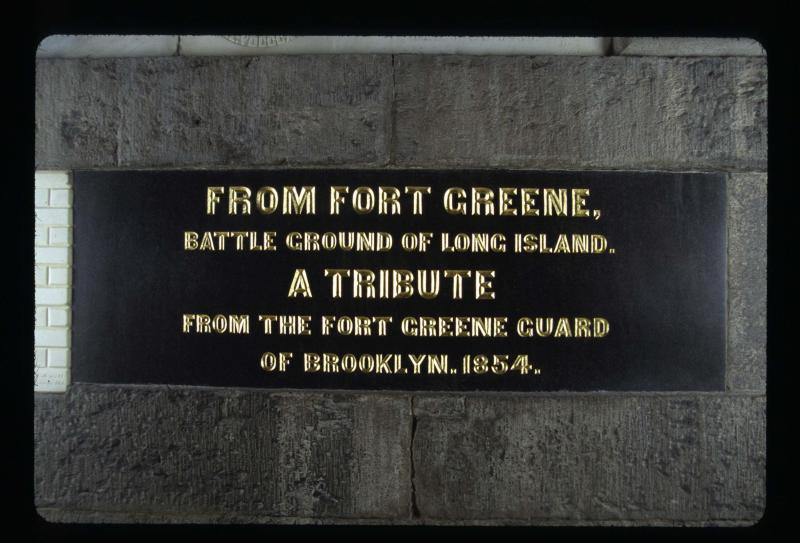
Even while riding down the elevator, when they slow to show you some of the commemorative stones, I got a better glimpse of the markers. I just saw the back of some kids' heads before, but this time I got a shot of half of the stone from Fort Greene, home of the Brooklyn Navy Yard, where the USS Maine was built a few years after the marker was donated.
The Mall was so fogged in the first time that I didn't even bother to take a photo of it. This time, I got a clear view of the U.S. Capitol and the turf-reconstruction work going on in front of it. In case you can't tell, the patch closest to the Capitol is finished, but the entire project isn't slated to be completed until before the 2017 inauguration.
After some lunch and a stop at the National Archives -- where we digested the significance of the Magna Carta, the Declaration of Independence, the Constitution, the Bill of Rights, and the Emancipation Proclamation -- we witnessed what these documents hath wrought during a tour of the Capitol (top left). We gazed upon the donut hole of the Rotunda, which like the Washington Monument is being restored after some damage from the 2011 earthquake (top right). It seems that none of the state submissions to the National Statuary Hall were affected by the tremor (bottom left), and its nearby epicenter didn't shift the golden center of Washington, located in the building's Crypt (bottom right).
From the city's axis, we spiraled out into its quadrants, with a jaunt through the jungle section of the U.S Botanic Garden (top left) and a step back in time at the National Museum of American History. I jealously perused Julia Child's kitchen, as recreated in the "Transforming the American Table" exhibit (top right). We shut down the museum then swung by the Martin Luther King Jr. Memorial (bottom left) and Korean War Veterans Memorial (bottom right) before heading home for the night.
It was a whirlwind day of sightseeing, but I was glad we saw so much by foot because the next day was the wind-chill day of our city safari. With temperatures below freezing and the "real feel" even further below that, we selected a slate of mostly indoor activities. We spent a little more time at the U.S. history museum before seeking shelter in the National Cathedral (top left). I had been to the church before, but it must not have been on a sunny day because I don't remember the stained glass being so spectacular (top right). I also don't remember adequately admiring the needlework of the Tree of Life in the War Memorial Chapel (bottom left) or the mosaics in the Resurrection Chapel (bottom right), located at the crypt level beside the Bethlehem Chapel and the St. Joseph of Arimathea Chapel. 
We experienced the second great view of the weekend by heading to the cathedral's Observation Gallery, from which we could look back on the national monument and legislative offices we visited the previous day (left). The president's house was hidden by the trees, but the Vice President's Residence peeked out from a clearing on the grounds of the U.S. Naval Observatory (right). 
After hearing the wind shaking the windows of the gallery, we decided to skip a trip through the National Zoo. We figured the pandas would be snuggled up inside, so we huddled up with our buddy Abraham outside at President Lincoln's Cottage, on the grounds of the U.S. Soldiers' Home (left). According to a plaque by his statue (right), Lincoln rode from the "cottage" to the Capitol every day during the summers of his presidency to avoid the muck and mosquitoes downtown. As my face was being stung by the wind, I begged to differ with good old Abe -- a mosquito bite didn't seem so bad at the moment.

Saturday, February 21, 2015

Trying to find new work, going out and pounding the pavement day after day (159Cong.Rec.S8804)

I guess it's time for me to go public: In a little while, I will no longer be an EFM (Eligible Family Member). Oh don't worry, TJ and I didn't divorce. It's just that I recently received an invitation to the Department of State's 181st A-100 class, which means my acronym will soon morph into three different letters: FSO (Foreign Service Officer).

Any FSO can tell you what a relief this is. The process to become employed by the Foreign Service is a long and arduous one. Here's the not-so-short version of mine: After a post-bocce discussion way back in the summer of '11, I signed up to take the free general Foreign Service Officer Test. Despite the little history and government that I gleaned from my "substandard" public schooling, I managed to pass. This meant I was allowed to submit my Personal Narrative responses to another three-letter acronym: the QEP, or Qualifications Evaluation Panel. The panel was so impressed -- or confused -- by my answers that I was invited to the Foreign Service Oral Assessment of this extended tryout in the fall of that same year. Once again, a miracle occurred, and I scraped by with a just-barely-above-board score.

But even after passing all of the tests, my suitability was still up for review. I had to go through medical and security checks. Even with my numerous addresses, including just a few overseas, the Final Review Panel declared me suitable in early 2012. Being declared "suitable" means you are placed on a "register" of acceptable candidates. When the Foreign Service calls up new officers, they invite people from the top of this register; if you are not called within 18 months, you drop off the list completely and must start the entire process all over again.

By virtue of my low "orals" score, I was at the bottom of the list, and therefore I had little hope. So in an act of desperation, I tried to boost my score by proving my Spanish-language skills over the phone. The proof, as they say, was not in the pudding, so I opted to "freeze" my candidacy for 24 months while I followed TJ around to Mexico and Pakistan; this meant my 18-month "diplomatic clock" was not ticking down for those two years.

When we returned to the States for TJ's training in 2014, I had no choice but to restart my clock. But as the little hand was so slowly moving, I was studying Russian. Just in the nick of time, I managed to earn some language bonus points with my Russian-speaking skills, which boosted me toward the top of the candidate list. Not long after, a new class of officers was called up, and I was among them.

So for me, the process to get a job as an FSO took 3-1/2 years (I can't be sure, but this could be some kind of record for a one-time candidacy). And indeed, this process was often challenging and sometimes frustrating. Coincidentally, I also have been an EFM for about 3-1/2 years, and for much of that time I was actively looking for employment. So before I fully make the switch to FSO, I want to give a much-deserved shoutout to my fellow EFMs because their process to find a job is often just as long and arduous.

Here's the not-so-short list of the efforts I went through to try to become employed as I "trailed" my spouse overseas:
  • I took private-sector jobs below my level of expertise in order to not have gaps in my resume.
  • I applied for every job advertised at post to demonstrate my serious interest; each time, I had to fill out the exact same lengthy form, and I was not allowed to simply indicate that no details had changed since my last application. 
  • I waited only a short time to receive a security clearance for my first embassy job (another three letters: CLO, or Community Liaison Officer), mainly because the process had already been initiated after I passed the "orals" (many other EFMs wait months or years to start a job because it takes that long to get a clearance).
  • I hodgepodged together four part-time jobs to give myself full-time work.
  • I took at-post and distance-learning language courses in my "spare time."
  • I woke up at the crack of dawn to consult with my language instructor or to interview for jobs (stupid time zones).
  • I stayed up late at night to consult with a Global Employment Initiative adviser about resume formats and job prospects (stupid time zones).
  • I regularly stalked USAJobs, devex, the PROPs group on LinkedIn, and The Network. 
  • I attended numerous daylong workshops on employment tools, portable careers, and non-governmental organizations.
  • I attended multiweek functional training classes, such as the Basic Consular Course, otherwise known as ConGen.
  • I established qualifications in six areas of the Expanded Professional Associates Program.
  • I successfully applied for the EFM Consular Adjudicator Pilot Program.
  • I sought a Professional Development Fellowship to pay for classes to earn a certificate that would help expand my career opportunities. 

That's a pretty long list, right? And it might seem like I'm complaining (and I am, but only a little); actually, I am extremely thankful for all the opportunities that the State Department, especially the Family Liaison Office, provides. But it takes a great deal of effort to take advantage of all of these programs. In other words, the process to become employed as an EFM is often as stressful and difficult as -- if not more stressful and difficult than -- the process to become employed as an FSO. And EFMs have to go through this process not just once, but every time their spouses change post! (I know, I know, some FSOs went through the testing process multiple times before they were hired, but that was by their choice.)

Obtaining a job as an EFM is often a job within itself. Therefore, it is no surprise to me when EFMs give up on the process or opt out of post employment altogether. I do not have children to take care of, and I did not give up an extremely high-paying career -- and still, at times, I felt more than daunted and jaded about the possibility of finding employment.

Incidentally, upon reading this post and finding out about my new job, a lot of people probably will congratulate me. And trust me, I will appreciate all those well wishes. But if you really want to spread some joy, congratulate the next EFM you know who gets a job. He or she worked hard for it.

Tuesday, February 17, 2015

Consumers of alcoholic beverages choose between hard cider and beer (S.Rept.105-33)

Considering that we move a bunch of crap nearly every two or three years, TJ and I have an unspoken pact that we generally try not to give each other non-consumable presents. So for Christmas, I put into effect the "teach a man to fish" philosophy and bought him enrollment in a one-day cider-making class at Distillery Lane Ciderworks near Burkittsville, which we visited back in the fall.

During that visit, TJ bought some non-alcoholic cider that he fermented into alcoholic cider. After all, the process is less complicated than homebrewing, with which he already has experience. The first batch of cider came out quite tasty, so TJ wanted to get some further tips and try a second one. I accompanied him to the class, basically because I knew free cider samples would be on hand.

Quite a bit of the class took place inside the apple-pressing room in the form of lectures, demonstrations, and Q&A periods (read: no good picture-taking opportunities). But the owner got us outside to show us some of the operations of the orchard, which was nice since we didn't even notice and therefore follow the self-guided tour signs during our previous visit.
First, he explained the process of actually growing apple trees. Apparently, if you plant apple seeds, there is no telling what kind of apple will sprout; a Granny Smith seed does not get you more Granny Smiths, for example. And buying and planting full-grown trees is expensive and difficult. So growers start specific varieties of new trees by grafting, in which a branch is attached to an already-planted tree base. This farm mainly uses the whip-graft technique, in which the branch and base are notched then taped together (left). According to genomic studies, the apple originated in Kazakhstan, so the farm bought some untested sprouts from the Central Asian country, but it still has to wait a few years to see what type of fruit -- tart to sweet -- they bear (right).
During the winter, the main operations of the orchard center on maintenance. All the trees are pruned to keep branches growing slightly above parallel to the ground, which allows them to get the right amount of sunlight and bear the weight of the apples (left). Bad apples that fall to the ground and rot before they can be harvested are collected and distributed to South Mountain Creamery to be used as cattle feed (right).
 
All the good apples, of course, have already been picked, then sold whole or pressed into cider, either alcoholic or not. The hard-cider process is pretty simple. It starts with sanitizing all ingredients and equipment so no bad bacteria throw off the flavor. Then yeast is added to initiate fermentation, which can last a month or longer. Then you drink the cider, or if you want sparkling cider, you leave it to carbonate in bottles for another couple of weeks. As you can see, the hardest part of the process is having patience. And on this day, we didn't have any, so we went to Mad Horse Brewpub in nearby Lovettsville (left). They didn't have cider on tap, so we tried the Falcon IPA, Nut Brown Ale, Pony Pale Ale, Abbey Ale, and Stout instead (right).
Besides cider and beer, the only way to make this present even more perfect for TJ was to let him go running in the mountains. So we headed to Gathland State Park, formerly the site of the Gapland estate of George Alfred Townsend, whose empty crypt sits right next to the Appalachian Trail (left). Townsend, who ended up being buried next to wife in Philadelphia, was a Civil War correspondent who wrote under the pen name "Gath," which is how the park got its modern name. On the grounds of the park is a War Correspondents Memorial Arch that Townsend built in honor of his fellow reporters (right).
 
The state park also pays homage to the 6,100 soldiers who were killed, wounded, or missing because of events at the South Mountain State Battlefield. Union troops wanted to pass through Crampton's Gap in order to get at Confederate troops being led by Gen. Robert E. Lee. They didn't entirely succeed, but they weakened his forces before the Battle of Antietam three days later. That bloodiest day in American military history was thankfully a distant memory as we watched the sun set over the Blue Ridge Mountains on our way home, where hopefully we soon will have a few gallons of cider to sip.