I
prefer to keep my blog posts about my observations of the country around me,
but since I have landed back in the classroom, it’s been harder and harder for
me to ignore the issue of education in the United States. Recently, a fellow
teacher, who is lucky enough to be teaching in international schools instead of
U.S. public schools, posted an article relating to education that kept me awake
one night. No doubt, he had posted the article as an inspiring example of what
young people, especially girls, can bring to our world if given the chance.
Indeed, Maria
Elena Grimmett is a role model for us all, young and old, female and male.
But
I got hung up on some information about Grimmett’s inspiration, particularly
when she was quoted as saying, “There was only one science teacher in the entire middle school,
and she didn’t think she could help all of us fairly, so that’s why it had
to stop. I decided to continue on my own, leading me to the path I am on
today.”
Almost
immediately, I had as much sympathy for that middle-school teacher as I did
admiration for Grimmett’s achievement. I especially felt the weight of that
word “fairly.” The article, appropriately, does not go into what the teacher
meant by “fairly,” and it occurred to me that it might take a whole other
article just to explain the various aspects of “fairness” that might have
influenced that teacher.
The fact that Grimmett mentions “only one science teacher in the
entire middle school” suggests that the teacher was concerned about the
fairness of time. Some simple data collection and analysis, the kind Grimmett
could easily perform, reveals this teacher’s time constraints. According to data
from the Organization of Economic Cooperation and Development in 2011, most
states require 990 hours of instruction at the middle-school level. But for the
sake of argument, let’s even consider the best-case scenario, Texas, which
requires 1,260 hours. According to the Texas
Education Code, public schools must squeeze those hours into at least 180
days, which means on average students spend 7 hours a day in instruction during
the school year. Of course, science is not the only course in middle school, so
those 7 hours are probably split among at least 6 classes; not accounting for any
lunch or other breaks, that generously averages to 70 minutes per day in
science class.
But within that single science class, there are multiple
students. According to data
from the Organization of Economic Cooperation and Development in 2009, the
average class size in U.S. “lower secondary schools” is 24.3 students. Rounding down to
24, that means the teacher can spend slightly less than 3 minutes with each
student during each class; teachers, who are realists, realize that this would
be time spent inefficiently, so if the class were working on science-fair
projects, they would probably split meetings with students over many days. But even
if this teacher dedicated an entire week to the meetings, he or she would still
only meet with each student for 15 minutes; in a whole month, it would be an
hour.
An adequate science-fair project, one not nearly as ground-breaking
as Grimmett’s, is going to require far more than 60 minutes of consultation
time. To compensate, some schools creatively incorporate community volunteers
and/or high-school students to act as after-school mentors. Of course, parents
also could and should serve as mentors, but many have legitimate or tenuous
reasons why they don’t have time to help at home. Nonetheless, society would
expect this middle-school teacher to give up his or her after-school time to
assist students, even if that teacher had a child of his or her own who needed
help with a science-fair project.
But
let’s say a teacher is willing to sacrifice his or her personal time to help
students – and many of them are – there’s another consideration to make, about
the fairness of curriculum. In the example above, even without the after-school
hours, the teacher would be dedicating at least an entire month of class, and
probably more, to a science fair. No doubt, a science-fair project is a great
way to teach and learn a lot of concepts and applications related to science. Unfortunately,
however, it does not encompass everything that students are required to learn.
According
to the Texas
Administrative Code, each middle-school grade level is required to achieve
at least 11 categories of “knowledge and skills,” each of which has at least 2-6
subcategories, in science. For each grade, 3-4 categories are about “scientific
investigation and reasoning,” objectives that likely could be achieved with a science-fair
project. But the remaining 7-8 are more specific objectives related to foundations
in physics, chemistry, and biology.
Most
certified teachers trained in the art of differentiation will tell you that
science-fair project topics should be selected by the students to maximize
interest and achievement. It’s quite likely that some, if not many, of students’
selected topics would not match the state standards. So for the sake of
argument, that means all the objectives not related to “scientific investigation
and reasoning” would have to be taught during the other eight months of the
year, to make sure everyone has been properly prepared for testing. Oh, and did
I forget to mention that testing usually takes place in early April, so really, the teacher has only six months left?
From
this point, it becomes a cost-benefit analysis. Is giving up personal and
classroom time worth the risk of not being able to teach the rest of the
material in time for the tests? This analysis is complicated by the fact that
even that one month with the science fair might be wasted because demonstrating
“scientific investigation and reasoning” knowledge on a written test is quite
different than demonstrating “scientific investigation and reasoning” skills through
an experiment, an adjustment that also must be addressed some time during
classroom instruction.
Some
teachers take the risk because they see the long-term consequences: It likely will
benefit society much more in the future if a student can perform an experiment
rather than ace a test. But there is certainly no benefit for the teacher. And
this is yet another type of fairness a teacher has to consider: fairness of achievement. If too
many students fail that test, it might or might not cost society, but it will
definitely cost the teacher.
Luckily,
right now, despite much talk about merit pay, most states and school districts have
opted for incentive pay, not performance pay, meaning that teachers who
meet goals for professional development or test-passing rates can earn bonuses
or pay raises. However, in an industry where salaries are on the low side,
forcing many teachers to find second or summer jobs, not earning this incentive
pay is definitely a loss to a teacher. If states and school districts move to
performance pay, basing salaries – and even jobs – solely on student outcomes,
the cost for teachers will be that much higher.
The
underlying impetus for testing – that all students should be able to perform at
the same minimum level – has caused another crisis for teachers. Somehow, the
idea of equality in terms of minimum ability has turned into equality in all
areas. It is a real worry to a teacher, myself included, to be accused,
possibly even in court, of being negligent toward one student simply by providing more
or different resources to another. Of course, the amount and type of resources
cannot be equal for all students, so say the principles of differentiation, once
again.
But
a science teacher giving additional instruction to someone as motivated as
Grimmett is dangerous because it might give the appearance of not fairly (re:
equally) devoting additional instruction to another student (who, incidentally,
might prefer the extra attention in history instead). Conversely, the same rule
does not apply to lower-achieving students; they are often given extra time and
resources in order to ensure that they achieve the “minimum” standard of the
tests. To wit, the science fair at Grimmett’s elementary school was “discontinued
due to a lack of staff and resources,” a lack possibly created by diverting
staff and resources to testing demands, including remedial instruction. Sadly, the
notion of devoting that same extra time and resources to students who want to
achieve beyond the “maximum,” like Grimmett, has diminished, disappeared, or, worse,
been decried as favoritism.
And
this last charge is what I believe deeply wounds most teachers because it
accuses them of lacking the very characteristics that drove them to become
teachers: a love for humanity. I honestly want to help every student who walks
through my door. It is more of a struggle with some students than others, to be
sure, but still, I want to make each of them better, even if it is in a small
way or in a way unrelated to language arts. And by telling me that the only way
I can achieve that is to ensure each of them can exhibit the exact same
knowledge and the exact skills in the exact same way, the students are robbed
of their humanity, too. By acknowledging my students’ differences and treating
them “unequally” because of those differences, I am treating them like humans. I
would bet that this middle-school teacher wanted to treat Grimmett humanely and help her continue on
her path of scientific exploration, but instead, she had to treat her “fairly.”
In
the article, Grimmett says her interest in science began in third grade because
of “an inspiring teacher who was supportive of science projects.” This
elementary-school teacher seems like the good cop, while the middle-school
teacher seems like the bad cop. But trust me, both of these teachers have had
their hearts broken and reputations smeared in recent years. Both are being
asked to do the impossible: Make consistent conclusions in a situation with
many variables – schedules, class sizes, staffing levels, resources, standards,
tests, incentives, parents, administrators, and politicians.
As any good science-fair
guide will tell you, for a “fair” test of a dependent variable, there
should only be one independent variable. To fairly evaluate if teachers affect students,
those other variables must be controlled. Instead, society seems to want to
ignore how they might be contributing to the overall results in the experiment
that is education, which unfortunately forces teachers into the impossible position of trying
to bring “fairness” into their classrooms.
Saturday, June 29, 2013

Saturday, June 22, 2013
Domestic and imported lamb and mutton (142Cong.Rec.H2716)
For my first foray into Pakistani food, I wanted to do something simple, using some of the main ingredients of choice here: lentils and mutton, both of which are inexpensive on the local market and therefore had quickly found their way into my kitchen. Even the name of the dish I chose, Daal Gosht, is straight-forward because it simply identifies the two main ingredients: daal means lentils, and gosht means meat.
Usually, when I venture to try a new recipe, I like to rely on Food Network recipes, but it was immediately clear that the website does not have a Pakistani chef on staff. The only recipe that came close to Daal Gosht was a lamb stew, but it included no spices from the subcontinent; in fact, its flavoring comes from the highly European rosemary and thyme.
So I hunted down this more authentic recipe, even though it comes from an Indian food website, because it includes spices characteristic to Pakistan as well. (After all, Pakistani land was part of the British India empire for a long time, but I won't scratch at old wounds here; simply put, the country kept the cuisine but found its own religion.) I also incorporated some variations in technique from this Indian chef's recipe for dalcha, a Hyderabadi lamb and lentil stew.
The key to Pakistani cuisine, in my opinion, is the spices. The main recipe called for, from left to right, cumin, turmeric (in the Nescafe jar), coriander, garam masala, and red chili powder (left). I mixed a teaspoon of each into a bowl, creating a mosaic of tastiness, before mixing in the lassi, a yogurt-based drink, substituted for plain yogurt (right). In this way, the spices became part of a marinade for the mutton, as suggested in the chef's recipe, instead of just being added directly to the stew.

 The lentils, probably not the Toor variety because of their brown and not yellow color, soaked in some water, while some lamb ribs tenderized in the marinade. At the supermarket, there are four times as many varieties of daal than varieties of rice, all in the same aisle of course, so although each is labeled, it's hard to know which to buy to make a multitude of recipes.
 With the lentils and lamb in their baths, I began working with the wok. First, I browned up some coriander seeds, which give a great aroma to the stew (left). Then I sauteed the peppers and caramelized the onions before I added some minced ginger and garlic; I didn't have any paste of the latter two on hand (right). I also didn't have enough fresh tomatoes or any canned tomatoes, so I used one diced tomato and about a cup of tomato sauce.


Usually, when I venture to try a new recipe, I like to rely on Food Network recipes, but it was immediately clear that the website does not have a Pakistani chef on staff. The only recipe that came close to Daal Gosht was a lamb stew, but it included no spices from the subcontinent; in fact, its flavoring comes from the highly European rosemary and thyme.
So I hunted down this more authentic recipe, even though it comes from an Indian food website, because it includes spices characteristic to Pakistan as well. (After all, Pakistani land was part of the British India empire for a long time, but I won't scratch at old wounds here; simply put, the country kept the cuisine but found its own religion.) I also incorporated some variations in technique from this Indian chef's recipe for dalcha, a Hyderabadi lamb and lentil stew.
The key to Pakistani cuisine, in my opinion, is the spices. The main recipe called for, from left to right, cumin, turmeric (in the Nescafe jar), coriander, garam masala, and red chili powder (left). I mixed a teaspoon of each into a bowl, creating a mosaic of tastiness, before mixing in the lassi, a yogurt-based drink, substituted for plain yogurt (right). In this way, the spices became part of a marinade for the mutton, as suggested in the chef's recipe, instead of just being added directly to the stew.


Once the vegetables and tomato sauce boiled slowly for about three minutes, I added in the mutton, marinade and all (top left). Then I strained in the lentils (top right) and used the "lentil stock" to wash the rest of the marinade off its dish and into the stew (bottom).


While the stew simmered for more than hour, TJ tried his hand at making homemade naan, which we used to soak up the stew instead of rice. He used his own recipe, garnered from various ones on the internet, made primarily with flour, salt, and baking powder. He fried them stovetop in a non-stick pan, and before they cooled completely, he sprinkled them with sea salt.

The salt was a good choice because the stew was not seasoned as well as I had hoped. Perhaps it was because I didn't choose the right type of daal, or because I didn't use concentrated ginger and garlic paste, or because I substituted lassi for yogurt, or because I didn't have enough tomatoes. Nonetheless, the stew was a success, as it was definitely edible, with suprisingly tender mutton pieces. But I still have a long way to go before I achieve the genuine spice of a Pakistani meal.
Saturday, June 15, 2013
Development of a new chairlift and associated trails (76FR23273)
When it's the umpteenth straight day of temperatures of 110-plus, it's time to head for the hills. So we joined up with an embassy-led trip to the nearby Murree Hills, where the temperatures are 20 to 30 degrees lower. Our first stop was Dunga Gali, a small village resort that provides access to Ayubia National Park. We hiked one of the most popular paths through the park, the Pipeline Track, an easy four-kilometer trail that hugs the hillside.


The trail from Dunga Gali ends in Ghora Dhaka, where there is a collection of restaurants and shops clustered around a popular attraction (left). On this day, the famous Ayubia chairlift was particularly busy because school had just let out for the summer, and there was a religious festival taking place nearby (right).


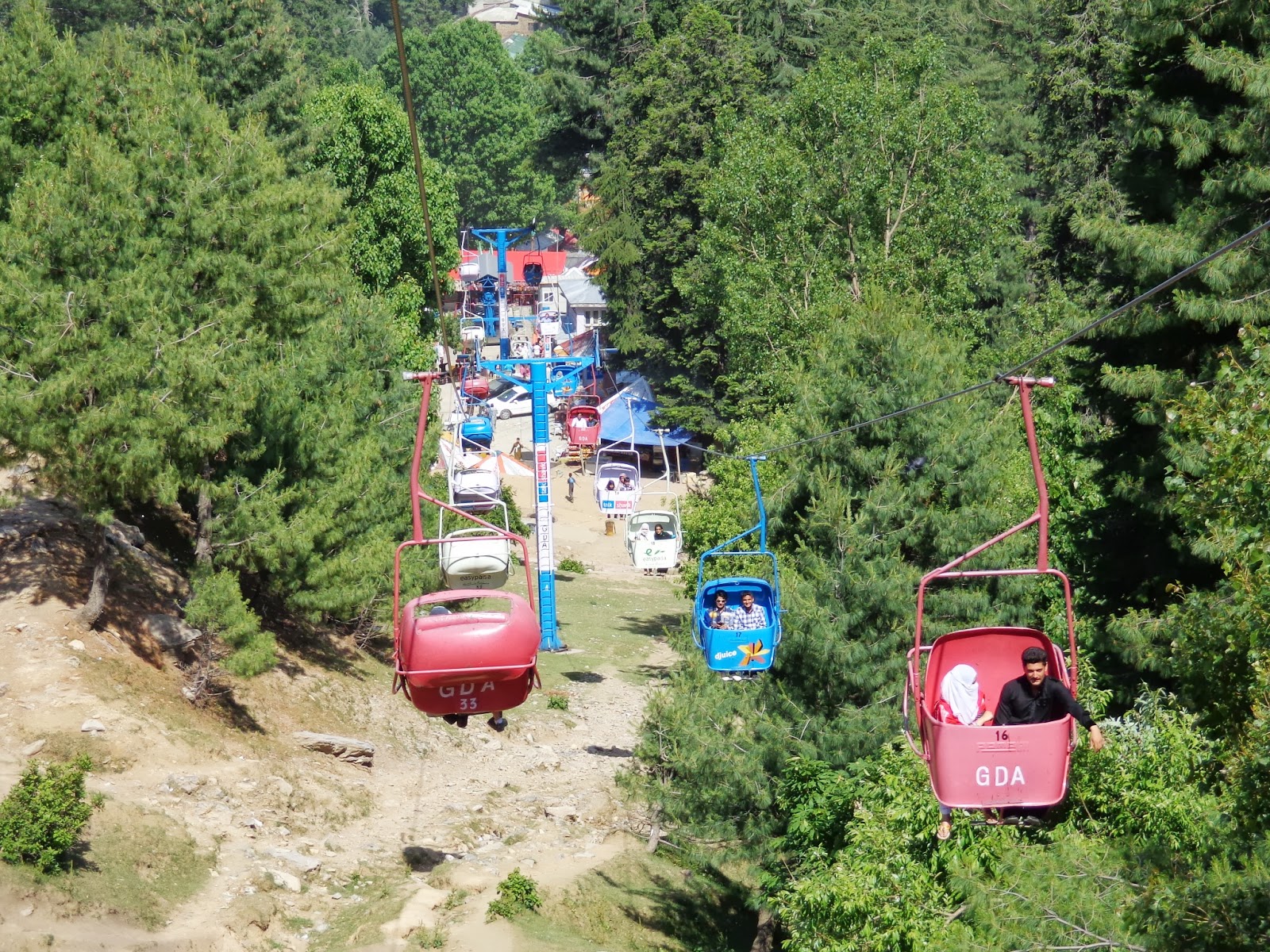
I'm not sure the view from the top was worth risking life and limb, but it was definitely beautiful. You could get a 360-degree view of the hill-filled Abbottabad district. For those of you paying attention, that is the district that contains the city of Abbottabad, where Osama bin Laden was killed. His compound, however, will never become a tourist attraction because it has been torn down.

The chairlift, on the other hand, is a full-blown tourist trap, complete with hoards of hawkers -- literally. There are quite a few young men who encourage you to pay for the privilege of holding a falcon (okay, it's not a hawk, but still). Others try to put air guns in your hands, so you will pay to pop some balloons. All along the road are villagers with roasted-corn and fresh-coconut stands, and around just about every corner hang rows of carpets, scarves, and shalwar kameez in makeshift showrooms.

You might notice the small windows available for our on-the-road sightseeing. Because of security requirements, all embassy-led trips are taken in armored vehicles. Although you won't see them in any of my pictures, a cadre of police escorted us everywhere, by car and by foot. Not only did they protect us from petty theft, which can occur on the hill trails, but they also helped us cut through the line at the chairlift and through traffic on the roads.
Although it was a little uncomfortable to be catered to in this manner, it was definitely preferable to other transportation options. After all, we could've been precariously perched atop a bus, made even more dangerous by severe switchbacks winding up the mountains. Indeed, we saw a bus that had overturned but luckily had not tumbled off an unrailed precipice.

The roads seemed too narrow to accommodate any volume of traffic, which was particularly heavy on this day because the broader highway to the area had been shut down by a rockslide. Not even the most gloriously decorated bus (left), part of the truck-art tradition in Pakistan, or camel (right) garnered enough attention to get other drivers to yield.


All in all, our first foray into greater Pakistan was a success. We discovered that the local joke -- "Islamabad, a beautiful city just minutes from Pakistan" -- holds some truth. Islamabad is immensely fascinating in and of itself, but it was definitely worth venturing farther afield to get a broader view of the country -- and a respite of cooler weather.
Saturday, June 8, 2013
At the end of my stay in the U.S. capital, I felt as though I were at home in Tashkent (S.Hrg.109)
During the first week of our one-year posting in Islamabad, TJ found out his onward assignment. Although we told close family, we held off sharing the news with others because many factors can cause an assignment to be changed. But now that TJ has been "panelled" and has received his official "cable," we feel comfortable going public with the news: Our next assignment is -- drum roll, please -- Tashkent, Uzbekistan.
Why not Europe?
So, you might be asking: What happened to getting a plumb post as a reward for volunteering to go to Pakistan? This means you are old enough for us to finally have "the talk." It's mainly this: There are no guarantees in the Foreign Service; a diplomat agrees to "worldwide availability" for a reason. This is something TJ and I are well aware of. Although it would've been nice to land in Europe, that is not the reason TJ applied to come to Islamabad, nor is it the reason that I supported his decision. Obviously, the reason was the money. I kid, I kid. It was because of the chance to witness the complex nature of global relationships in Pakistan, as I explained in a previous post.
There are two ways a diplomat can get a leg up after going to a less desirable post. First of all, he or she can bargain for a linked assignment, basically arranging his or her onward assignment in conjunction with the next assignment. However, there are only so many linked assignments available, and by the time TJ was bidding, they were all used up. The second way is to lobby for an early handshake, in which, during the regular bidding cycle, a consulate or embassy is allowed to offer the position to someone before everyone has even submitted bids for assignments.
Why Uzbekistan?
TJ actually received an early handshake for Tashkent. He found out well before others in his bidding cycle, the winter cycle, that he would be given the job. Speaking of bidding cycle, linked assignments can be used to obtain any position, as long as it matches up with the person's schedule for posting and training; on the other hand, early handshakes can be used only with those positions on a person's bid list. And therein lies the rub: TJ's bid list did not include many posts that people would consider "plumb." The closest one to Europe was in Kiev, Ukraine (incidentally, although the city appealed to us, the position did not fit).
We looked at a lot at posts in South America. Many of them fit TJ's schedule because, with his Spanish, he would not require much training before proceeding to his onward assignment. He considered many posts in Washington, DC, for the same reason. But in the end, he decided to take a chance on Tashkent because it was mix of a fascinating place to live and an interesting position to work. And there are absolutely no concerns or complications about whether Sage and I can go with him. And yet still, I'm sure you have more questions ...
No really, why -- wait -- what -stan was it again?
Uzbekistan, which won its independence from Russia in 1991. Originally, it joined the Commonwealth of Independent States with the surrounding "Stans," but it withdrew in 1999 after opposing re-integration. It has had a hot-and-cold relationship with the United States; Uzbekistan opened an airbase to U.S. military operations in Afghanistan, which also threatened its security and stability, but ended the relationship after the United States accused it of human-rights violations, specifically during the Andijan massacre of 2005. Because of its history, the main language remains Russian, with its Cyrillic alphabet, but there is also an Uzbek language, with a Latin alphabet. Most Uzbeks speak both languages, and most read both as well; the literacy rate of the country is over 95 percent. The primary religion is Islam, but not the fundamental kind; it will be especially interesting to compare its brand of secular Islam to the Islam of Pakistan. For example, there is a growing wine industry, and it seems former Russians haven't given up their vodka.
So really, why Tashkent?
Well, besides the wine and the vodka, the city has some other great things going for it. It actually has a decent public-transportation framework, which will make travel in the city and beyond better. The historic Silk Road ran through Uzbekistan, and there are four UNESCO World Heritage sites in the country. Plus, Uzbeks have their own fallen Tour de France hero, the Tashkent Terror, but there is still respect for cycling, so I might be able to do some touring on two wheels as well as four. The national cuisine will be great fuel for riding; we ordered palov and lagman from Khiva Restaurant in Islambad, and they were both unique, filling, and delicious. But what it really boils down to is: Why not?
When and how long will you go there?
TJ's position requires Russian, so after leaving Islamabad and going on home leave, we will be in Washington for about nine months while TJ has language training (and I might, too, if there's room in the class). We will not get to Uzbekistan until the end of 2014 or the beginning of 2015, and we will be there for two years. And yes, it is utterly weird to know where we will be three or four years from now, considering we rarely know what we will be doing next weekend.
What will you do there?
You'll have to ask TJ for more details about his job, as they allude me, but I do know he will be working in a different section than he has in the past (consular). As for me, unlike Tijuana and Islamabad, there are international schools in Tashkent where I am allowed to teach, the primary one being Tashkent International School, so I might get back into secondary education. The school is based on the International Baccalaureate program, so I am already thinking about taking some IB training while I'm back in DC.
But then again, I'm showing up in the middle of a school year, so I might have to look for something else, if only temporarily. I might even end up working for the federal government again. My current position as an English language instructor gives me some experience to help in the embassy's Regional English Language Office, and the embassy also has an EducationUSA Advising Center for Uzbeks who want to study in the United States, which is a field I've often considered entering. And of course, I can always see what being a native English speaker can get me into. Or, if all else fails, maybe I'll just find a way to help contribute to the burgeoning wine industry.
Saturday, May 25, 2013
A day in the life of Indus Valley inhabitants (143Cong.Rec.E1132)
Okay, to be fair, I am not exactly an Indus Valley inhabitant. Although the Indus River originates in the Himalayas just north of Islamabad, the city lies on a plateau that is not usually considered part of the ancient valley civilization. But sometimes, when I live overseas, I do feel a little like I am living in a different civilization, so it's no surprise that my friends and family are curious about what I do on a day-to-day basis. The idea of living in Islamabad sounds particularly exotic, I suppose. But I am here to tell you that it is perfectly mundane.
As far as my workday goes, I teach pretty much all day long. I'm sure most people can envision what this looks like (although if attitudes toward U.S. education today indicate anything, some people might not exactly understand all that this involves). Right now, I teach five different types of classes to more than 200 Pakistani employees. This is equivalent to teaching a small public high school, and incidentally, more classes and students than I have taught at some international schools. I act as sole administrator, guidance counselor, curriculum coordinator, building supervisor, and classroom instructor for the entire program; it is exhausting but rewarding.
After a long day in the classroom, I usually decompress at the gym that is located right on the embassy compound. It is well-stocked with all sorts of cardio and weight equipment, which seems surprisingly underutilized. Right outside the gym there is a pool where one never has to fight for a lane, and I can't wait for my goggles to arrive so I can give some laps a go. After the gym, it's off to a quick shower before catching a shuttle home. Riding the shuttle to and from work is pretty much like riding a bus to and from school, if the bus were fully armored.
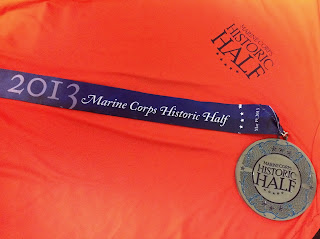
It's hard to work out on the weekends. There are shuttles to the embassy, where I could use the 24-hour gym, but the schedule is not as convenient. And there's a cricket field a few blocks from our house with a nice track for jogging, but our attempts to run there have been thwarted by extreme heat, match play, and nearby gunfire. But you can definitely find ways to stay in shape. TJ and both ran in the local version of the Marine Corps Historic Half (top). Despite temperatures that were already in the 80s by the 6 a.m. race start, we both managed to finish without melting (bottom). A few weeks earlier, we ran in a 10K organized by a local group of international runners, the Islamabad Dashers; we hope to participate in more of their events in the future. TJ has already accomplished the run up the Margalla Hills road, organized monthly by some U.S. Marines, but I'm putting off any decision on making the climb until after the summer.


As far as my workday goes, I teach pretty much all day long. I'm sure most people can envision what this looks like (although if attitudes toward U.S. education today indicate anything, some people might not exactly understand all that this involves). Right now, I teach five different types of classes to more than 200 Pakistani employees. This is equivalent to teaching a small public high school, and incidentally, more classes and students than I have taught at some international schools. I act as sole administrator, guidance counselor, curriculum coordinator, building supervisor, and classroom instructor for the entire program; it is exhausting but rewarding.
After a long day in the classroom, I usually decompress at the gym that is located right on the embassy compound. It is well-stocked with all sorts of cardio and weight equipment, which seems surprisingly underutilized. Right outside the gym there is a pool where one never has to fight for a lane, and I can't wait for my goggles to arrive so I can give some laps a go. After the gym, it's off to a quick shower before catching a shuttle home. Riding the shuttle to and from work is pretty much like riding a bus to and from school, if the bus were fully armored.
It's hard to work out on the weekends. There are shuttles to the embassy, where I could use the 24-hour gym, but the schedule is not as convenient. And there's a cricket field a few blocks from our house with a nice track for jogging, but our attempts to run there have been thwarted by extreme heat, match play, and nearby gunfire. But you can definitely find ways to stay in shape. TJ and both ran in the local version of the Marine Corps Historic Half (top). Despite temperatures that were already in the 80s by the 6 a.m. race start, we both managed to finish without melting (bottom). A few weeks earlier, we ran in a 10K organized by a local group of international runners, the Islamabad Dashers; we hope to participate in more of their events in the future. TJ has already accomplished the run up the Margalla Hills road, organized monthly by some U.S. Marines, but I'm putting off any decision on making the climb until after the summer.


Still without a car, for now we fill our weekends more with chores and errands than day trips. Our housekeeper, who comes twice a week, keeps the place neat: sweeping up dog hair, doing the dishes, and cleaning the toilets. Since our shipments have not yet arrived, we have to wash clothes fairly frequently, and I haven't worked up the courage to ask him to launder my dainties. Our guards are responsible for maintaining the yard and garden, but we have tried to contribute with some seeds, including coriander, dill, and spinach. Already growing inside or just outside our walls are peppers, oranges, bananas, mint, and mangos.
In an attempt to not let food go to waste, we try to shop for fresh groceries frequently. We walk to nearby stores and lug home our purchases in duffle bags. About the only foods you can't find on the local market are alcohol and pork, but we can buy those at the embassy commissary if we so desire. So far, we've found the produce to be of low price and high quality, although you do have to bleach fruits and vegetables to kill any lingering parasites. But by far the best deal is bread; a local baker sells it hot-from-the-oven --including roti, naan, and chapati -- for less than 10 cents apiece.
Of course, one good way to enjoy the weekend is by not cooking. We continue our sporadic habit of Friday pizza night, with deliveries from 14th Street Pizza and Pizza Originale. One Friday, we didn't feel like pizza, but we didn't want to go out either. Just Eat Islamabad is a service that makes ordering delivery even from Urdu-speaking establishments easy. We decided to get a taste of TJ's next assignment (more on that in another post) by getting some Central Asian takeout from Khiva Restaurant. One excellent meal we ate at a restaurant instead of in front of our TV was excellent curry and daal from The House of Bombay.
We do have cable and internet at home, and like any home entertainment abroad, the offerings are interesting. Both YouTube and Buzzfeed are blocked online, which has made me realize just how many links posted on Facebook actually direct you to one of these sites, regardless of the URL. On TV, most of the channels are from India, but we do get some international offerings, like National Geographic, Animal Planet, and HBO, but even those have a South Asian bent. The primary movie offerings are action, mostly superheroes and kung-fu masters. This is good because kissing scenes are deleted, which makes for some confusing transitions in romantic comedies. Curse words regularly accepted by the FCC are bleeped, and I swear I even saw a reference to killing a cow, held sacred in Hinduism, beeped over.
There is no lack of entertainment outside of the home either. Cultural groups like the Asian Study Group and Kuch Khaas often hold public art, music, and nature events. We managed to get to a folklife festival at Lok Virsa, where we watched regional craftsmen create their wares before our eyes. But if you prefer to stick to American culture, the employee association at the embassy offers plenty of activities, including yard sales, sports tournaments, and karaoke nights. We recently threw our hat into a happy-hour trivia competition; we didn't win, but the free appetizers were prize enough.
The other embassies open their activities to the diplomatic community as well. In just the next few weeks, there are chess, soccer, and pétanque tournaments; salsa and Bond film nights; and even a play featuring an international cast. One weekend, we sipped Moosehead while wathcing a street-hockey tournament at the Canadian Embassy. More recently, we managed to snag tickets for the British High Commission's Burns Night (left), the annual dinner devoted to the Scottish poet, including his love of the lassies and haggis (right). In addition to dinner and speeches, the night included Scottish dancing and a dramatic reading of Burns' poem "Tam o' Shanter."
In an attempt to not let food go to waste, we try to shop for fresh groceries frequently. We walk to nearby stores and lug home our purchases in duffle bags. About the only foods you can't find on the local market are alcohol and pork, but we can buy those at the embassy commissary if we so desire. So far, we've found the produce to be of low price and high quality, although you do have to bleach fruits and vegetables to kill any lingering parasites. But by far the best deal is bread; a local baker sells it hot-from-the-oven --including roti, naan, and chapati -- for less than 10 cents apiece.
Of course, one good way to enjoy the weekend is by not cooking. We continue our sporadic habit of Friday pizza night, with deliveries from 14th Street Pizza and Pizza Originale. One Friday, we didn't feel like pizza, but we didn't want to go out either. Just Eat Islamabad is a service that makes ordering delivery even from Urdu-speaking establishments easy. We decided to get a taste of TJ's next assignment (more on that in another post) by getting some Central Asian takeout from Khiva Restaurant. One excellent meal we ate at a restaurant instead of in front of our TV was excellent curry and daal from The House of Bombay.
We do have cable and internet at home, and like any home entertainment abroad, the offerings are interesting. Both YouTube and Buzzfeed are blocked online, which has made me realize just how many links posted on Facebook actually direct you to one of these sites, regardless of the URL. On TV, most of the channels are from India, but we do get some international offerings, like National Geographic, Animal Planet, and HBO, but even those have a South Asian bent. The primary movie offerings are action, mostly superheroes and kung-fu masters. This is good because kissing scenes are deleted, which makes for some confusing transitions in romantic comedies. Curse words regularly accepted by the FCC are bleeped, and I swear I even saw a reference to killing a cow, held sacred in Hinduism, beeped over.
There is no lack of entertainment outside of the home either. Cultural groups like the Asian Study Group and Kuch Khaas often hold public art, music, and nature events. We managed to get to a folklife festival at Lok Virsa, where we watched regional craftsmen create their wares before our eyes. But if you prefer to stick to American culture, the employee association at the embassy offers plenty of activities, including yard sales, sports tournaments, and karaoke nights. We recently threw our hat into a happy-hour trivia competition; we didn't win, but the free appetizers were prize enough.
The other embassies open their activities to the diplomatic community as well. In just the next few weeks, there are chess, soccer, and pétanque tournaments; salsa and Bond film nights; and even a play featuring an international cast. One weekend, we sipped Moosehead while wathcing a street-hockey tournament at the Canadian Embassy. More recently, we managed to snag tickets for the British High Commission's Burns Night (left), the annual dinner devoted to the Scottish poet, including his love of the lassies and haggis (right). In addition to dinner and speeches, the night included Scottish dancing and a dramatic reading of Burns' poem "Tam o' Shanter."


So yeah, Islamabad is just like any other city -- it is what you make of it. Some days, we take advantage of the immense number of opportunities to enjoy our surroundings. Other days, we spend the day sitting at home on the computer, possibly writing a blog post. Such is life in our civilization.
Saturday, April 20, 2013
Mountainous region of Pakistan lies at the foothills of the great Himalayan Mountains (151Cong.Rec.E2555)
This week has been full of security advisories about blocked paths to and from the U.S. embassy. Mainly, the advisories have been because of protests over recent actions against former Pakistani president Pervez Musharraf -- who returned from self-exile to run for president again, only to be denied a place as a candidate then be arrested on terrorism charges. One demonstration began at the office of Musharraf's party, the All Pakistan Muslim League, in a market near our house.
The marches to the Supreme Court, also conveniently located between the embassy and our house, aren't so much dangerous as large enough to make roads impassable. (And lest you are tempted to fear for my life, I point out that one of the most recent advisories was about a road closure near the British high commission, because of the Queen's birthday celebration.) The road closures, which only compound the craziness of Islamabad traffic, are enough to make you head for the hills.
The Margalla Hills, that is; these foothills of the Himalayas stretch along the northern edge of the city. A national park within the hills features miles of interconnected trails. Sadly, it's getting pretty hot to hike them, but we managed to squeeze in two trails before the summer heat hits full-force. We took on Trails 3 and 5, two of the most popular trails, on back-to-back weekends.

For our first foray, we picked Trail 5, mainly because the trailhead is closest to our house. I found out only later that this is the more difficult of the two trails, especially when you take the path along the steep and scraggly fire break (left). To be honest, most of the trail is precipitious, and little of it is easy on the feet, with all the rocks to navigate (right). My hiking boots have not yet arrived in our shipment, so I hiked in tennis shoes, and my arches definitely felt it the next day.


Having fallen out of shape during home leave, this was not perhaps the best introduction back into physical activity. But I managed to make it, albeit slowly, to the lookout where could see the expanse of Islamabad (top), including Faisal Mosque, the largest mosque in Pakistan (bottom left), and Rawal Lake, a man-made reservoir that collects water from Margalla Hills streams (bottom right).


At the lookout, it was clear that we hadn't made it to the top, as we saw a higher ridge loom ahead of us. Knowing that TJ was hoping for a glimpse of distant snowcaps, I agreed to push on. Unfortunately, when we reached the top of the next rise, we realized such a vista was blocked by yet another -- and higher -- ridge of hills. However, we had made it to Pir Sohawa, a viewpoint where many hikers stop to lunch at Monal or La Montana restaurants. We felt a little too gritty to enter a dining room, so we grabbed some masala Lay's (almost as good as the new sriracha-flavored potato chips) and sodas from a snack stand before heading back down.

The next weekend, we tackled nearby Trail 3 with a small group. The trail, although just as steep toward the end, was a much more pleasurable walk, mostly because of the colorful flowers, abundant trees, and bubbling springs that the path winds among. Presumably, these are some of the streams that eventually make their way to Rawal Lake.


Despite my better judgment, once we reached the end of the main trail, I joined a couple others in clamoring up a slippery wall of scree to an even higher viewpoint of Islamabad (that's Rawal Lake at the left). A little higher from here, we could've connected with Trail 5 and made a big loop back down, but considering we had hit that trail the week before, we were happy to retrace our steps through the shade of Trail 3.

Save a few village children selling creations woven from grass, there was little hassle or congestion on the paths. And the only risk to my safety was how overworking my quads made going down steps particularly difficult the next day. And yet, strangely, among the many advisories about tensions in the city, not one has made mention of potential tightness in my muscles.
Friday, March 8, 2013
On the highway for the great American road trip (S.Hrg.111-712)
It goes without saying that a road trip solo is much different than one with your spouse. Mainly that, with your spouse, you will have to fight over which radio stations to listen to, and probably will not be allowed to sing along at top volume to any of them, even if you are the driver. The differences multiply when that spouse works for the federal government. Mainly that you have to stick to a pretty strict driving regimen in order to reach your destination by the deadline determined by the powers that be.
When it was just me and Sage, we could go off course to see whatever interesting or silly roadside attraction we wanted. With TJ, there was no time to see the largest groundhog sculpture in the country. Mostly, we could stop only to eat and sleep. Sometimes, we saw something of note when we stopped to walk the dog. On the upside, with a co-driver, you can surrender the wheel and imbibe with some meals. Although a faithful companion, Sage was not helpful in this respect.
Day 1
Our first day on the road took us only from San Diego, California, to Tucson, Arizona, mainly because we spent half the day running last-minute errands: handing in house keys, dropping off a car for shipment, and mailing a visa application. But we managed to eat, of all things, a bratwurst at, of course, Das Bratwurst Haus, a surprisingly authentic German restaurant in Yuma, Arizona, as witnessed through the accent of the Harley-riding cook/owner who chatted with us as we finished some frosty mugs of Weihanstephaner on its patio. Later on, we had a less unusual quaffing experience, at Dragoon Brewing in Tucson, which seemed to be following the lead of many SoCal microbrewers: setting up in an industrial-park garage and inviting a food truck to provide some nutritional absorption for its customers. After driving out of our way to Catalina State Park, only to find it full, we drove even more out of our way to sleep at Gilbert Ray Campground in Tucson Mountain Park. This was a lucky turn of events, considering the park -- unlike Catalina, which was across from a Walmart -- was in the middle of the Sonoran Desert, one of the only sights of note during our first day on the road.
Day 2
For our second day, we set a target of El Paso, Texas, which had been of interest to us ever since we thought we might land in Cuidad Juarez as our first post, instead of Tijuana. We lingered a little too long with a morning dog walk in the desert, so we had to combine our eating and drinking stop. We ended up at Mimbres Valley Brewery in Deming, New Mexico, whose vacant storefronts belied a town that has seen better days. The brewpub, with its satisfying craft beer and spicy BLT, was a lucrative oasis. Our sleeping plans were thwarted again, when Franklin Mountains State Park in El Paso was closed due to construction and dive motels turned us and our dog away at the inn. So we pushed on to a KOA in Van Horn, Texas, where we arrived well into the night. With the long distance, we didn't have time for sight-seeing, so we settled for the sparkle of the border lights of Cuidad Juarez, which stretched even farther than those in Tijuana, a feat I would've thought impossible. On the other hand, Sage's highlight of the day was spying an emu grazing in land adjacent to the KOA.
Day 3
Day 2 of mainly driving was a boon because we arrived that much earlier in San Antonio, Texas, the one "solid" point of interest during our trip. We made it into town in late afternoon, even after stopping to split a brisket sandwich at Coopers Bar-B-Q in Junction, Texas. There, Sage had his moment of sight-seeing when he watched a bunch of hound puppies play in the grass nearby. He happily snoozed in a La Quinta Inn in downtown San Antonio while we explored the River Walk, which was pretty dead, probably because it was Super Bowl Sunday. We had no problem ordering some pints at Esquire Tavern, the oldest bar on the River Walk, or Menger Bar, a replica of the House of Lords Pub in London where Teddy Roosevelt recruited many Rough Riders. We cruised by the Alamo (and all the tourist traps right across the street from the historic fort) before we realized it was getting a little late for dinner, by American standards. Near midnight, we were served up patties and fries at Whataburger by the friendliest fast-food manager I have ever met.
Day 4
Not ready to give up our tourist pursuits, we started our day with some more sight-seeing, in New Braunfels, Texas, a city of German heritage that has a permanent beer-hall structure for its annual Wurstfest. We snacked on kolache, a Czechoslovakian turnover, from Naegelin's Bakery, the oldest bakery in Texas, dating to 1868, before hunting down New Braunfels Brewing. The young brewery wasn't open and didn't appear to have a tasting room anyway, so we headed to Black Whale Pub in hopes of finding some of its offerings on tap. Down the bar was a man who shared, over some pints from Guadalupe Brewing, that he helped start Rogue and was helping start New Braunfels, which was still awaiting some equipment on order from Europe. This potential pathological liar was the first of many characters we met that day. The others were at Sam's Cove near Lake Charles, Louisiana, where a couple interrogated us about why we outsiders were in this out-of-the-way dive bar (and one lady creepily told me that I had nice skin). They did not believe our honest response, which was that we stopped for a beer to escape the rain as we headed from our bayou campsite at Sam Houston Jones State Park to find dinner in town. After downing a few Millers to placate the insiders, we found an open burger shop in nearby Westlake, where a fried catfish po-boy made all the weird go away.
Day 5
Upon leaving Lake Charles, our trip got a little more traditional, at least in terms of food. While stopping for gas outside of Baton Rouge, Louisiana, we decided to venture into Bergeron's Boudin and Cajun Meats down the road. TJ laid claim to the featured boudin po-boy, so I ordered a sausage one. They were both cheap, tasty treats, but not as cheap as the free samples at Tin Roof Brewing, near downtown Baton Rouge. The brewery's tasting room wasn't actually open, but the owner was kind enough to pour us a few four-ouncers anyhow. The beer was tasty enough that TJ bought a six-pack at the gas station down the road, pretty much the only place outside a bar where you can buy the beer. From Baton Rouge, we started our tour up through the Mississippi River Valley. We stopped to walk Sage amid the fancy river-merchant homes of St. Francisville, Louisiana, the once-capital of the former Republic of West Florida. As we headed farther north, we passed plenty of plantation homes on the way to Natchez, Mississippi, a predominantly French settlement that expanded because of the slave trade. The city's Forks of the Road area was once home to dueling slave markets; now, it is home to only a few educational signs explaining the intersection's sordid past. After seeing the river vista from Natchez, we sought out at campsite at Warfield Point Park, which is right on the river in Greenville, Mississippi. Sadly, the fog was so thick, both at night and in the morning, that we could only see about a foot of its shore, making the park's riverside observation tower obsolete.
Day 6
When the park's caretaker came to collect the fee in the morning, he shared a surprising longing for his hometown of Toledo, Ohio, then assured us that the fog would lift about 10:30 a.m. And indeed, it did, as we pulled out for Oxford, Mississippi, but not before we picked up a quick breakfast from Shipley Do-Nuts (Plan B after we couldn't find the diner run by the caretaker's grandmother). The landscape seemed familiar as we drove through the Delta to Oxford, hometown of William Faulkner. I had a hard time envisioning how he dreamed up the Compson family in this town full of co-eds in leggings and Ugg boots, so I opted to embrace the Ole Miss style, with a tenderloin toaster at the Rib Cage and a bottled Abita at Funky's. After two nights of rain, which left us sleeping on soaked or damp blankets, Sage and I talked TJ into getting a room at a Red Roof Inn in Nashville, Tennessee. After getting too caught up in college life, we had to speed through Memphis, Tennessee, missing Graceland, and Nashville, missing the Grand Ole Opry, to make it to the hotel at a reasonable hour. We didn't want to venture out too far for dinner, so we headed around the corner to Donk's Bar & Grill, where we were only slightly less out of place than at Sam's Cove. But nobody seemed to mind, if we kept to ourselves and tipped well, so we had a beer before we picked up some Taco Bell to eat back at the hotel.
Day 7
On our way out of the Tennessee capital, we took a driving tour of downtown, and the Nashville Farmers' Market looked so inviting that we had to stop. We ate a very early and New Orleansy lunch at Nooleys, where TJ completed his weeklong run of sandwich selections with a muffaletta; I shared my shrimp gumbo and red beans and rice with him. The portions were so generous that we took half of each stew home with us, along with some country bacon we bought at one of the farmers' stalls. We went back to college again when we drove through Lexington, Kentucky, home of Country Boy Brewing, whose tasting room was so lively and friendly that it was hard to leave. We managed to escape at least for dinner, a couple of blocks away at a student late-night standard, the Tolly-Ho Restaurant. Already compounded by self-created delays in previous days, I was forced to drive without stopping, through Cincinnati and Columbus, Ohio, so we could make it home within the government-allotted week timeframe. Luckily, TJ snoozed so I could sing as loud as I wanted, and therefore, we managed to reach my dad's driveway in Mansfield, Ohio, just before midnight.
When it was just me and Sage, we could go off course to see whatever interesting or silly roadside attraction we wanted. With TJ, there was no time to see the largest groundhog sculpture in the country. Mostly, we could stop only to eat and sleep. Sometimes, we saw something of note when we stopped to walk the dog. On the upside, with a co-driver, you can surrender the wheel and imbibe with some meals. Although a faithful companion, Sage was not helpful in this respect.
Day 1
Our first day on the road took us only from San Diego, California, to Tucson, Arizona, mainly because we spent half the day running last-minute errands: handing in house keys, dropping off a car for shipment, and mailing a visa application. But we managed to eat, of all things, a bratwurst at, of course, Das Bratwurst Haus, a surprisingly authentic German restaurant in Yuma, Arizona, as witnessed through the accent of the Harley-riding cook/owner who chatted with us as we finished some frosty mugs of Weihanstephaner on its patio. Later on, we had a less unusual quaffing experience, at Dragoon Brewing in Tucson, which seemed to be following the lead of many SoCal microbrewers: setting up in an industrial-park garage and inviting a food truck to provide some nutritional absorption for its customers. After driving out of our way to Catalina State Park, only to find it full, we drove even more out of our way to sleep at Gilbert Ray Campground in Tucson Mountain Park. This was a lucky turn of events, considering the park -- unlike Catalina, which was across from a Walmart -- was in the middle of the Sonoran Desert, one of the only sights of note during our first day on the road.
Day 2
For our second day, we set a target of El Paso, Texas, which had been of interest to us ever since we thought we might land in Cuidad Juarez as our first post, instead of Tijuana. We lingered a little too long with a morning dog walk in the desert, so we had to combine our eating and drinking stop. We ended up at Mimbres Valley Brewery in Deming, New Mexico, whose vacant storefronts belied a town that has seen better days. The brewpub, with its satisfying craft beer and spicy BLT, was a lucrative oasis. Our sleeping plans were thwarted again, when Franklin Mountains State Park in El Paso was closed due to construction and dive motels turned us and our dog away at the inn. So we pushed on to a KOA in Van Horn, Texas, where we arrived well into the night. With the long distance, we didn't have time for sight-seeing, so we settled for the sparkle of the border lights of Cuidad Juarez, which stretched even farther than those in Tijuana, a feat I would've thought impossible. On the other hand, Sage's highlight of the day was spying an emu grazing in land adjacent to the KOA.
Day 3
Day 2 of mainly driving was a boon because we arrived that much earlier in San Antonio, Texas, the one "solid" point of interest during our trip. We made it into town in late afternoon, even after stopping to split a brisket sandwich at Coopers Bar-B-Q in Junction, Texas. There, Sage had his moment of sight-seeing when he watched a bunch of hound puppies play in the grass nearby. He happily snoozed in a La Quinta Inn in downtown San Antonio while we explored the River Walk, which was pretty dead, probably because it was Super Bowl Sunday. We had no problem ordering some pints at Esquire Tavern, the oldest bar on the River Walk, or Menger Bar, a replica of the House of Lords Pub in London where Teddy Roosevelt recruited many Rough Riders. We cruised by the Alamo (and all the tourist traps right across the street from the historic fort) before we realized it was getting a little late for dinner, by American standards. Near midnight, we were served up patties and fries at Whataburger by the friendliest fast-food manager I have ever met.
Day 4
Not ready to give up our tourist pursuits, we started our day with some more sight-seeing, in New Braunfels, Texas, a city of German heritage that has a permanent beer-hall structure for its annual Wurstfest. We snacked on kolache, a Czechoslovakian turnover, from Naegelin's Bakery, the oldest bakery in Texas, dating to 1868, before hunting down New Braunfels Brewing. The young brewery wasn't open and didn't appear to have a tasting room anyway, so we headed to Black Whale Pub in hopes of finding some of its offerings on tap. Down the bar was a man who shared, over some pints from Guadalupe Brewing, that he helped start Rogue and was helping start New Braunfels, which was still awaiting some equipment on order from Europe. This potential pathological liar was the first of many characters we met that day. The others were at Sam's Cove near Lake Charles, Louisiana, where a couple interrogated us about why we outsiders were in this out-of-the-way dive bar (and one lady creepily told me that I had nice skin). They did not believe our honest response, which was that we stopped for a beer to escape the rain as we headed from our bayou campsite at Sam Houston Jones State Park to find dinner in town. After downing a few Millers to placate the insiders, we found an open burger shop in nearby Westlake, where a fried catfish po-boy made all the weird go away.
Day 5
Upon leaving Lake Charles, our trip got a little more traditional, at least in terms of food. While stopping for gas outside of Baton Rouge, Louisiana, we decided to venture into Bergeron's Boudin and Cajun Meats down the road. TJ laid claim to the featured boudin po-boy, so I ordered a sausage one. They were both cheap, tasty treats, but not as cheap as the free samples at Tin Roof Brewing, near downtown Baton Rouge. The brewery's tasting room wasn't actually open, but the owner was kind enough to pour us a few four-ouncers anyhow. The beer was tasty enough that TJ bought a six-pack at the gas station down the road, pretty much the only place outside a bar where you can buy the beer. From Baton Rouge, we started our tour up through the Mississippi River Valley. We stopped to walk Sage amid the fancy river-merchant homes of St. Francisville, Louisiana, the once-capital of the former Republic of West Florida. As we headed farther north, we passed plenty of plantation homes on the way to Natchez, Mississippi, a predominantly French settlement that expanded because of the slave trade. The city's Forks of the Road area was once home to dueling slave markets; now, it is home to only a few educational signs explaining the intersection's sordid past. After seeing the river vista from Natchez, we sought out at campsite at Warfield Point Park, which is right on the river in Greenville, Mississippi. Sadly, the fog was so thick, both at night and in the morning, that we could only see about a foot of its shore, making the park's riverside observation tower obsolete.
Day 6
When the park's caretaker came to collect the fee in the morning, he shared a surprising longing for his hometown of Toledo, Ohio, then assured us that the fog would lift about 10:30 a.m. And indeed, it did, as we pulled out for Oxford, Mississippi, but not before we picked up a quick breakfast from Shipley Do-Nuts (Plan B after we couldn't find the diner run by the caretaker's grandmother). The landscape seemed familiar as we drove through the Delta to Oxford, hometown of William Faulkner. I had a hard time envisioning how he dreamed up the Compson family in this town full of co-eds in leggings and Ugg boots, so I opted to embrace the Ole Miss style, with a tenderloin toaster at the Rib Cage and a bottled Abita at Funky's. After two nights of rain, which left us sleeping on soaked or damp blankets, Sage and I talked TJ into getting a room at a Red Roof Inn in Nashville, Tennessee. After getting too caught up in college life, we had to speed through Memphis, Tennessee, missing Graceland, and Nashville, missing the Grand Ole Opry, to make it to the hotel at a reasonable hour. We didn't want to venture out too far for dinner, so we headed around the corner to Donk's Bar & Grill, where we were only slightly less out of place than at Sam's Cove. But nobody seemed to mind, if we kept to ourselves and tipped well, so we had a beer before we picked up some Taco Bell to eat back at the hotel.
Day 7
On our way out of the Tennessee capital, we took a driving tour of downtown, and the Nashville Farmers' Market looked so inviting that we had to stop. We ate a very early and New Orleansy lunch at Nooleys, where TJ completed his weeklong run of sandwich selections with a muffaletta; I shared my shrimp gumbo and red beans and rice with him. The portions were so generous that we took half of each stew home with us, along with some country bacon we bought at one of the farmers' stalls. We went back to college again when we drove through Lexington, Kentucky, home of Country Boy Brewing, whose tasting room was so lively and friendly that it was hard to leave. We managed to escape at least for dinner, a couple of blocks away at a student late-night standard, the Tolly-Ho Restaurant. Already compounded by self-created delays in previous days, I was forced to drive without stopping, through Cincinnati and Columbus, Ohio, so we could make it home within the government-allotted week timeframe. Luckily, TJ snoozed so I could sing as loud as I wanted, and therefore, we managed to reach my dad's driveway in Mansfield, Ohio, just before midnight.
Subscribe to:
Posts (Atom)