Sunday, July 28, 2019

The United States won agreement ... in Porto, Portugal (S.Hrg.108-19)

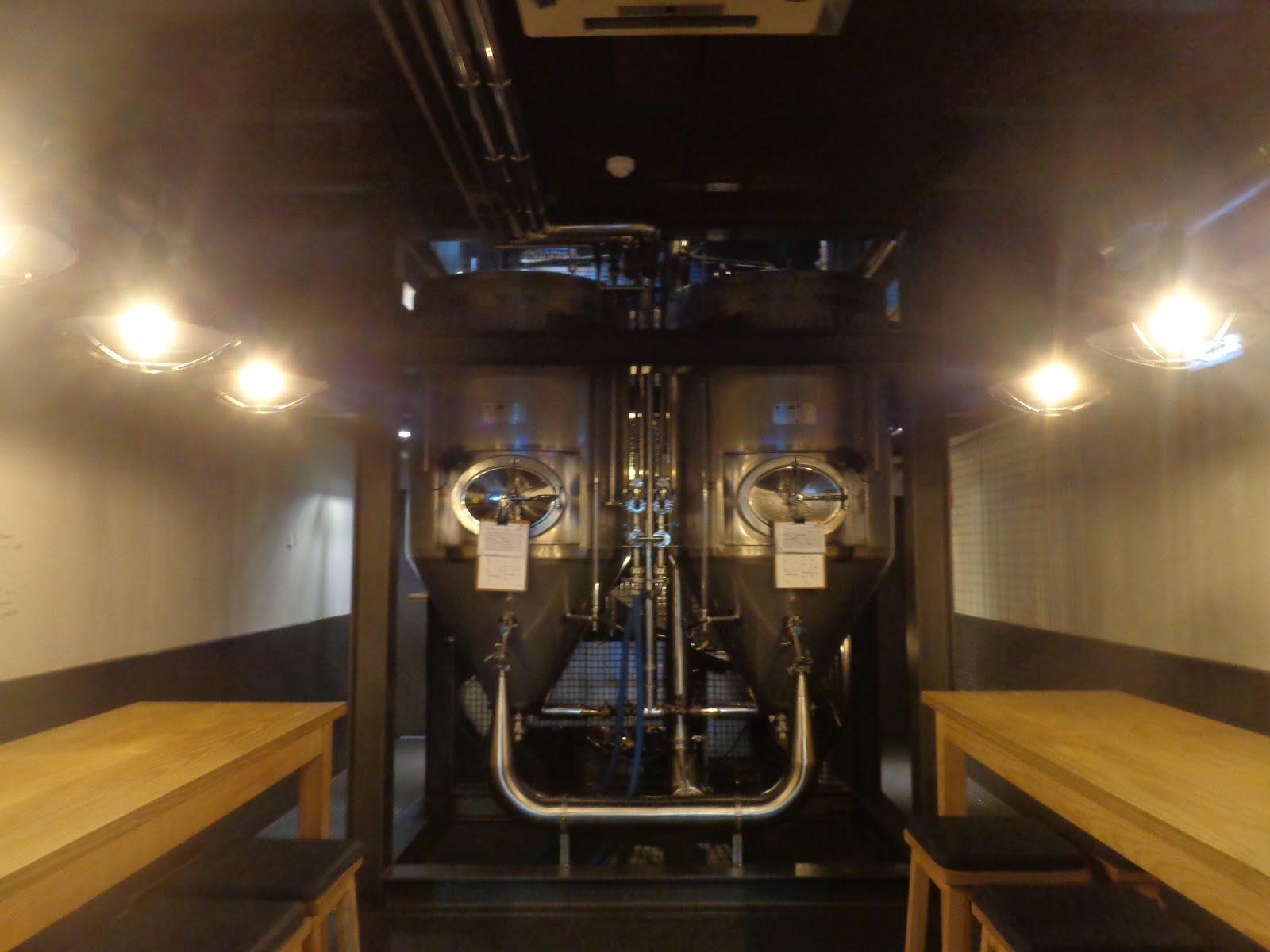
Portugal is famous for wine, but after five days of biking, I was craving some beer instead. So shortly after I was dropped off at my guesthouse in Porto, I headed out to explore the local craft-beer scene. That first night, I visited the most mass-market watering hole, Nortada Brewery, where I downed a thirst-quenching IPA (left). At the more intimate Fabrica Picaria, I enjoyed two happy-hour half-pints: Black Weiss and Golden Brown (right). 
 
Throughout the next couple of days I hit a bunch of beer spots. At Armazem, I enjoyed a Colina IPA from Duque Brewery (top left). The low-key bottle shop is right around the corner from Letraria, which has a lovely, leafy garden, where I had a flight of pilsner, weiss, red ale, IPA, dark Belgian, and stout (top right). However, the hottest ticket in town was definitely Catraio Beer Shop, where I fashioned my own flight: a berliner weisse from Sori Brewing, a maibock from Post Scriptum Brewery, a juicy IPA from Letra, and an amber ale from Sovina Brewery (bottom left). The offerings at Carmo Craft Beer House weren't so extensive -- I had Lindinha Lucas Brewery's IPA -- but the view of Carmo Cathedral across the street was exquisite (bottom right).
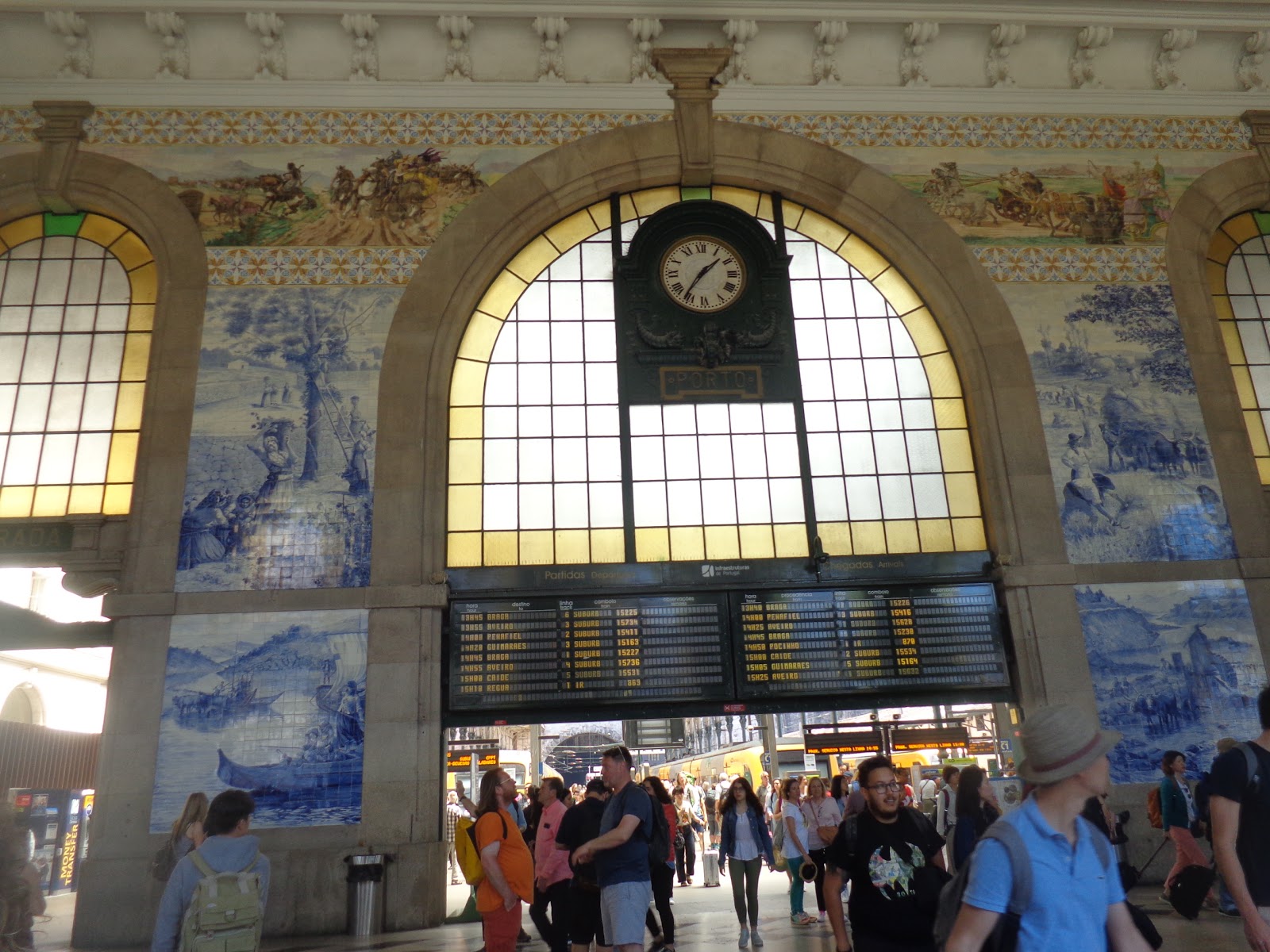
The cathedral is bedazzled with a Porto trademark, azuelos. The blue tiles can be found on many famous buildings, including Sao Bento Station (top left). It's easy to see why the train hub is a source of pride for Porto residents (top right). But if they're going to brag about the azuelos, locals point you to the Church of Saint Ildefonso (bottom left) and the Chapel of Souls (bottom right).
But really, everywhere you look in Porto, you find awe-inspiring architecture, including some tongue-in-cheek public art (top left). The city and country have gone to great lengths to preserve the facades, which include elaborate insignia shields (top right) and intricate geometric patterns (bottom left). Even the more modern structures are chock-full of color (bottom right).
Wandering around town feels like you are walking through a movie set. Not surprisingly, the winding stairs and shelves of the Livraria Lello inspired J.K. Rowling's descriptions of Hogwarts (top left). As a result, the city has become the destination of choice for Potter-themed stag and hen parties (top right). The more classy set can enjoy champagne or coffee at Majestic Cafe, which could easily fool you into thinking you were in Paris (bottom left). But then blocks away, there's a general-goods store that seems to be from Main Street U.S.A. (bottom right).
Porto pulls its street props straight out of central casting as well. The traditional trams are beautiful both outside (top left) and inside (top right). They get pretty packed by sightseers taking the riverside line to the coast. Luckily, I beat the rush, so the lighthouse seawall was sparsely touristed (middle left). The banks by the marina, however, were full of net-mending fisherman recovering from their morning outings (middle right) and coffee-drinking youths recovering from the night before (bottom). 
I suspect the post-partiers go downriver to escape the crowds in the central old city, which is known for its cotton-candy houses clinging above the river (top). They are stunning close-up, but I preferred to take in the whole waterfront from the Luis Bridge, whose two levels provide great views of both the downtown Ribeira district (bottom left) and as well as Vila Nova de Gaia city on the opposite bank (bottom right). 
That area, not actually part of Porto municipality, is home to the port houses whose cellars attract wine aficionados. Tourists are enticed in by the rabelos anchored outside the port producers, which number in the double digits (top). Not knowing how to choose, I went on the recommendation of my guesthouse owner, who pointed me to Calem due to its small museum (middle left), which is free as part of an entertaining and informative tour (middle right). The tour concludes with a tasting of three ports: white, 10-year tawny, and late bottled vintage (bottom left). At Ramos Pinto, I was too late for a tour, but it still offered reasonably priced flights. I opted for one that had the same three types as Calem, plus a 20-year tawny and a collector's reserve (bottom right). 
With the amount of free-flowing alcohol, it's no surprise that the Portuguese offer filling food to soak it all up. I couldn't pass up a snack of fresh-from-the-oven Pasteis de Nata from Manteigaria (top left), even though one of the tasty tarts, authentically prepared at a bakery around the corner, was included with each breakfast at Sao Luis Guesthouse (top right). Also a short walk from the guesthouse was Casa Guedes, a working-class institution that serves delicious pork-knuckle sandwiches from a busy lunch counter (bottom left). Before my port tastings, I headed to Brasao, so I could build a good base with the local specialty francesinha, which I tried to wash down with Sovina's IPA but couldn't fully finish (bottom right). 
Luckily, hilly Porto gives you many opportunities to walk off the calories. Unfortunately, many of those strolls take you past gelato stands that are hard to pass up (top left). I did manage to resist the gourmet food-hall dishes at Mercado Beira Rio (top right) and the raw market-stall offerings at Mercado de Sao Sebastiao (middle top left). The fish stands are adjacent to the city's main cathedral, whose entrance is guarded by a statue of Vimara Peres, the first ruler of Portugal (middle top right). The church is one of the main tourist sites in Porto, along with Clerigos Tower (middle bottom left). I skipped waiting in the two-hour line to climb to the top, opting to gaze upon it and the Town Hall's bell tower instead (middle bottom right). To be sure, the best part of my walking was finding a back street with nary a tourist in sight (bottom). 

Sunday, June 30, 2019

Bottle of Tawny Port Wine, Bottle of Colheita Port Wine (71FR45603)

The second part of my cycling tour took me from medieval villages to wine country. I was already at a higher altitude, so my fourth ride was supposedly mostly descent, but I did have to climb some at the start. But as I passed grape vines in the panorama, I didn't mind (top left). And it certainly wasn't a bother to share a bed of wildflowers with some bees when I stopped for a snack (top right). I knew it was all downhill when I saw Douro Valley in the distance (bottom left). The next day's route included a visit to Pinhao (bottom right), but I was feeling invigorated enough that I took a detour there, so I could take it easy on my final ride. 
Plus, I wanted to make sure that I had time to take a boat tour along the Douro River (top left). It's easy enough to see the waterway by bike or car, but it seemed romantic to go by rabelo, the boats once used to transport port barrels downstream (top right). I only took an hour-long cruise, halfway upstream past some remote vineyard estates (bottom left). A couple times, we were passed by larger ships doing multi-day excursions the length of the river (bottom right).
 
When I got back to dock, I took a short stroll through the town, pausing to look at the mosaics on the train station, another convenient way to reach the region (top left). I made a more leisurely stop at Xtreme Douro, where I had my first pasteis de nata with a glass of white (top right). Only one glass, so I could make the 10-mile ride to Hotel Folgosa, where I was given a generous welcome gift of tawny port (middle left). The village doesn't have much in the way of restaurants, so the hotel directed me around the corner to neighborhood hangout La Bamba, which offered a liberal helping of local specialties, including olives and crusted cod (middle right). Legs tired and belly full, I fell asleep with my balcony door open, enjoying the lapping of the river and the twinkling of Covelinhas (bottom).
Quite frankly, I was a bit frightened of my fifth and final ride because I knew that, from my hotel, there was nowhere to go but up. Actually, I could have cheated and skipped the climb, but the uphill grade turned out to be not too overwhelming (top). And downtown Tabuaco was a pleasant midway point in the loop, with its refreshingly green park (middle left), adjacent to yet another pillory surrounded by more mosaics (middle right). The view wasn't spectacular but the beer was cold at Cascata Bar (bottom left). The drink and some hail marys fueled me up one more hill before I coasted back down to the valley (bottom right).
My package included a winery tour, but I had some time to kill before my scheduled visit, so I backtracked along the river to Foz do Tavora, a riverside bar featuring reds from Quinta Do Pego (top left). I had just enough time for a glass before I returned to Quinta do Tedo (top right). The vineyard, conveniently located along a national trail, is named for a native bird (middle left). Apparently, they are small and hard to spot, so I focused on the winery's other fauna: a flock of snoozing farm dogs (middle right). Before I could pet them awake from their slumber, the tour began, first with a demonstration of historical methods of grape collection (bottom left). Then we were allowed to view the old, wooden vats still used to ferment the wine (bottom right).
 
But let's be honest, I was there for the booze. I heartily enjoyed my trio of ports and even snagged the leftovers of a less-imbibing tablemate (top left). That evening, the decadence continued, albeit sans dining companion, at DOC, where I indulged in a white-port martini to start off my meal, alongside some complimentary curry popcorn (top right). I opted for the "essence" tasting menu, which included seven dishes. All of them were Instagram-worthy, but I will share just two of my favorites: raw egg and alheira sausage adorned to look like a forest floor (bottom left) and lemon cake and sorbet with honeycomb (bottom right).
I guess, technically, my last ride was to Regua, my designated pickup point. But the 10 miles downhill along the river hardly seemed strenuous (top left), especially considering it ended at a museum about port (top right). The Douro Museum was more academic than I expected. The standard tour takes you past restoration rooms (middle left), where workers preserve wine-related records in climate-controlled archives (middle right). The visit concludes on a riverview patio, which some resident roosters have made home (bottom left). Immune to their crowing, I enjoyed my free glass of port, relishing the last moments of an inspiring respite (bottom right).