Monday, November 20, 2017

Hundreds of house boats that line the canals in and around Amsterdam (A111D5 NISI PUBLICATIONS)

Sometimes, you have such a good friend that when she tells you that you should run a race in the Netherlands, you trust her so much that you say yes without thinking much about the commitment. So, a few weeks ago, after absolutely no training regimen, I landed in Amsterdam on a Friday night and settled into an AirBnB near Olympic Stadium. With race day a day away, we started an extended warm-up on Saturday morning by walking through the city. 

As you might know, the Dutch are avid cyclists, so we had to dodge a lot of wheels, even on the sidewalks (top left). The city is so bike-friendly that it has parking garages just for cycles (top right), but they still seem locked to every available accoutrement. Much to my delight, the Dutch are equally obsessed with pastries, so there were not enough racks for bike-riding visitors to Le Fournil de Sebastien, down the street from our apartment (bottom). The bakery smelled delicious, but my stomach was impatient, so we got breakfast at Bagel Nosh instead.
 
We were blessed with excellent roaming -- although not really running -- weather, so we probably completed a 10K just by walking amid the city's canals, classified as a UNESCO World Heritage Site (top left). Lots of people were getting tours via the waterways themselves (top right), but we were satisfied with our streetside vistas of the coming autumn (bottom left). Even when darkness obscured the tinted trees, the city was alive with color (bottom right).
We didn't have much of a tourist agenda, but we did manage to stumble upon some Dutch tidbits. In Rembrandt Square, we walked among statues based on the painter's subjects (top). At the Floating Flower Market, we passed tons of tulip bulbs -- and kilos of marijuana starter kits (bottom left). We were requested not to take pictures in Begijnhof, formerly a nun-like community of devout women and still now a private community of single women, but I couldn't resist one piece of documentation (bottom right). It was the only rule I broke while in Amsterdam, I swear.
Speaking of famous women of Amsterdam, the day after the race, we stretched our legs by walking to the Anne Frank House (left). Unfortunately, tickets to the house were unavailable, so we had to settle for seeing a memorial statue of the young writer in front of Westerkerk, which is right around the corner from the house (right).
But of course, the main event of the weekend was the TCS Amsterdam Marathon. Races started by the stadium that hosted the 1928 Olympics, the first games in which women were allowed to compete in certain events, like gymnastics. It was also the first Olympics to feature a symbolic fire, the vessel for which could be seen from the starting line (left). I opted to run the half, so I was able to watch TJ, my friend, and the elite runners take off (right). No Olympics records were broken, of course, but competitors set both a new track record, 2:05:09, and a new Dutch record, 2:08:16. I finished half the course in 3 seconds more time: 2:08:19, earning me 2,393rd place in my category, out of 6,170, and 8,492nd overall, out of 15,508.
The best part about running -- and really the thing that makes it worthwhile for me -- is the fueling. For carb-loading before the race, we went to Italian restaurant Savini, where I had truffle ravioli; Frietsteeg, where I faced option overload with the many mayonnaises that I could get to accompany my fries; and the Foodhallen, where I went with salty ramen (top). Our immediate post-race dinner was from the neighborhood Indonesian carryout, Warung Tegal, chosen for its close proximity and "big meals." We set our sights on traditional Dutch food for our final meal in country. At La Falote, chef Peter van der Linden sat at our table doing prep work in between making us delicious food, including split-pea soup, or snert, and smoked herring salad as starters (bottom left) followed by beef stew and stamppot as mains (bottom right).
The only thing better than fueling is prehydrating and rehydrating. We had to be careful about visiting too many brown cafes before the race, but we did stop by Cafe Bos, a bar along the route that bills itself as "home of the Amsterdam Marathon" and that was sponsoring a runner (top left), and Het Elfde Gebod, or the 11th Commandment, a craft-beer bar near the main train station and across from Sint-Olofskapel (top right). But my favorite place was In de Wildeman, which maintained a brown-cafe vibe (bottom left) but also had a highly curated on-tap list, including an old favorite from London: Kernel Brewery (bottom right).
 

Saturday, October 21, 2017

People bicycle ... to visit points of interest, to be healthy, and because it’s fun (77FR39927)

Ever since I was young, I wanted to do the Great Ohio Bicycle Adventure, or GOBA for short. After my mom got even more into long-distance cycling, I had always hoped that we would be able to do it together some day. But I let life get in the way. When GOBA came through Mansfield in 2014, I made a pact with myself that I would complete the ride with her beside me in spirit. So when I found out I would be doing home leave alone with very few obligations, and it would coincide with the 2017 ride, I took it as some sort of sign -- and signed up, even though I had limited experience with multi-day, long-distance cycling.

I squeezed in as much training as I could before my bike was packed out from London, but still, I set my expectations low: I just wanted to be able to make it through the five days of mandatory riding, 40-60 miles each; I wouldn't beat myself up if I didn't feel up to doing the optional loops on rest days. After all, I wouldn't have anyone pushing me through, as I registered not knowing a single soul who would be participating. My only friend at the beginning of the week was a horse in the barn adjacent to my tent in Findlay (left). Throughout the week, I pretty much rode by myself, but nonetheless, by the last day of the event, I had made some great non-equine friends (right).
I had anticipated a lot of the ride's aspects, particularly in terms of sore body parts, but I wasn't prepared for the sheer amount of food I would be eating. The morning of the first ride, I filled up on Chris's Cakes (left). I quickly realized I don't like riding on a full stomach, so for the rest of the week, I popped a granola bar for breakfast, saving my major fueling for the rest stops. During the first optional loop (yup, I ended up riding every day, for a total of around 350 miles), I discovered exactly how delicious a popsicle can be (right).
The rest stops are remarkable for the refreshments -- I think I ate four shredded chicken sandwiches over the course of three days -- but they are also hallmarks of the camaraderie of the ride. Plopping down on a playground picnic table with your hard-boiled egg, you're soon engaged in conversation with an interesting person (left). But if you need a break to get back in gear for the final stretch, you can sip your electrolyte drink as you admire your surroundings (right).
If you get going early enough, it's pretty easy to finish the day's ride with plenty of time to spare to visit some tourist sights. I never got up before 6:30 a.m., but I never made it to the day's destination later than 1:30 p.m. Lots of attractions, such as the American Civil War Museum of Ohio in Tiffin, accommodated riders by opening on off hours (top left). And of course, there are plenty of sights along each day's route; we crisscrossed the rain-flush Sandusky River quite a few times (top right). The Pottersburg covered bridge provided passage not over the river, but over Big Darby Creek (bottom left). Photo ops were a great way to take a break after climbing hills. I decided to take this shot of Mount Tabor after, earlier in the day, I unknowingly sped right past Campbell Hill, the highest point in Ohio, just outside Bellefontaine (bottom right).
My first order of business once I got to town -- after showering, anyhow -- was to set up my tent. Before I got too tired or distracted, I wanted to make sure I had a place to crash. Most days, camping was first-come, first-serve on grassy spots at county fairgrounds. Some locations were more campground-like, such as Hedges-Boyer Park in Tiffin, where I read like two pages before passing out (top left). Often, you were close to your neighbor, but I didn't really mind the cramped quarters, especially during a rainbow in Tiffin (top right) or a sunset in Upper Sandusky (middle). I especially preferred them to sleeping indoors, which we did the last two nights, at Bellefontaine High School (bottom left) and at the Hardin County Fairgrounds (bottom right), because of forecast then actual heavy rains.
 
Most cities provided evening entertainment for riders. As the first (and final) stop, Findlay hosted a participant parade through downtown (top left) that led to an opening ceremony, where awards were handed out for the best costumes related to the ride's Wizard of Oz theme (top right). In Tiffin, we didn't even have to leave camp to hear some tunes because musicians set up in the park's bandshell (bottom left). At the fairgrounds in Upper Sandusky, the venue wasn't as scenic, but the band, Grape Jam, was better, as was the adjacent beer garden (bottom right). In fact, I preferred it to the musical acts at the town's community street festival. But by far, the entertainment award goes to Kenton for its food-truck festival and the Elks Lodge's open performance by Uncaged.
For the most part, though, I entertained myself during the afternoons by hanging out with some fast and forever friends. Familiar faces from Logan's Irish Pub in Findlay reappeared at the Clover Club and MST (Madison Street Tavern) Pub & Grub in Tiffin. By the time I showed up Shotzy's in Upper Sandusky, it started to become clear who I would be hanging out with from then on. By the end of the week, my priority -- sometimes even before showering -- was to find out which bar everyone was going to. The first night in Bellefontaine, we gathered at Brewfontaine (left). But the second night, would it be 68 Grill or the Pincrusher Pub at TP Lanes? (In fact, it would be both.) Not even the weather would stop us in Kenton (right), where after riding about 30 miles in non-stop downpours, I couldn't have been more ready for some suds with buds at Skinny's Tavern.

Sunday, October 8, 2017

Since the abdication of President Yanukovych, the new administration has reflected the will of its people (H.Res.878)

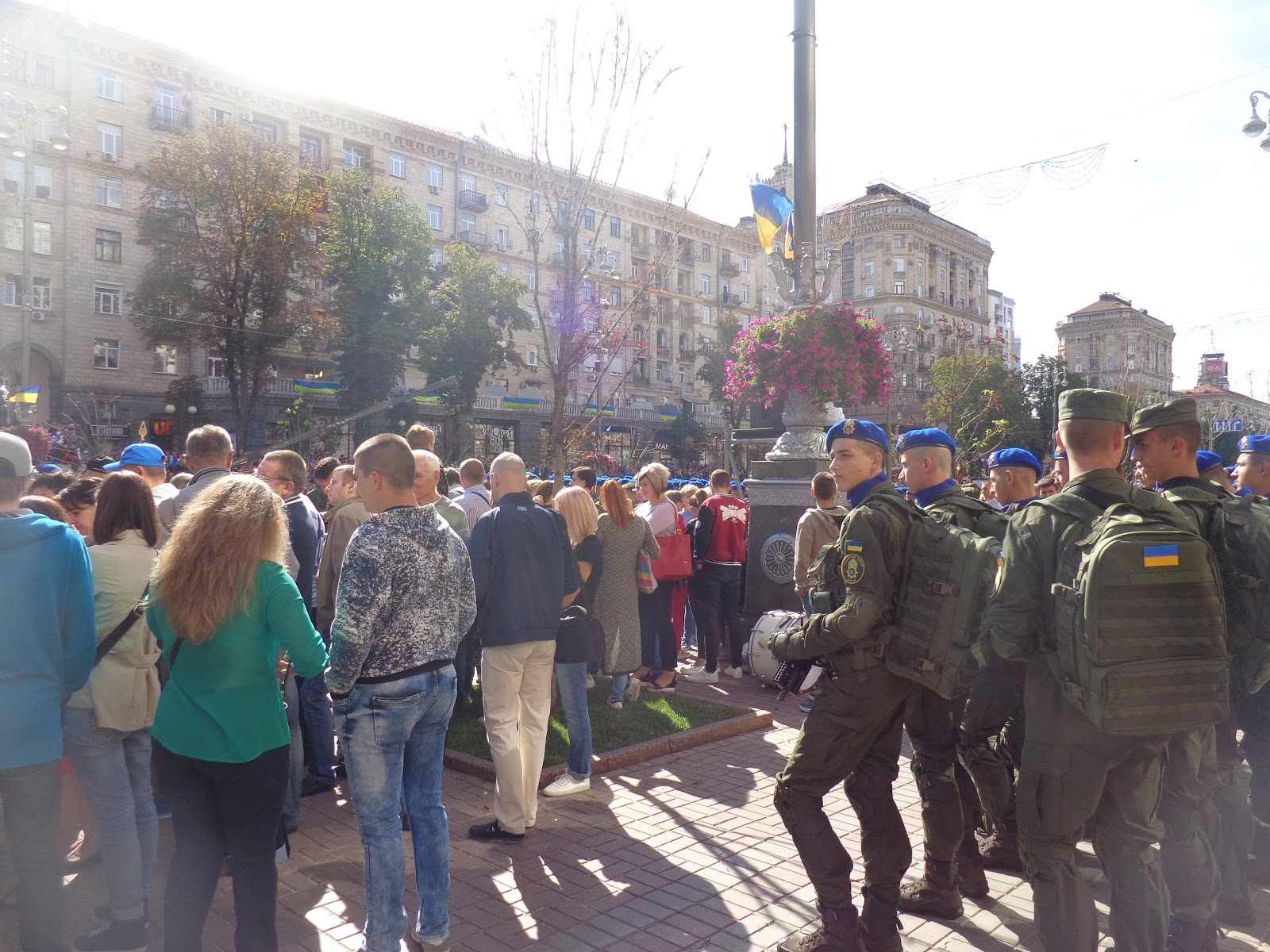
Ukraine's Independence Day snuck up on us, so we didn't have any time to plan a trip during the long weekend. But I was glad we didn't leave because it was interesting to see how Kyivians celebrate their freedom from the Soviet Union, won on August 24, 1991. The 26th anniversary was recognized much like in previous years, with a series of military demonstrations on Independence Square (top). But for the first time, NATO member nations, including the United States, also participated. The troops lined the main boulevard, making it difficult to see the action (bottom left). After craning our necks for a while, we stepped on to side streets, where we could see cultural expressions of national pride (bottom right).
The night before, it was much easier to navigate the main drag downtown, even though it was full of people gathered near Lyadsky Gate, which marks the location of one of the city's medieval gates (left). Standing atop the gate is the Archangel Michael, the patron saint of Ukraine, who also is perched on Independence Monument. Over the weekend, we saw various people dressed up as the "angel of independence," including while we perused the many military machines on display (right). 
We strolled downtown after attending the Independence Day Concert at the National Philharmonic of Ukraine concert hall, a wonderful atmospheric and acoustic location for a music performance (top). The Wings of Dixie, a U.S. Air Force band, really wowed the crowd with some American favorites (bottom left). They nearly brought down the house with their extra-jazzy extended version of "When the Saints Go Marching In" (bottom right).
 
After independence, the country was led by democratically elected presidents: two Leonids, Kravchuk and Kuchma, then two Viktors, Yushchenko and Yanukovych. Viktor Yanukovych was stripped of his title after he fled the country during the Revolution of Dignity. The public protested against the government for many reasons, including Yanukovych's last-minute refusal to sign a NATO association agreement, but they also were displeased that leaders appeared to be diverting government funds to feed their own luxurious lifestyles. 

A lingering sign of this is Mezhyhirya, the estate where Yanukovych lived until he fled in 2014. The estate was built on the site of a former monastery and is now a National Park. The estate's main building, the Honka, was constructed over two years at an estimated cost of $9.5 million (top). Tours of the residence start through a door in the fitness center, where on display in a nearby window are a dummy of Yanukovych and a replica of a solid-gold bread loaf that was reportedly found in his bedroom (bottom left). The tour, guided by a revolution protester who says he lives permanently on the site, ends at the front door of the Honka (bottom right). 
At the start of the tour, within the indoor four-lane bowling alley, you are instructed to don booties (top left), to help preserve what are billed as excessive expenditures, such as intricate hand-inlaid wood floors (top right). Besides the bowling alley, the fitness center includes an indoor tennis court; a full gym, which houses a boxing ring (bottom left); and a spa area, which includes tanning beds, massage tables, hydrobaths, and even a salt cave (bottom right).
 
The fitness center is connected to the Honka via a convenient underground tunnel (top). The residence includes all the trappings of a palace: multiple big-screen TVs and a media room, walk-in closets, bidets, silk carpets, marble statues, crystal chandeliers, and sweeping staircases (bottom left). Surprisingly, the kitchen was nothing more than a small galley, as food supposedly was prepared in the fitness center's industrial kitchen, which we didn't see. Unusually, the house includes a church, and on display in the main living area is a limited-edition John Lennon piano (bottom right). The guide said Muammar Gaddafi, the Libyan leader who fled during the Battle of Tripoli, had a piano from the same series. Unlike Gaddafi, who was killed by rebel forces in October 2011, Yanukovych's whereabouts remain unknown.
The residence is surrounded by pristine gardens. At the front of the house is a manmade lake, alongside which sits a banya and sauna complex (top left). The rear faces the Kyiv Sea, a reservoir formed by the construction of a hydroelectric power plant in the Dnieper River (top right). We boarded golf carts to get the full tour of the estate grounds, which include, well, a golf course and the Galleon, a reception barge that now operates as a restaurant (bottom left). We also stopped at the Motor Museum, which displays dozens of cars from Yanukovych's personal automobile collection (bottom right).