Monday, October 10, 2016

I think it is a story right out of Charles Dickens (148Cong.Rec.S11699)

It wouldn't be right to have TJ's family cross an entire ocean and not show them at least one quaint English village. Due to its location and attractions, we chose Rochester, which has a cute pedestrian high street accessible just steps from the train station (top left). The city is perhaps most well-known as the place where Charles Dickens grew up and died, which has contributed to some cheeky pitches to visitors (top right). A museum to the writer was once housed in the 17th-century Guildhall, but that attraction has since been eclipsed by the theme park Dickens World. Many buildings in the city became the basis of settings in Dickens' works, including Restoration House, which was the model for Miss Havisham's house in Great Expectations (bottom). 
The Six Poor Travellers' House was the inspiration for the short story "The Seven Poor Travellers" after Dickens visited there in 1854 (top left). Dickens inserted himself into The Canterbury Tales-like cast of the work, describing interactions among the characters in the garden (top right) and around the dining table (bottom left). In reality, the building actually operated as an almshouse with spartan bedrooms on offer as cheap accommodation for travelers (bottom right).
The almshouse was started with funds from the will of Richard Watts (top left), who is buried in a place of honor in Rochester Cathedral (top right). The cathedral, the second-oldest in England behind Canterbury Cathedral, is a mix of Gothic (bottom left) and Norman (bottom right) architecture.
 
Up the hill from the cathedral is another Norman-era structure, Rochester Castle (top left). The fortress was built in the 12th century to guard the River Medway crossing (top right). Even a catalpa tree between the cathedral and castle has historical significance (bottom). Dating back to the 19th century, the tree, also known as an American Indian bean tree, is thought to be the oldest of its type in England.
Along the other side of the castle sits one of the oldest pubs in England: The Coopers Arms, arguably the oldest pub in Kent (top left). The title is contestable because, although the building was constructed in the 12th century, it didn't become a pub until the 16th century (top right). We hopped forward a few centuries when we crossed into the more modern side of the high street and stopped at The Flippin' Frog for some craft beer and cider (bottom).
Refueled, we set sail for Chatham Historic Dockyard, which was opened in 1547 during the Tudor era to build ships for the Spanish Armada and was closed in 1984 shortly after it was used as a base to construct nuclear submarines during the Cold War (top left). Many famous ships, including the HMS Victory, were built in Chatham, and some still remain docked on the grounds, including the HMS Gannet (top right). After our day of stepping back in time, we caught the train to get back in time for our dinner reservations at The Brown Dog (bottom), where I put a point on the marine theme by ordering a whole baked sole as my main dish.

Sunday, September 11, 2016

A massive matchbook on a hill in Barcelona (2000 Public Papers 2744)

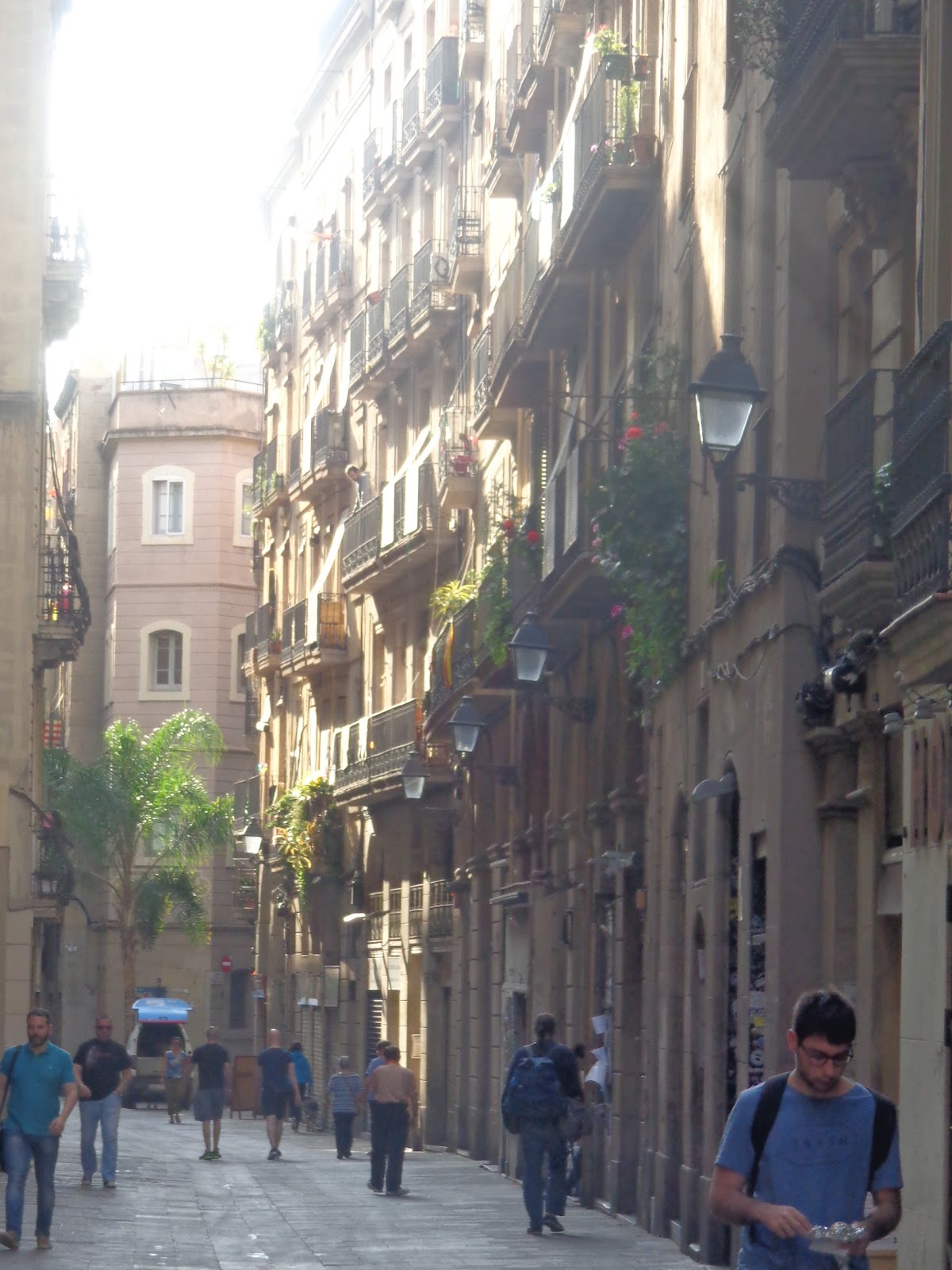
Despite what my first post about Barcelona might indicate, we did actually do some tourist activities besides eating. As much as Catalonia is known for its food, its capital is probably best known for its art and architecture. So as we walked from cafe to tapas bar to market, I often stopped to gawk at the many streetscapes, especially the pedestrian paths whose green balconies and colored facades were exposed by seeping sunbeams.
But of course, the most famous facades are those of Sagrada Familia, one of seven structures by Gaudi in the city that have been declared a UNESCO World Heritage Site. The main entrance is through the much-photographed Nativity facade (top left). As you enter the nave, it's hard to ignore the dominating sculpture of Jesus on the cross within the apse (top right). At every point in the tour, natural light bestows color on the basilica (bottom left). Then you exit opposite from where you entered, through the Passion facade (bottom right).
 
For an extra fee from general admission, you can get a ticket to visit a facade tower. After an elevator ride up the Passion facade, we emerged to look down upon the Plaça de la Sagrada Familia (top). But we also looked out across the sculptures of the cathedral to other spires, including the Torre Agbar, not to be confused with the Gherkin in London (bottom left). But perhaps our eyes were most trained as we maneuvered back to the bottom via tight spiral stairs (bottom right).
Later in the day, we admired two more Gaudi buildings from the outside: the seashell-like stylings of Casa Mila (left) and the skull-like structures of Casa Batllo (right).
During our visit to the Museu Nacional d'Art de Catalunya (top left), I learned that Gaudi designed not only the outsides but also the insides of buildings. He was able to create interior masterpieces from many materials, but I was particularly drawn to his woodwork, including a writing desk and some intricately carved doors (top right). The museum, housed in the Palau Nacional atop the Parc de Montjuic, is renowned for its art collection but also the huge organ installed in the palace's Sala Oval, which was a primary space for the 1929 World Exhibition (bottom).
Sixty-three years later, the park's peak would become the centerpiece of the 1992 Summer Olympics. The Olympic Stadium is still used for events (left); as we passed by, families were streaming in for a monster-truck show. In the background, the nearby Montjuic Telecommunications Tower mimics the design of the stadium's flame cauldron (right).
From the veranda outside the museum, we and the monuments could gaze back on the central city, including the Sagrada Familia (top left). Alongside the water flowing down to Plaça d'Espanya (top right), we rode escalators to its Magic Fountain, whose spouts are the source of a regular, free, evening light and sound show (bottom left). Fountains are also the central feature of Plaça de Catalunya, the busy square at the intersection of the city's two major streets (bottom right).
One of those streets, La Rambla, leads down to the Gothic Quarter, which envelops the Catedral de Barcelona (left). Unlike the Sagrada Familia, the light inside comes from electricity and reflection, but nonetheless, the atmosphere is illuminating in its own way (right).
Tucked away in a corner a couple of blocks from the cathedral is one of the city's most famous pieces of street art, titled The World Begins with Every Kiss. The close-up smooch is a mosaic made of publicly submitted photos showing "moments of freedom" (left). But of course, to truly appreciate the city's contribution to the arts, it is necessary to visit the Museu Picasso, which showcases the breadth of the artist's talent (right). Something about this city just seems to help people tap the depths of their potential. Who knows whether it's the sliced jamon or the sunlit alleys -- or both.
 

Monday, August 29, 2016

Scotland and Catalonia have peacefully sought both greater autonomy and full participation (145Cong.Rec.E975)

From Scotland, TJ and his family headed off to Ireland while I headed back to the rat race. The next weekend, though, we reunited in Spain; they had already been to Madrid before we met up in Barcelona. Traveling is basically an excuse to eat out every meal, and I was a bit behind. I arrived on a Friday night after work, so all we had time for then was a short tapas-bar crawl near our hotel. The next morning, though, we headed straight to La Boqueria market. We beat the arrival of the cruise-ship sojourners, so we were able to see vendors get ready for the rush: slicing jamon (top) and arranging the fresh catch of the day (bottom left). We even managed to find seats at the bar for a typical breakfast: tortilla with patatas (bottom right).
We had to be patient, and a tad aggressive, to get a table Bar Jai-Ca, a petite and packed neighborhood institution known for its seafood (left). We felt very lucky to have stumbled upon it after our first choice of restaurant in La Barceloneta -- Can Maño, a fish tavern -- was closed for the day. It was worth the wait to fill our table and our tummies with a variety of delicious dishes, including some the tastiest grilled octopus I've ever eaten (right).
It felt nice to mix with those "in the know" without being assaulted by hipness, which was how I felt when TJ and swung by Fàbrica Moritz Barcelona in the stylish neighborhood of Sant Antoni. I really enjoyed wandering the brewery itself, seeing how the brand has been revitalized with new equipment, like fermenting vats, in the company's historic factory (left). But the sleekness of the restaurant was overwhelming (right), especially considering the styles of beer on offer weren't that sophisticated.
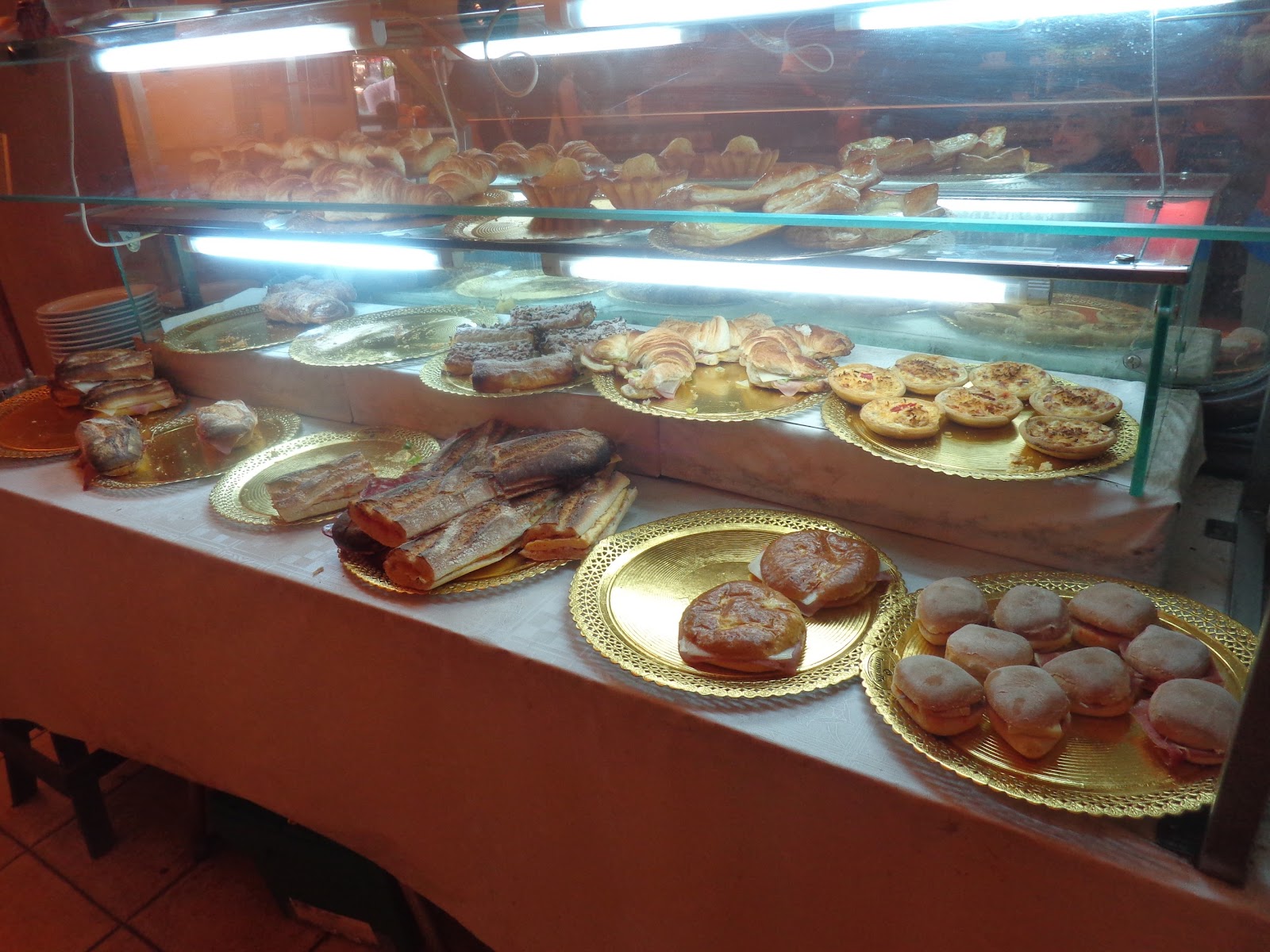
We tracked down another historic workshop for breakfast: Pastisseria Brunells, one of the oldest family-run bakeries in the city (top left). You can order coffee from the bar then choose from a variety of baked treats, both savory and sweet, on the buffet (top right). If you want, you can pick a table with a view of its on-site operations, including a wood-fired oven (bottom). The establishment also sells chocolate it makes, although not on site, at the store next door.
I dragged our crew to another stop for coffee amid the cramped and crooked streets of the Gothic Quarter (left). 4 Gats was once a creativity-inspiring haven for poet Ruben Dario, artist Pablo Picasso, and architect Antoni Gaudi (more on the latter two in an upcoming post). Now it's mainly a capitalism-inducing cafe for tourists seeking a rest from the nearby cluster of tourist attractions (right).
  
One of those attractions is the city's cathedral, where a band was playing on its steps when we passed by. Among the members of the "cobla" were a flabiolist and a shawmist (left). Some tourists but mostly locals were using the cathedral square as a dance stage for the sardana, a traditional Catalan dance performed by groups in circles (right).
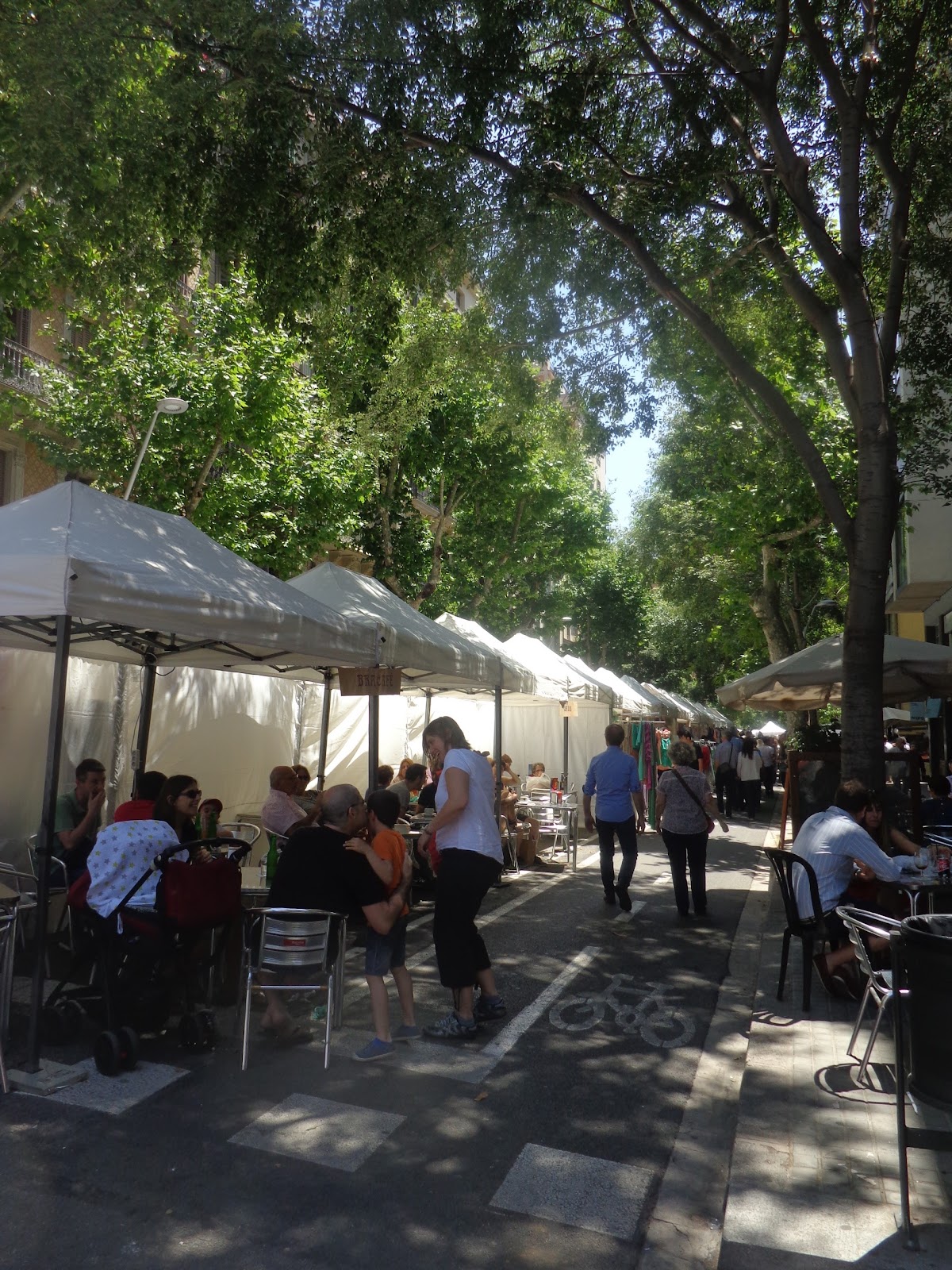
Later on, as we were strolling through the L'Eixample district, we came across another group of cavorting folk dancers (top). Their beer stand was one of many tents filling blocks of a boulevard for a neighborhood festival (bottom left). At various intersections, stages were set up for performances, and sadly, we were just a little too late to catch the gigantes in action (bottom right). 
Spontaneous jigs and enormous puppets aren't the only pastimes we witnessed in the city. Some locals exercising their petanca skills were immune to gaping onlookers in one park (left). On the other hand, and on a balcony, a Marilyn Monroe impersonator was enticing pedestrians along the main drag Las Ramblas to explore the Erotic Museum (right).
 
On such a sunny day, we skipped that kind of indoor culture and headed with what seemed like the rest of the city to the coast, specifically Llevant Beach (left). TJ headed in for a dip while the rest of hung out on the breakwater averting our eyes from topless sunbathers. I wished I could settle in with a book (right), but alas, Sunday evening was closing in, so I had to pull myself away from the sand for my flight back across the English Channel.