Saturday, February 10, 2018

Reporting on alleged corruption in the locality of Olomouc (147Cong.Rec.S13143)

The one metaphorical and literal detour on our road trip occurred as we departed Dresden and headed toward the Czech Republic. At a rest stop right before the border, we noticed drivers lining up to buy vignette stickers that allow you use toll roads. We stopped to buy one, but we had used up all our euros, and the kiosk didn't accept credit cards. We decided to take our chances and cross into Moravia, where we got off at the first exit to seek out said vignette. We stopped at three gas stations, to no avail, so we ended up circling back to Germany, where we got euros out of an ATM and returned to the original rest-stop kiosk.

This entire process set us back a good two hours, so the uncorrupted charm of Olomouc was a welcome sight indeed. After we checked into Hotel Flora, we headed straight to the nearby old center, home of the Holy Trinity Column, a UNESCO World Heritage site (top left). Just like in Dresden, the Christmas market had just concluded, so plenty of lights were still strung near the Town Hall, which features a unique Astronomical Clock (top right). Due to our debacle, we skipped lunch, so we way over-ordered at Hanacka Hospoda, whose hearty fare was clearly popular among the many manly male diners (bottom left). Despite our meat-packed meal, we managed to find room for some liquid dessert right around the corner at Bernard Bar (bottom right).
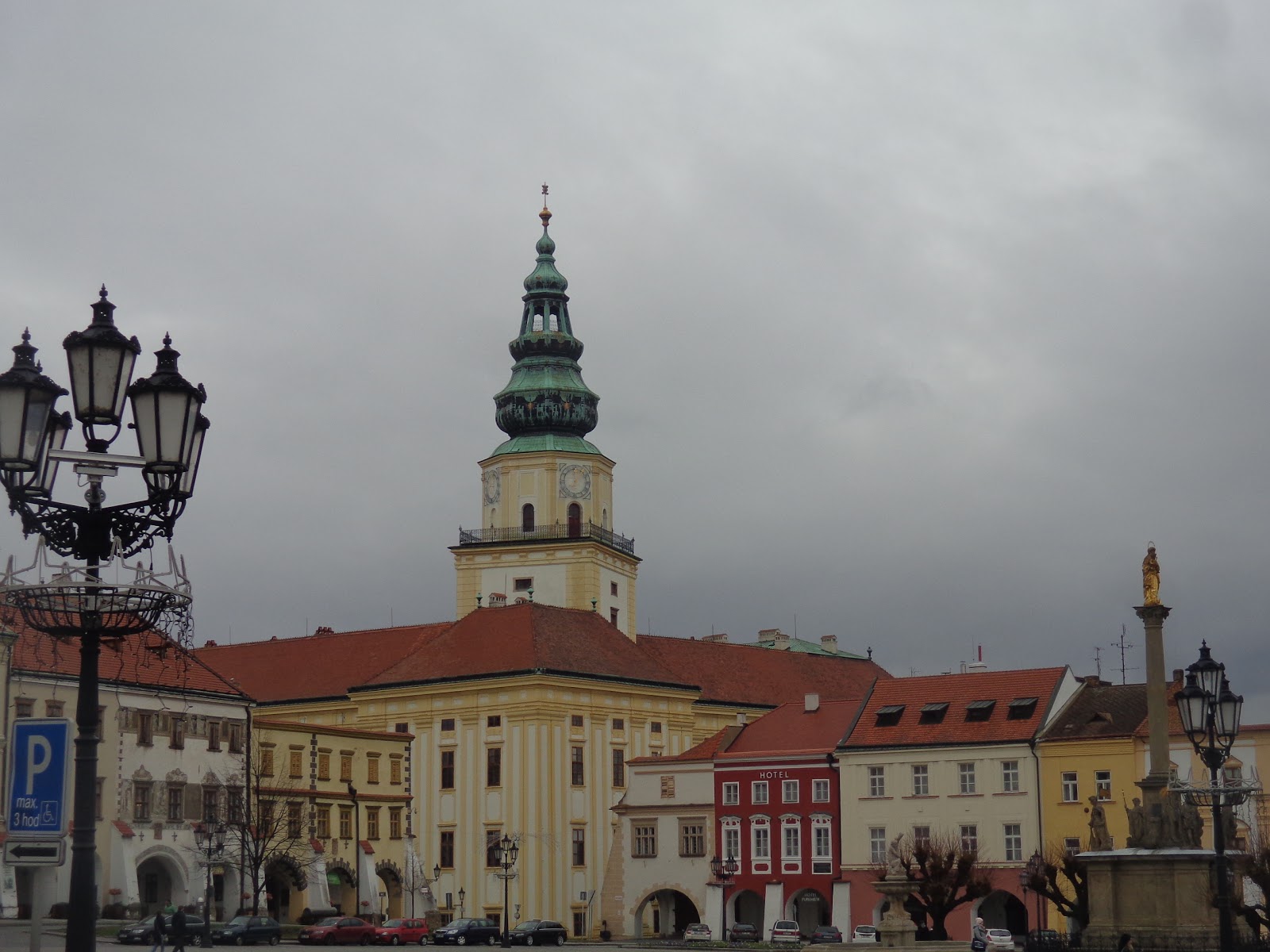
Olomouc's quaintness didn't require a huge time commitment to explore, so for the day, we took off to visit some nearby towns. We started with Zlin, a planned shoe-factory town whose brick modernism seemed even more drearily functional in the day's rain (top left). The baroque stylings of the Archbishop's Palace, a UNESCO World Heritage site, began to clear the fog (top right). But the nearby central square of Kromeriz did the best job of chasing away the gray (middle), especially within the cozy, cave-like confines of Cerny Orel Brewery (bottom left). Particularly invigorating was the fact that the restaurant's set menu came with a chance to serve yourself from a communal bowl of kapustinica (bottom right).
 
Back in Olomouc, we sampled two more breweries -- and struck out with a third. We took a bus out to the suburban Chomout Brewery, but it was closed, presumably because of the holidays. Perhaps because of its namesake, St. Wenceslas Brewery was still holding strong to the Christmas spirit (left). There, we snacked on some appetizers that made use of the city's famous stinky cheese, tvaruzky. Unfortunately, we did not get to try the establishment's beer spa, which is exactly what it sounds like: soaking in a hot tub full of brew. We waited quite a while to try to the lager at Moritz Brewery because it took some time to fill mugs from the old-fashioned, barely-dripping taps (right). 
As we set off for Slovakia the next day, we made one more stop in the Czech Republic, in the postcard-perfect village of Stramberk (top). Sage frolicked in the fresh snow as we climbed up to the 13th-century castle (middle left). As we scaled the steps down to the central square (middle right), we stopped at a small shop to buy some Stramberk Ears. The local Mestsky Brewery was kind enough to let Sage join us inside as we had some post-hike refreshments (bottom left). A gate, however, prevented dog and man from entering the cellars, which is home to another beer spa (bottom right). 
 

Saturday, February 3, 2018

Dresden was considered to be a safe, "open" city (133Cong.Rec.)

On Christmas Day, we left Krakow and headed to Dresden, in the Saxony region of Germany. Considering the country is quite secular, we figured there would be a better chance of places being open on the holiday. Besides having to check in by machine at B&B Hotel, we were right. There were plenty of people drinking and dining at Brauhaus Watzke (top left). TJ and I enjoyed hearty meals of meat and potatoes, with lard spread and bread on the side (top right). Much to our surprise, when we headed into more central Neustadt, we found fewer people, including at craft-beer bar Zapfanstalt (bottom left). We even managed to snag stools at Lebowski Bar, a small 20-seater or so, of which the Dude would approve (bottom right). 
The first time I ever knew of the existence of Dresden was when I read Kurt Vonnegut's Slaughterhouse Five in high school. When I found that the site was a short ways from our hotel, I requested that we walk the dog there. The complex where the author was imprisoned and beaten during World War II now is home to a convention center, but a cow statue indicates the site's previous incarnation (left). Only a small sign across from the statue explains the events that took place there (right). 
Across from the complex is a large park that annually becomes parking for the city's renown Christmas Market. The festival officially shut down on Christmas Eve, but some gluhwein stands were still holding out (top left). The main square near Frauenkirche was full of similar shacks that were shuttered for the season (top right). As a result, the streets were much less crowded, so we could more easily see the sites in Altstadt, which sadly was delisted as a UNESCO World Heritage site due to the construction of a new bridge. Despite their degraded status, we still marveled at the Royal Residence (bottom left) and the Fürstenzug, a mural along the residence's stables that shows the ruling lineage riding as a "procession of princes" (bottom right).
 
 
We crossed a footbridge (not the UNESCO deal-breaker), so we could check out Kunsthof Passage in the daylight. The series of sidewalks behind the street-facing facades is a haven for artists, including some who have extended their work to the hidden backs of buildings (top left and right). A restaurant within the passage has its own artistic point of view; Lila Sosse (Lilac Sauce) serves most of its food in preserve jars (bottom left). Among our chosen containers was a deliciously cheesy spaetzle (bottom right). 
After lunch, we rode a bus to a suburb above the Elbe River (top left), where we could board the Standseilbahn funicular for a ride down to the river valley (top right). The Blue Wonder Bridge across the river provided an excellent venue to spy Albrechtsburg Palace (middle). But we had our eye on the winter gardens; we stopped at one on each side of the span. We sipped drinks at the Körnergarten as we watched the sun go down (bottom left). As the early-evening chill set in, we warmed ourselves by a bonfire with another steaming mug at the SchillerGarten (bottom right). 
After an adventurous train ride to nowhere, we returned to the northern bank of the river for dinner at Brauhaus am Waldenschlösse (top left), a brewery located in what was once a hunting lodge for the royal family (top right). Afterward, we had a nightcap at Bautzner Tor, a cozy, house-like pub designed in a more egalitarian style with the commoner in mind (bottom). 

Saturday, January 27, 2018

It was like going on a road trip ... but it was more impactful for that (163Cong.Rec.H2078)

TJ and I decided to spend our Christmas vacation National Lampoon-style with a multi-day road trip around Europe (Cue "Holiday Road" theme song). Somehow, we managed to be the opposite of the Griswolds, who plan everything but then everything goes wrong. We planned last-minute, with a week to spare, but lucked into successful logistics despite potential problems with car maintenance, winter weather, pet importation, and border crossings. During our 10-day sojourn we hit only one snag, involving a toll-road vignette that most people wouldn't have even bothered to obtain.

And even that minor blip was only slightly more unbearable as the marathon driving we did the first day, from Kyiv to Krakow, which involved about 10 hours in the car. So we were very happy to arrive at Lwowska 1 Aparthotel, so we could unload and proceed to stretch our legs. We cruised through Ghetto Heroes Square, right across from our hotel (top), before crossing Father Bernatek Bridge (bottom left). The spotlights on the span's "Between the Water and the Sky" sculptures momentarily turned Sage into a disco dog (bottom right).
 
Once on the other side of the Vistula River, we headed to T.E.A. Time Brewpub, the only cask-ale bar I've ever been in outside of the United Kingdom -- although you couldn't tell from the decor (top left). To go with the pub's pint-and-peanuts combo, the generous proprietors brought us a set of samples from the tanks downstairs (top right). Peanuts were not quite enough to satiate us, so we headed to U Vicenta, where TJ and I shared a platter of pierogies with various meat fillings for dinner (bottom left). I was so full the following morning that I couldn't take full advantage of the hotel breakfast, which was quite a spread, considering it was Christmas Eve morning (bottom right). 
During the morning dog walk, we swung by Schindler's Factory Museum, where the famous list creator built a haven for his Jewish workers to save them from deportation to nearby concentration camps (top). In the afternoon, we made the short drive to Auschwitz, now a UNESCO World Heritage site, where over 1 million people were killed after being transported there via grueling train journeys (middle left). They were greeted by the "Arbeit Macht Frei" (Works Makes Free) sign at the entrance, whose initial E was installed backwards by disgruntled prisoners (middle right). We saw the two places where most prisoners "left" the camp: the execution courtyard, where they were hung or shot (bottom left), and the crematorium, where they were gassed and burned (bottom right). 
 
It was definitely difficult to decompress after visiting such a distressing and depressing place, but we attempted to do so by visiting Kazimierz, the city's Jewish quarter. Considering the holiday, it was one of the few places in Krakow brimming with activity. We headed to the New Plaza, the market square where animals once were slaughtered according to Jewish rites (left). There are kosher options available at Gastro Zapiekanki, but TJ and I selected the Highlander zapiekanka, which inappropriately mixes meat and cheese (right).
Even though we suspected it would be shut down, we strolled through the city's Market Square, another UNESCO World Heritage site (top left). Indeed, all the inside stalls were shuttered (top right). But many restaurants near St. Mary's Basilica were surprisingly open for business, and plenty of tourists were sauntering through the rain-slicked pedestrian zone (bottom left). We preferred the less well-lit, so we headed back down to Kazimierz, passing Wawel Castle along the way (bottom right).
We found our first homey hideout, including a chill-distinguishing fireplace, at Singer Bar (top left), where many of the tables are the actual eponymous sewing machines (top right). Next, we sampled the extensive craft-beer selections at Domowka Cafe, which literally translates to House Party Cafe (bottom left). We rounded out the night with a final stop at Krolicze Oczy, whose locals welcomed our presence in their living-room-like front chamber (bottom right).