Saturday, January 20, 2018

Cotswold cottage, or some of the things that we have seen here (02-73188 Chirco, et al v. Gateway Oaks LLC, et al)

I like hiking and I like camping, but I have never done them together, despite TJ's past experience with and ever-present desire for backpacking. I guess I am a little scared that I won't be able to handle roughing it 24/7 like him. So for Thanksgiving weekend, we struck up a compromise: hiking but overnighting in B&Bs, in the Cotswolds. I like hiking for hiking's sake, but a warm village pub at the end of each day certainly made the circular route more appealing.

Some of the most difficult logistics of the trip involved getting to the start of the route. We had a short window to catch a bus from the airport to Oxford, where we would get some sleep before taking a train to our initial destination. We managed to make the bus, which meant we got to Oxford early enough that we could explore a little before going to bed. We started with a pint in literally the first pub we saw, from the window of the bus: the Port Mahon (top left). We took the fact that the place had chicken Kiev on its menu as a promising sign (top right). A few blocks down from our digs at the The Excelsior, on historic Cowley Road, we studied some suds at The Library (bottom left). Then we had one last nightcap at BrewDog before closing time (bottom right). 
Not surprisingly, we ended up waking up later than planned, which meant we ended up missing earlier trains to Stroud, where we would start our hike. But the extra time turned out to be good because we strolled through downtown Oxford for a while (top). Due to the delay we did not dally in Stroud, only snapped a few pics of St. Laurence Church as we hit the road to Slad (bottom left). The path cut mostly through the woods until just outside the village, where we skirted the road to stay out of the way of local traffic (bottom right). 
Slad was added to the route mainly because of The Woolpack, a pub that features frequently in the works of Laurie Lee, whose books and likenesses can be found throughout the small establishment (top). We managed to sneak into a table for lunch, a lamb-filled feast, starting with kidneys as an appetizer (bottom left). We rounded out the menu with lamb stew and a lamb sandwich (bottom right). 
By the time we let all the lamb digest, the weather had turned. We slogged to Bussage, where our appropriately named planned pub pit stop, The Ram Inn, was closed. But we turned our bad luck around by using the extra time to make a detour to Stroud Brewery, where we warmed ourselves by the woodstove (left) and treated ourselves to pizza and porters (right). 
It was fortuitous that we refueled because we got a little lost on the way to The Ragged Cot, our pub inn for the night. It was located further outside of town than we had suspected, but eventually, TJ's GPS pointed us in the right direction. We made it in time for dinner: beef-cheek roast for me and a pork-schnitzel sandwich for TJ (top left). Breakfast the next morning was equally generous, with a view of the fields we traipsed through the night before (top right). As we set off for the day, we finally saw how quaint the 17th century coaching house is (bottom). 
We retraced our steps back to Minchinhampton, where animals, especially cattle, are in charge, as is made clear in the town sign (top left). We saw only horses and donkeys, but no cows, on Minchinhampton Common, the public green space all residents may use to let their livestock graze (top right). The common is surrounded by ancient defensive walls called Bulwarks (bottom left). Unfortunately, the walls did nothing to protect the animals from once being auctioned at the Market House for slaughter (bottom right). 
 
The sad fate of cattle created a satisfying lunch for us at The Rose and Crown in Nymphsfield, where the burgers included lots of cow (top). I can credit only all the walking with our evening appetites for pies at The Old Crown Inn in Uley (bottom left). The pub was packed on Friday night, but when Saturday morning came, we were the only guests at breakfast (bottom right). The proprietors seemed happy that we got off to an early start, so they could head out to a nearby pheasant hunt sooner.
We didn't have any illusions that Uley Brewery would be open so early in the morning (top left), but in a trusting tiny town, a lot of its operations, including piles of kegs, could be observed outside (top right). TJ might disagree, but I thought the view from Uley Bury, an ancient hillfort a short climb away, was a bit more enchanting (bottom left). The grass-covered ruins provided a 360-degree view of the surrounding valleys (bottom right). 
From there, we hiked down to where we could join the Cotswold Way, which coursed along the valleys, eventually ascending up to Crawley Hill, where a panorama provided glimpses of the River Severn (top left). Along the way, we met a local man and his dogs, who led the way to Selsey Common (top right). Another descent and we connected with the Thames and Severn Way, which brought us back to Stroud (bottom left). Before we hopped on a train, we had a quick drink at The Little George to toast the completion of our route (bottom right). 
We decided to spend our last night in nearby Swindon, as it offered better post-hike celebratory opportunities, including Hop Kettle Brewery (top left), where TJ tried to recall all the interim imbibing we had done during the hike (top right). Having just completed about 30 miles in 3 days, it didn't seem like a big deal to walk to Old Town, where we had a drink at The Hop Inn while we figured out how to access our accommodations (middle left). Eventually, we met our host, settled in, and sought out sustenance. We had atmospheric alcohol at The Wheatsheaf (middle right) after dinner at Old Town Thai (bottom left). An even better meal was to be found the next morning at Dotty's CafĂ©, where I had eggs Benedict and TJ had a bacon bap the size of his head (bottom right). 
 
On the way to the airport, we had some time to reflect on our route. I could overwhelm you with snapshots of Cotswolds countryside, but I'll stick to the highlights. We crossed a lot of farmland, so we frequently saw sheep (top left) and horses (top right). Sometimes we saw other two-legged creatures (middle left). But most of the time, we had nature to ourselves, including stream-intersected forests (middle right) and limestone-cut cliffs (bottom left). It was easy to become entranced and almost walk by historic sites, including the Nymphsfield Long Barrow, a mound from which Neolithic skeletons and artifacts have been excavated (bottom right). 
In the end, our success convinced me that I probably could handle backpacking. But of course, I say that knowing our good fortune included good weather. With the exception of a few showers, we were blessed with sunshine (top left). Even when the sun went down, the temperatures weren't unbearable (top right). And of course, I can't deny that it was always nice to end the day with good pub food. Indeed, right before we caught a train to the airport from downtown London, we had one last belt-busting meal of fish and chips and beef Sunday roast at The Crown and Anchor (bottom).
 

Saturday, January 6, 2018

Via a route that passes through Tbilisi, Georgia (151 Cong.Rec. H5983)

After our sneak peak of Georgian cuisine at a festival in Kyiv, I had no doubt that Tbilisi would fill my belly, but I didn't know how fulfilling it would be as a tourist destination. I am happy to report that I was satiated both culinarily and culturally. Even though it was the middle of the night, the minute we checked into our room at Shakespeare Rooms, near Freedom Square (left), our taxi driver treated us to a toast with his homemade wine. The next morning, the view out our window proved the city was welcoming in location as well as in degustation (right). 
After a quick first and second breakfast from two different bakery windows, we headed for the hills. On our way, we wove through Old Town, whose crumbling architecture is being propped up by revitalization efforts (top left). But it's worth it, considering the many fading florid facades (top right) and the wonky wooden balconies (middle left). On our way up to the Mother of Georgia, we passed an even older structure, the 13th-century St. George's Church (middle right). Once at the foot of the matriarchal monument, we could look back on Tbilisi's mix of modern and traditional, with the silver of Rike Park's Theater and Exhibition Hall on one bank and the gold of the Holy Trinity Cathedral, the largest in Georgia, on the other (bottom). 
A short walk downhill brought us to Narikala Fortress, a fourth-century bastion whose earthquake-shaken walls also could use some reconstruction (left). With its extensive views of the Kura River valley (right), it's no wonder that the stronghold was used for centuries by various invaders to keep tabs on their newly acquired empire.
Considering its long legacy of being conquered, it's also no surprise that the city decided to commemorate its contemporary calm with a Peace Bridge, completed in 2010 (left). We took a stroll on the span before a snack stop at g.Vino, where we had our first taste of Georgian beer, not wine. TJ had the Black Lion APA, while I sampled the Argo Dark, a craft beer made by macroproducer Brewery Castel that is masquerading as a microbrew (right).
Next, we hopped the Metro to the Deserter's Bazaar, which appeared to be pretty deserted when we entered on the upper level (top left). The streets below, however, were packed with people and lined with trucks that were packed with potatoes (top right). From the locals market, we headed over to Aghmashenebili Avenue, a haven for the high-class consumer. The historic avenue is lined with brand-name stores, and eventually it becomes a pedestrianized thoroughfare known for its nightlife (bottom left). Down an alleyway across from a jazz bar, we came upon Crafted, a watering hole-in-the-wall that makes its own beer and alcohol (bottom right). 
With all the walking, we worked up an appetite. Somehow, we managed to snag seats at the trendy, no-reservations spot Lolita (top). The restaurant has atmosphere to spare, as it maintained the ambiance of the courtyard it converted by installing heat lamps next to an old basketball hoop in the outdoor communal seating area (bottom left). The menu wasn't innovative, but the standards -- like Georgian salad and pork ribs -- were deliciously well done (bottom right). 
After our unexpected hop into hipness, we decided it was time to return to our station. So first, we stopped at Alibi Room, whose low ceilings and makeshift tables were reminiscent of some of my college haunts (top). Then we rounded the corner to Dive Bar, whose cramped, smoky din also brought back memories (middle left). We chose from a variety of NaturAle options to complement our churchkhela, or nuts covered in grape paste (middle right). Eventually, we needed some fresh air, so we stepped outside (bottom left) and headed back toward our hotel, where we classed it up with one last nightcap at Moulin Electrique (bottom right). 
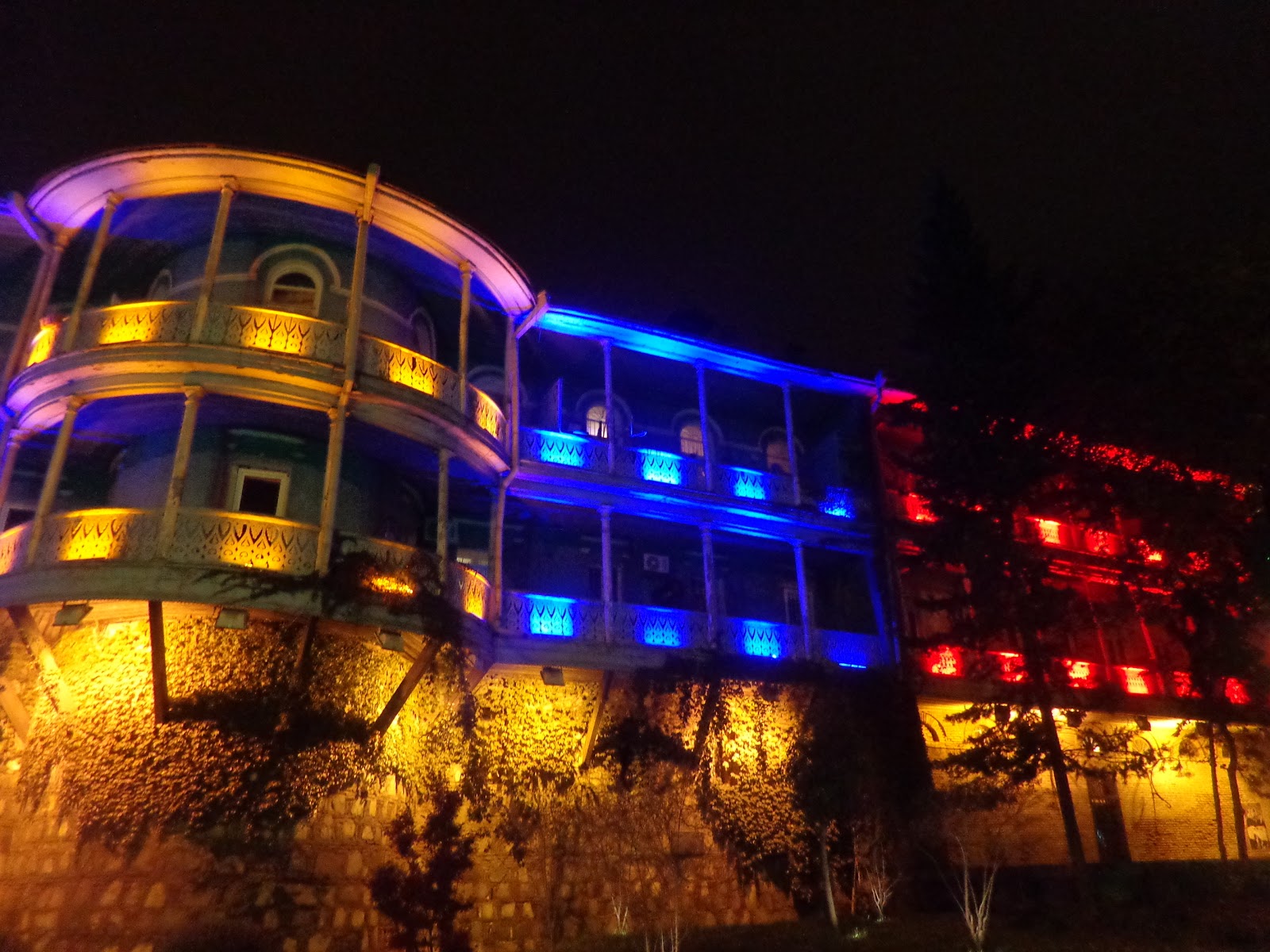
As we wandered our way home, we came across some great sounds and sights. A couple times, we heard groups of teens polyphonic singing -- also known as Georgian chants, and not to be confused with Gregorian chants -- which UNESCO has identified as intangible heritage (top). The city isn't afraid to show off its harmony or electricity. The Peace Bridge has LED shows nightly, and the Old Walls near the bridge (bottom left) and the TV Tower on Mount Mtatsminda (bottom right) also are illuminated. 
Once the sun was up again, we set off for another hill climb. But we made a detour through 9 April Park, which is named after the date of Georgia's independence and features a statue of poet Giorgi Leonidze (top), so we could survey the souvenirs on offer at the Dry Bridge Flea Market (bottom left). Most of the goods being bartered seemed like junk to me, but down in Dedeana Park, artists displayed an impressive array of paintings and sculptures (bottom right).
With no frames in hand, we hopped a bus to Vake Park, which features another large stone woman, the Statue of Victory (top left). The route started with steps but soon turned into slippery scree. Somehow, we managed to scale the trails to Turtle Lake, where we walked around the water and out to a promontory that abutted against Mount Mtatsminda (top right). The lake itself wasn't much of an attraction, although it was the site of the Youth Olympic Festival in 2015 (middle). We didn't linger long before we boarded the cable car that took us back to the park (bottom left). Across from the park, we stopped in Hop Head, a microbrewery where we could revel in our achievement with some craft beers (bottom right). 
For our evening entertainment, we took the recommendation of a fellow Lolita diner to visit Fabrika, a former textile factory that plays host to a hostel and other shops (top left). One tenant is Dive X, a secondary and less seedy outlet of Dive Bar (top right). TJ kicked my ass on the Capcom arcade console, proving I have lost my skill at Street Fighter (middle left). Sadly, we didn't have time for me to recover my reputation with an analog game (middle right). We left just in time to become one of the last patrons at Shavi Lomi (bottom left), where we finally wined and dined in traditional Georgian style; TJ chose pork chops, and I had katmis satsivi, or chicken in almond sauce (bottom right). 
 
We didn't have time to walk off all the calories before our flight on the last day in Tbilisi. So instead, we tried to sweat them out at the sulphur baths (top). We opted for Gulo's Thermal Spa, where, like at most of the spas, you can rent a private bath by the hour and pay extra for a massage or scrubbing. Our traditional room was small but suitable for our needs, with a skylight (bottom left) providing all the natural light necessary to navigate the two-person tub and shower (bottom right). 
 
Despite our lack of exercise, we couldn't leave without one more hearty Georgian meal. On our second pass, we managed to locate Racha, a basement-level utilitarian eatery (top left). One look at the kitchen convinced us that we should order everything on the menu (top right). But we managed to limit ourselves to some marinated eggplant, pork stew, khinkali, and lobiani (bottom). Still, our eyes were bigger than our stomachs, as we took half the lobiani with us to eat on the plane.