Saturday, February 27, 2016

Representing those different countries who have come here on different pilgrimages (151Cong.Rec.H4375)

With so much going on in the capital, it's easy to forget that there's lots to see outside of London. During my series of visitors, I recruited a few as fellow travelers for pilgrimages to nearby attractions. One very appropriate city was Canterbury, the destination of the story-tellers stuck in Southwark, now a London suburb, in Chaucer's tales. 

On the train ride there, we saw many buildings with weird white caps (left), which turned out to be oast houses, where hops once were dried for the region's famous Kentish ale. After passing through many pastoral miles, we eventually passed under the West Gate Tower (right), whose builder was killed in a revolt by peasants from the surrounding countryside. 
In medieval times, many pilgrims streamed through the arch on their way to the Canterbury Cathedral (top left). Still today, the UNESCO World Heritage site attracts thousands of tourists who pay respect to the church's Romanesque and Gothic architecture (top right). Part of the cathedral grounds back up against the city walls, originally built by Romans but rebuilt during the Middle Ages, near Quenin Gate (bottom).
On the other side of the walls lies an oft-overlooked part of the UNESCO site: St. Augustine's Abbey, a Benedictine monastery founded in the 6th century, hundreds of years before the cathedral was built (left). Amid the abbey ruins are the graves of the saint himself, along with a few Anglo-Saxon kings and archbishops of Canterbury (right). 
TJ and I honored history, but we had to pay homage to hops as well. The tourist-information desk directed us to the Foundry Brew Pub tucked off the main street in the town (left). We tried a range of beers on sample from Canterbury Brewers, the in-house microbrewery (right).
Although named after the Victorian cast-metal maker the building once contained, the brewpub itself opened fewer than five years ago. So later in the day, we took roost at The Parrot, the oldest pub in Canterbury (left), just down the street from The Dolphin, the oldest pub in Canterbury named after a marine animal, as a cheeky sign proudly stated. Within the Parrot, the 14th-century beams of St. Radigund's Hall, a monk gathering place built on Roman foundations in 1370, are exposed above the bar (right). 
For dinner, we chose The Thomas Becket (left), named after the saint who was slain in the cathedral and whose shrine still draws pilgrims to the town. We toasted Mr. Becket with the pie of the day for TJ and a Sunday roast platter for myself (right). 
On our way out of town, we passed The Old Weavers, now a restaurant but formerly a 15th-century fabric house, whose candlelit windows overlook the Great Stour River (left). The main pedestrianized thoroughfare of the city was brightened by more modern electrified lights (right). 
Another weekend, we headed to another city with paths lit up for the public: St. Albans (left). The glimmering white peaks in the background belong to The Boot, a neighborhood establishment where we couldn't budge anyone from a table, so we could eat dinner there. Behind the sparkly blue tree is one of the city's claims to fame: the Clock Tower, a belfry built in the early 15th century as a sign of rebellion against the local abbot (right).
 
The abbot is long gone, but the Benedictine abbey, part of St. Albans Cathedral, remains (top). The older section of the church contains a watchtower (bottom left) to look after the shrine of St. Alban (bottom right). The saint is considered the first British martyr, for being executed after he refused to worship Roman gods. 
The St. Albans Abbey Gate, just downhill from the cathedral, was the main entrance to the monastery (top). The gate once contained presses that printed Latin primers for the abbey school; to this day, the structure is a foundation of education, as part of St. Albans School. Further down the hill from the gate, we found Ye Olde Fighting Cocks, reputably the oldest pub in England (bottom left). We had to walk outside instead of inside through tunnels from the cathedral to the beer cellar of the pub, which was built in the 11th century (bottom right).
The hallowed halls of religion and education became even more closely intertwined during our day to trip to Cambridge. The many religious institutions in the area attracted clergyman to the city in the 12th century, and by the beginning of the the 13th century, scholars fleeing a town-gown conflict in Oxford joined them. The students organized courses of study that eventually led to the creation of the University of Cambridge. Today, the university is a confederation of 31 autonomous colleges with their own procedures, regulations, and buildings, including chapels. 

Each college has a unique specialty or reputation as well. King's College has what is considered the most spectacular chapel and is known for its music program (top left). Trinity College is perhaps more well-known for its library and lawn along The Backs (top right). St. John's College is home to the Bridge of Sighs, crossed by its many science and rugby devotees (bottom). 
One of the most popular recreation activities in the college town, at least for tourists, is punting, which has nothing to do with football. It's similar to a gondola ride along the River Cam, from which the city gets its name. One bridge above the river belongs to Clare College, which pitches itself as more friendly and less pretentious than the other colleges (top). We stayed on dry ground and propelled ourselves through the narrow alleys between the colleges (bottom left). You have to look up, lest you miss the many plaques honoring the university's famous students, including Alan Turing, of Bletchley Park fame (bottom right).
Although the college buildings draw the crowds, the 12th-century architecture of the Round Church, one of only four remaining medieval round churches in England, is compelling, too (left). But of course, in a college town, you have to hit at least one bar, so we went to Cambridge Brewhouse, home of Cambridge Brewing Company. I had a Dark Wheat porter, and TJ had a Misty River pale ale to go along with our pig cheeks and Scotch eggs, brain food if ever there was some (right). 

Saturday, February 20, 2016

I want to thank you for keeping the spirit alive (40 WCPD 367)

The Christmas decorations come out early in the United Kingdom, pretty much right after Halloween since there's no Thanksgiving to celebrate in between. And Brits don't seem in any hurry to put them away either. Many holiday events continue until at least New Year's Day. Such was the case for the annual holiday happening at Kew Royal Botanic Gardens. The event's finale consists of carols synchronized with waterspouts in front of the Palm House, a rare Victorian glasshouse, much like the Bellagio fountains (left). But I actually preferred the humming and chanting of the holly bush choir, which came right at the beginning of the trail (right). 
The light trail also hints at the natural wonders that can't be experienced during the winter, such as flowering bushes (top left), or seen during the night, such as poinsettias (top right). But by far, the most entrancing part of the light show comes from fire, not electricity. One section recalled the pagan connections to Christmas, with a sun pole surrounded by luminaries signifying the winter solstice (bottom left). Right around the corner was a calming display honoring the Victorian tradition of hanging candles on the tree (bottom right).
Some traditions along the trail were more participatory, such as roasting marshmallows over an open fire. There was also a tree of bulbs on which to hang holiday wishes and a gazebo of mistletoe under which to snag some kisses (There's photographic evidence of this, but I'll spare you -- and myself -- the smooch pics).
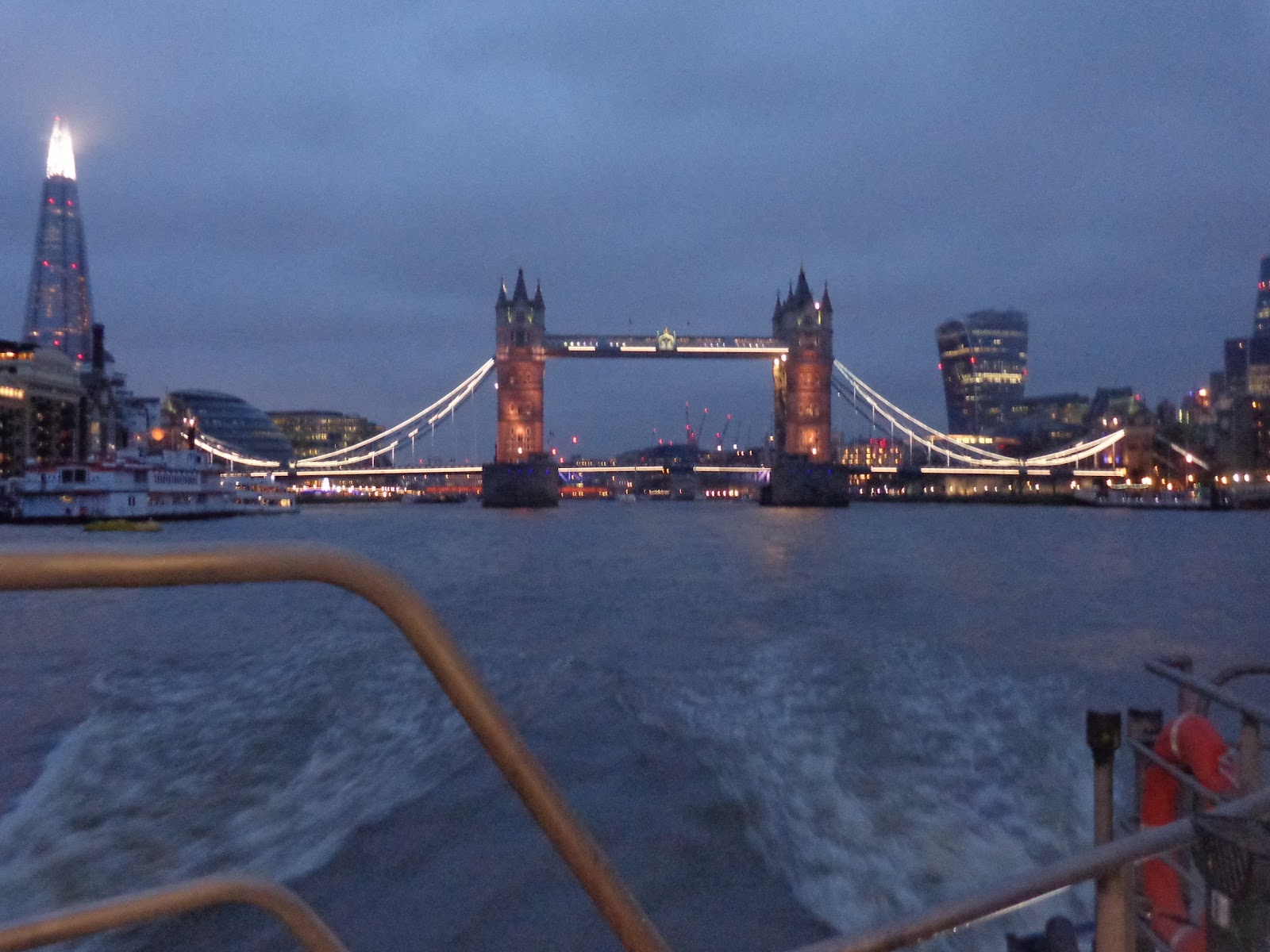
In some ways, London always looks like it's lit up for the holidays, what with the beacon atop the Shard and the strands along Tower Bridge, both of which we saw from the River Bus on the way to Greenwich (left). The city seemed to be a good goal for New Year's Day, considering it is a centerpiece of the passage of time. When we disembarked at the pier in front of the Old Royal Navy College, home to the "Sistine Chapel of the UK," we were greeted with even more holiday cheer: a Christmas tree strung on the masts of the Cutty Sark, the sole surviving British tea clipper (right).
By the time we hiked up to the top of the hill in Greenwich Park, it was so dark that we could barely see the dome of the Royal Observatory, and we definitely couldn't figure out who was memorialized at the top of a nearby pillar (left). When another friend came to visit later in the month, we visited the landmark by the light of day, so we could clearly see the time ball above Flamsteed House (right). 
 
John Flamsteed, a student of Isaac Newton, was the first Astronomer Royal, primarily tasked with making longitude more precise for safe sailing. (Surprisingly, the statue outside Flamsteed's front door is not a scientist, but Gen. James Wolfe, a Greenwich native killed in the Battle of Quebec.) It was the eighth Astronomer Royal, William Christie, who developed the Altazimuth Telescope to track star movement patterns in order to further improve navigation (left). Christie also commissioned the still-operational Great Equatorial Telescope, the seventh-largest in the world, contained in the observatory's onion (right).
Our modern system of longitude was determined by a series of astronomers in Greenwich, so it should come as no surprise that the line nearest the observatory was chosen by vote of an international conference as the prime meridian: 0 degrees and the delineator of Greenwich Mean Time. On the observatory grounds, you can straddle the prime meridian and stand in both hemispheres of the earth (top left). But even after the building is closed, you can still see the laser representing the prime meridian shooting over the Thames (top right). From the hill, you can see a good portion of the river flowing toward downtown (bottom).  
  
Upon zooming in with my camera, I could see the Cutty Sark tree along with the rest of central London seemingly decked out for the holidays (left). During the later daytime visit, it was easier to see which skyscrapers were which, but they didn't look nearly as Christmasy (right).
We worked up an appetite hiking up the heath, so we headed back down to Greenwich Union, where we sampled some offerings from Meantime Brewing Company: I cracked a bottle of Chocolate Porter, and TJ had a stein of London Stout (left). During our day trip to Greenwich, we ate at the Greenwich Market before I dragged my friend to the out-of-the-way Dog & Bell. I wish I could say that was the worst I did to her, but then I took her on London Walks' Jack the Ripper Walk on the coldest night of the new year. Afterward, we put on some alcohol jackets at The Ten Bells, where victim Mary Kelly was seen drinking the night of her murder (right). We, thankfully, managed to make it home alive.

Sunday, February 7, 2016

To accommodate increasing numbers of ... holiday visitors (Joint Committee Print 113-21, Volume II)

I had a hunch that I would be hosting a lot more visitors than at our previous posts, but even I underestimated the draw of London Town. In four months alone, I have had five guests stay with me, and I met up for drinks and/or meals with three more. With so many visitors, I was far from lonely during the holidays.

On Thanskgiving, my crew and I went to the The Mayflower, site of the former pub The Spread Eagle in Rotherhithe, where some Pilgrims boarded the famous ship before it picked up the rest of its passengers in Plymouth (left). Most of the indoor tables were reserved for an all-out turkey dinner (right), so we shared a toast on the pub's deck, where water from the Thames can splash through.
We made our own trans-water sojourn on the Emirates Air Line, which crosses the Thames near Greenwich to the Docklands (top left). The cable-car ride provides a good view of downtown, if you can ignore the otherworldly dome of the O2 Arena (top right). At one end of the line, you can head into the Emirates Aviation Experience, which includes a cockpit simulator, a passenger simulator (eating airline food in an airplane seat), and a baggage simulator (bottom left). The only simulation we opted for was a cheesy photo booth where we could recreate our trip with a less cloudy London in the background (bottom right).
 
Although we acted like Pilgrims, we are hardly Puritans, so another evening, we headed out for fancy cocktails in Shoreditch, at the underground speakeasy-like bar Happiness Forgets. We sampled plenty of "happiness," but somehow, we still remembered to eat, so we headed to the nearby Urban Food Fest Pump, a collection of street-food stalls sheltered under a former gas-station awning (top left). Later, a member of our expedition needed a second dinner, so we made a pit stop at some dueling kebab shops (top right). A few weeks after, a friend who eschews red meat inspired me to hunt down The Fryer's Delight, a delightfully old-school fish and chipper (bottom).
Sometimes, it's worth hitting a few long-standing attractions. Camden Town was once known for its punk-music and pop-art scene, as can be seen on the storefronts along Camden High Street (left). But then it turned pop-music when Coldplay lead singer Chris Martin moved into the area with Gwynny, and now it's gone totally mainstream, with the Camden Market selling mostly souvenirs (right).
 
Singer Amy Winehouse also lived -- and died -- in the neighborhood, and fans flock to see the life-size statue memorializing her in the North Yard of Camden Lock Market (top left). The statue appropriately stands within the Stables Market (top right), considering that it is a nexus of fashion, much like Winehouse herself. The "lock" part of the overall complex's name refers to the gate right next door in the Regent's Canal (bottom).
 
But to repay your hosting generosity, you also get to drag your guests to places they never would've thought of, such as a panto version of Cinderella (left). The traditional Chrismastime musical at the Lyric Theatre in Hammersmith was certainly a show-stopper, considering its final scene consisted of snow falling from the ceiling (right).
My demand to go mini-golfing didn't exactly live up to expectations, as Birdies Crazy Golf Club was a bit overpriced for its 9-hole course (top left). But it was nice to have a pint with my putt-putt out of the elements in The Vaults (top right). And we did stumble upon some great graffiti in action as we wandered around the tunnels under the train tracks to Waterloo (bottom).
On Christmas Day, the trains don't run, and services are limited the day after, so TJ and I decided to use Boxing Day for a nearby field trip with Sage to see how he would fare on public transport. After an uneventful bus ride, we arrived in Richmond, just like Queen Elizabeth I, who would spend the holidays at Richmond Palace (left). Before hitting a few pubs, we walked along the river path besides the Thames (right). 
 
Our first stop was The White Cross, whose dog-friendly patio often floods during the river's high tide. As we started to head back, we came across The Cricketers, which advertised that its interior welcomed animals alongside humans (left). Eventually, Sage signaled that it was time to leave (right), so we hit the Tube, which provided another smooth ride home in time for his dinner.