Saturday, September 26, 2015

In my own backyard of Brighton beach (141Cong.Rec.S13995)

After getting him some beer in Bermondsey, I made sure to get TJ the beach in Brighton. But after the two-hour train ride from London, it was nigh time to find some suds again. Straight down the hill from the train station, we fortunately found the Fortune of War pub, tucked under the seaside promenade (left). It's not much to look at from the outside, especially after a rainy morning, but the interior, decorated like an upside-down boat, was a cozy place to dry off (right).
By the time we got to the bottom of our pints, the clouds were clearing, opening the skies on the boardwalk seafood stands (top left). At one shack, TJ got a snack of anchovy-wrapped olives, whiled I munched on some shrimp and crab mayonnaise (salad). We didn't really need any more at the moment, but we couldn't pass up the smoked mackerel pate advertised on a sign outside Jack and Linda Mills Traditional Fish Smokers (top right). Luckily, by lunchtime, our stomachs were ready to receive classic fish and chips from Fish + Liquor. The haddock, cod, and potatoes were more than enough, but we couldn't resist ordering a Brighton sausage on the side (bottom).
The food was obviously a big draw for us, but most people come to the Southern English shore for its centerpiece, Brighton Pier (left). The deck is basically a carnival above the sea, packed with lots of salty and sweet treats on offer between two entertainment halls full of games for kids and adults alike. I watched some grown-ups play multi-puck air hockey while TJ tried out the slots (right).
At the end of the pier is a small amusement park, the main feature of which is the Crazy Mouse, a small-car roller coaster (left). There is a traditional ferris wheel for kids on the pier, but it is puny compared to the Brighton Wheel back on the beach (right). TJ and I didn't go on any rides; instead, we got our thrills by people-watching from the beer-garden deck at Horatio's Bar.
I'll admit that the water was warmer than I thought it would be, but that couldn't make up for the chilly wind you faced upon exiting the waves (left). So I was quite content taking in the sun -- and some champagne-ginger gelato -- from the shore, but TJ braved the waters of Brighton beach just below the pier (right).
As the sun went down, and it started to be time to think about catching a return train, we wandered through The Lanes on the way back to the station (left). The narrow alleyways opened up to the vast grandeur of the Royal Pavilion, King George IV's seaside pleasure palace (right).
A banjo-playing busker in the park out front didn't seem to match the style of the palace spires (left). But even more out of place to me was the production currently showing at the city's Theatre Royal: a stage adaptation of the famous movie filmed in my hometown, The Shawshank Redemption (right).
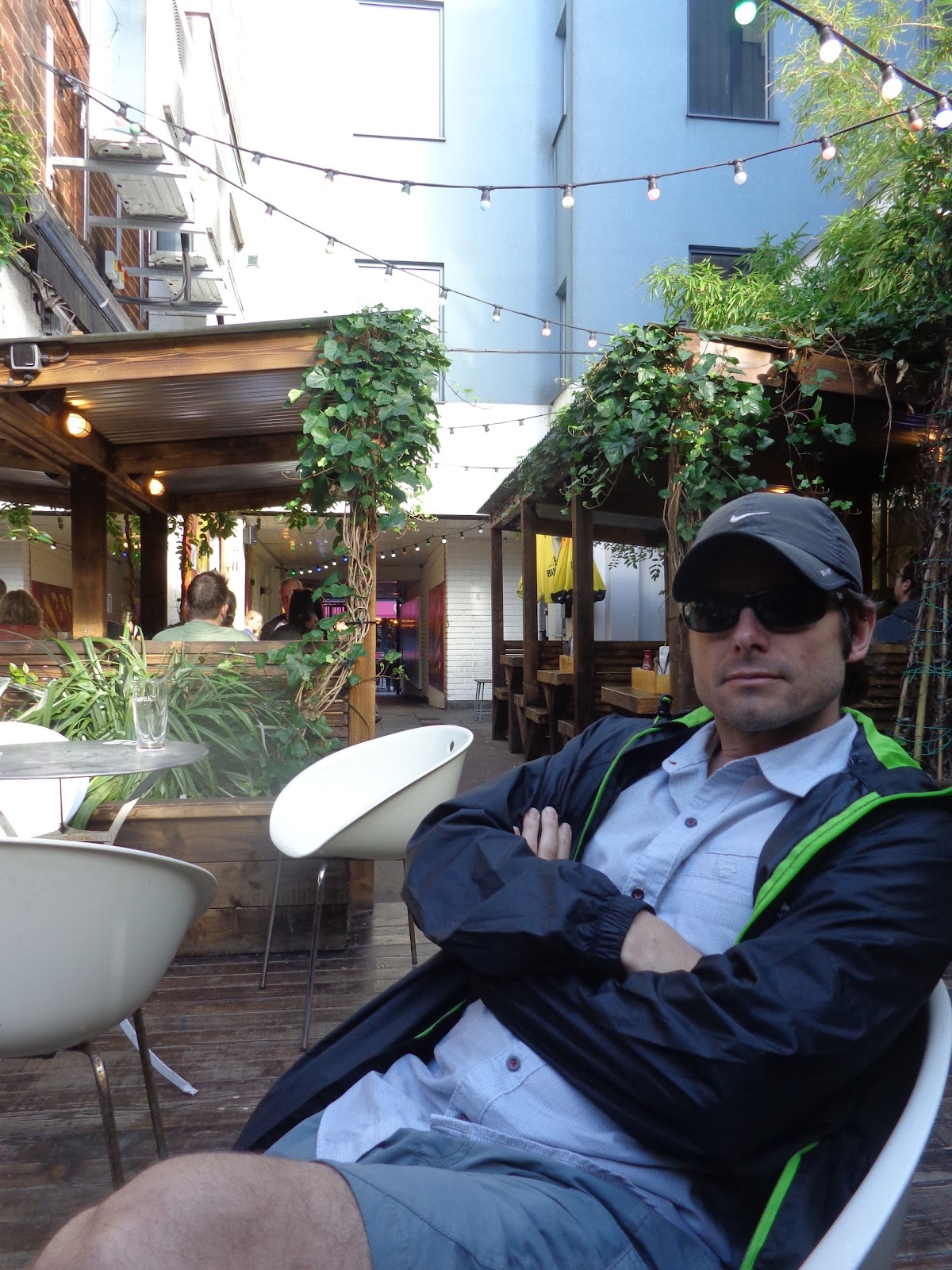
We didn't have time to take in a show, but we did have time for one more pint before boarding the train. We headed first to the oldest pub in Brighton: The Cricketers, where Jack the Ripper allegedly once spent the night (left). It was quaint but a bit cramped, so we headed next door to the back-yard garden of the Black Lion (right), where TJ could take in some last breaths of salty air before heading back to his land-locked home.

Sunday, September 13, 2015

Six much smaller parcels located nearby (10-11555-Brewery Park Associates)

Two criteria that make a good vacation for TJ are beer and a beach, so when he came to visit me in London, I tried my best to get him to both. In terms of beer, the ultimate destination in London is Bermondsey, home to the Beer Mile, a collection six microbreweries and two beer outlets within walking distance. (With no sand in sight, the beach would have to come later.)

We started our tour on foot at Kernel Brewery, whose Mosaic beer I had added to my top 10 of all time after a try on a previous outing (left). The brewery, whose offerings have become so popular that they will soon close their cramped tap room, bases -- and names -- all of its beers on hop combinations. Sure, they're a bit beer snobby -- the note says, "Please do not put average beers that no one will drink in this fridge" -- but they appreciate Virginia's own Mad Fox Brewing Co., so they can't be all bad (right). And seriously, the beer isn't bad either.
Kernel is known for its plain, brown-paper labels, a simplicity that is a far cry from Fourpure Brewing Co., which had a high-tech computerized screen showing the availability of its beers, including the amount left in each barrel (left). Among the choices on tap was the summer ale I won for completing a scavenger hut during the London City Beer Festival. The only seating is outside, so we sought some shade among the industrial buildings to enjoy our beers with some mac and cheese from the food stand beside the garage (right).
 
Partizan Brewing is situated in an even smaller space; like many London microbreweries, it has retrofitted a former warehouse railway arch (left). But it has kept the same industrial touches. We leaned against a stack of wooden pallets as we sampled some beer (right). I had their Rasperry Lemon Saison at the London Brewers' Market, so I went with a non-fruity option, a straight-up pale ale.
 
By the third brewery, the lines were getting long, which made the name of Brew by Numbers particularly apt. The numbers on the chalkboard didn't refer to the quantity of customers, however; each BBN beer is given a four-digit name, with two digits each based on the style and recipe of the beer (left). Another unique number at the brewery was the pounds paid for the deposit on the peculiarly shaped glasses, which I can imagine go missing quite often (right).
By the time we got to Anspach & Hobday, the crowds seemed to be thinning out, maybe because the Saturday Druid Street market was shutting down (left). TJ managed to bag some Asian dumplings from one of the closing stands, while I snagged two beers and seats on the sidewalk. I was excited for this stop because A&H had put up a solid series of beers at a tasting I attended previously, but TJ was more interested in the decaying Marquis of Wellington across the street, where more daring drinkers than we were co-opting the picnic tables left among its weeds (right). (If you read the comments in the link, you'll get a good sense of why the pub is now shuttered.)
It seems we might've walked the mile backwards, as the last stop, at Southwark Brewing Co., was the least inventive (left). The beers weren't bad, but they came off as basic compared to the other flavors of the day. Luckily, we were able to revive our tastebuds with a spicy and delicious dinner at Ma Goa, where TJ found another form of grain he had been craving: roti (right).
A few weeks later, with TJ again exiled from London, I headed to another locale with barrels of booze within walking distance, the Green Man's Courtyard Welsh ale and cider festival (left). The festival was tucked away behind King's Cross train station, but the gastropub sponsor kindly built an actual "green man" to direct the way (right). 
 
I went on the the last day of the festival, so some of the selections were already spent, but even with the remaining choices, I had trouble deciding. So I started with a brewery I had stumbled across when I was planning a trip to Wales for TJ and me (We ended up not being able to take the trip, but hopefully, we will in the future). Brecon Brewing's Orange Beacons wheat saison didn't taste much like citrus, but it was still a refreshing choice for a sunny September afternoon (left). Indeed, there was a bit of an Oktoberfest feel on the benches as I tried third-pints of Pixie Spring Brewing's Devilfish Ink black IPA, Cwrw Ial Community Brewing Co.'s The Volunteer English bitter, Tudor Brewing's Skirrid traditional Welsh ale, and the Williams Brothers' Splanky medium cider (right).
 
My sixth and final choice, to make for two full pints in total, was inspired by the powerful lead singer of the first musical act of the day. The namesake of Rozi Plain had the voice -- and fringe -- of Jenny Lewis (left), while the band had the instrumentation of Bright Eyes, including a saxophone, and I am always a sucker for brass. I honored another strong woman by sampling Glamorgan Brewing Co.'s Jemima's Pitchfork, named after Jemima Nicholas, who captured 12 drunk French soldiers with only a pitchfork during the 1797 Battle of Fishguard, often called the "last invasion of Britain." The second act of the day was led by a man, Wesley Gonzalez, formerly part of the band Let's Wrestle but now performing "with guests." His opening song, "I am a Telescope," sounded like a mix between Belle and Sebastian, with no girl vocals, and They Might Be Giants, with more punk notes (right). 

Monday, September 7, 2015

History tour, including stories on environmental, economic, and social issues (S.Hrg.113)

My recent success with a scavenger hunt showed that I can find my way to bars of the present, but when it comes to breweries of the past, I'm no expert, so I continued my celebration of the London Beer City Festival by signing up for "Porter, Peers & Pilgrims: A London Brewery History Walk," led by Des De Moor, author of many Campaign for Real Ale books, including The CAMRA Guide to London's Best Beer Pubs and Bars, which I got him to sign as a birthday present for TJ.

From our starting point at the Old Street Tube station, De Moor gave us some general background on brewing, which was the first modern commercial industry in London. The connection between the area and ale goes as far back as The Canterbury Tales; the unnamed host in the introduction encourages the pilgrims to share their stories over the "finest Southwark ale." In particular, London and England became known for brewing porter, which gets it dark color and acrid taste from the burnt grains that are used to make it and which gets its name from the people who used to drink it. 

Our first stop -- The Brewery, next to The Montcalm London City hotel -- once was home to Whitbread Brewery, the first purpose-built brewing building in the world. After opening in 1715, Whitbread helped perfect the brewing of porter. In fact, its porter tun room, now used as an events space, is the second-largest room in London after Westminster Hall. The building was closed in 1976, and the beer business was sold in 2000. Whitbread moved on to brewing Costa Coffee, possibly the only outlets more ubiquitous than pubs in London.
Next, we walked through the Spitalfields neighborhood to the Old Truman Brewery, founded in 1666 by the namesake family along with partners Hanbury and Buxton (left). By the mid-1800s, Truman claimed to be the largest brewery in the world. It definitely had large influence in London, as Charles Dickens mentions the brewery as a potential employment location in his novel David Copperfield. The building has hosted markets and special events since the brewery closed in 1989 (right). Shortly thereafter, Heineken obtained the brand but later sold it back to two local beer enthusiasts, James Morgan and Michael-George Hemus, in 2010. Truman's Beer re-opened in 2013 with The Eyrie, a new brewery facility in Hackey Wick.
After heading south, we found ourselves along the Thames at St. Katharine Docks (top), once the base location of Lion Brewery, which was at one time the oldest brewery and oldest continuously operating business in England. The brewery, later renamed Hoare & Co., was known for enlarging its aging vats to create mass amounts of the "Parson's black champagne." The ever-growing size of vats is partially to blame for the Great Beer Flood of 1814, which killed eight people. On the docks now sits the Dickens Inn, likely a former brewery warehouse that was moved from its original location due to development (bottom left). Some fellow tourists stopped for an ale at the inn, but since I had skipped breakfast, I opted for a coffee as well as a cinnamon and custard cruffin (croissant muffin) from the White Mulberries shop across the lock (bottom right).
As we headed across the Thames to the Southwark district heralded by Chaucer, we passed two more former and converted brewery buildings: St. George's Brewery, or the Hult Plaza Building that now houses an international business school (left), and Anchor Brewhouse, next to Butler's Wharf, which both are now developments with restaurants and flats (right).
On the south bank of the Thames, De Moor stopped to tell us about Anchor Brewery, which was built on the site of the original Globe Theatre and was known for its imperial Russian stout (top left). Both "Anchor" breweries developed in Southwark because it was a freer area just across the single bridge to London, which closed at night. Many vices were illegal in London proper, but the Bishop of Winchester allowed brothels and other houses of ill repute to entertain the deliverymen waiting for the bridge to open on the other side. Anchor Brewery started small in 1729 but grew under ownership by the Thrale family. Dictionary writer Samuel Johnson's ad copy helped sell the business to Barclay & Perkins, also referenced by Dickens in David Copperfield. Later, it was bought by Courage & Co. Brewery, as seen by the slogan on the former head brewer's house (top right). During its time under B&P, there was a bit of a scandal over the beatdown of Baron von Haynau by two bartenders (bottom).
Our tour ended near Borough Market, which houses an outpost of Neal's Yard Dairy. The dairy's decision to use railway arches for storage quite possibly sparked the recent trend of microbreweries setting up operations underneath Tube lines. De Moor set us free at The George (top), a National Trust site because it is the last remaining galleried inn in London (bottom left). I drank to its history by having a Rumrunner -- a rum-infused blonde ale by Greene King, the sponsor of the pub -- in its outside garden (bottom right).
 
On a less sunny day, TJ and I returned to The George's 335-year-old structure, so we could feel like Dickens and Shakespeare, who both frequented the watering hole, as we ordered pints from the tenders compartment, with its old cash register (left), then settled into well-worn wooden chairs in a crook next to the fireplace stove (right).
 
My last London Beer City Festival stop paid homage to the modern incarnation of the London brewery. I stayed in my neighborhood by heading to By the Horns Brewing Co. in Wandsworth (left), which for its Taste of Southwest event was hosting guest ales: Hackney Brewery's Red Ale; Weird Beard Brew Co.'s Mariana Trench pale ale; and Belleville Brewing Co.'s Red Wheat N' Blue and Northcote Blonde. First, I took the beer by the horns with the home brewery's Samba King rye blonde ale, then I had Howling Hops' Black XX Superior No. 1, a black IPA (right). I brought it all together in the end by finishing with a special collaboration between Belleville and Rocky Head Brewery: Unite, a blended white sour saison, which kind of tasted like drinking steak. I guess when beers are tapping the umami tastebuds, you know you're back in the 21st century of brewing.

Saturday, September 5, 2015

I am thinking I ought to have a scavenger hunt (141Cong.Rec.S18311)

Ever since I was a kid, I have been a sucker for a scavenger hunt. For many years, I have wanted to come even close to finishing the Post Hunt, but at least twice I have fallen well short, despite my attempts to recruit ringers for my team. So I was very excited when I discovered that the London Beer Hunt would be part of the London Beer City Festival. I was the only member of my team, but it turned out I was a ringer myself.

For the hunt, you are emailed a vague "treasure map" with clues leading you to five different bars within walking distance of one another. When you get to each bar, you must find the clue word, and when you put all of the words together, you get a final phrase that you must utter at the last bar in order to receive your reward. There is no requirement to drink at each establishment, but if you don't, it's obviously unsportsmanlike.

From the initial map and clues, I was able to decipher two bars immediately because I had already visited them. I guessed the name of the first stop on the map from its clue: "Sing me a song, don't get the words wrong." Then all I had to do was use the interwebs to find the location of The Lyric (left). The bar had a broad collection of craft cask ales on tap: Big Smoke Brew Co.'s Electric Eye English pale ale, By the Horns Brewing Co.'s The Mayor of Garratt English bitter, Magic Rock Brewing's High Wire American pale ale, Two by Two's Monkey Puzzle IPA, and Waen Brewery's Red River amber ale. I went with Goddards Brewery's Ale of Wight, a hand-pulled citrus blond ale, which was a bit bitter, perhaps because it was the bottom of the barrel (right).
Participants can complete the hunt any time within the two weeks of the festival, but I got off to an early start on a Saturday, so The Lyric was pretty empty. When I arrived, there was only one other couple, who didn't appear to be in the hunt. As soon as other competitors showed up, I quickly swilled the rest of my half-pint and headed to the next stop.
From the clue "I'll lure you in, come play with my strings," I immediately recognized The Harp, which I previously visited after the Queen's birthday. I tried to order a half-pint of Raw Brewing Company's Grey Ghost IPA but I got a pint instead. But that was okay because it gave me a little more time to enjoy an enticing view and an interesting talk with John, an ex-barrister who practiced in Magistrates' Court on Bow Street, where Gen. Augusto Pinochet of Chile was tried for international war crimes.
On my way to the third stop, I got momentarily distracted by the sounds, scents, and colors of Neal's Yard (left). My stomach was a little rumbly, so I considered stopping by one of the many cafes along quaint Monmouth Street (right), but I knew I needed to stick to my mission. I thought a doughnut snack might create only a short delay, but when I saw that a single Krispy Kreme cost $2.50, I reconsidered.
 
The clue for the third stop, Craft Beer Co., was "No tricks here, just a lot of great beer," which twas true (left). The drink list was lengthy with a lot of intriguing options: Dark Matter, a black gose by Chorlton Brewing Company; Eve, an elderflower sour by Orbit Beers; and The Dude's Rug, a chai cider by B. Nektar (right). I picked a half-pint of a Cherry Stout that was part of the venue's current Tyne Bank Brewery tap takeover.
 
The fourth stop was also a bar with which I was already familiar. The clue "Be quick off the mark, to beat the top dog" led me to Holborn Whippet, where I had had a pint after doing my placement test for Russian classes at the Pushkin House down the road. After my test, I had Siren Craft Brew's Love of Work, an Earl Grey pale ale. Now off the clock, I opted for Mallinsons Brewing Company's Columbus, a single hop pale ale.
As I headed to the last bar, I got a little tripped, or tippled, up. The clue was "The final destination, the pantheon of beer," accompanied by a drawing of a pyramid with the Eye of Horus at the top. When I passed by The Knight's Templar, I was sure I had won. It was only after I ordered a celebratory beer that I realized a Wetherspoon's outlet with numerous pokie machines was probably not in keeping with the craft-beer spirit of the hunt (left). I was also waylaid by The Temple Bar, which seemed to fit the clue but was shuttered (right).
Just a street away I found Temple Brew House, which I was planning to visit after the hunt anyway because it was offering "Inside the Temple" brewery tours as part of the festival (left). When I sidled up to the bar, the final word of the phrase wasn't as obvious as in the other stops, but the nice tenders gave me a hint of where to look. I sipped Essex Street Brewing Company's Tempale as I surveyed the bar (right).
Finally, I had the last word, and when I spoke the phrase "Remember, beer speaks, people mumble" to the brew crew, they handed me a free London Beer City Summer Ale, created by Fourpure Brewing Co. specially for the festival. The beer tasted so citrusy it was almost like a shandy, but it also tasted like victory because the bartenders told me that I was the second finisher of the day, and since it was only the second day of the festival, I was most surely in the top 10 of the competition. I had finally found the scavenger hunt I was made for.